 LazAgro

Cassava farming in Cameroon is everywhere and nowhere at the same time. Almost every farming household in the forest zone has a cassava plot, yet few people think of it as a serious crop. It is the thing you plant at the edge of the farm and dig when there is nothing else. That attitude leaves a lot of money in the ground.
Cassava feeds families through water fufu, garri, miondo, bobolo, kumkum and boiled roots, and the leaves end up in kpwem and other sauces. In towns like Buea, Kumba, Douala and Yaoundé, processed cassava sells every single day. A farmer who grows cassava deliberately, with clean cuttings, proper spacing and a plan for selling, can harvest far more from the same land than a neighbour who just "throws sticks".
This guide covers the whole cycle: choosing varieties and cuttings, timing your planting with the rains, weeding, spotting disease, harvesting in stages, and adding value through processing.
1. Why take cassava seriously?
Cassava tolerates poor soils, irregular rainfall and long dry spells better than most food crops. Once established, it can stay in the ground for months after maturity, which makes it a kind of living storage. You dig when you need cash or food.
It also has many markets. Fresh roots go to processors and market women. Garri and water fufu travel to towns and across borders. Leaves sell in bundles. Stems are themselves a product: farmers who maintain clean, improved varieties can sell cuttings to neighbours at planting time.
The weak points
- Fresh roots spoil within two or three days of harvest, so you cannot dig more than you can sell or process.
- Prices fall when everyone harvests at once.
- Diseased planting material quietly cuts yields year after year.
- Bitter varieties must be processed properly to reduce cyanogenic compounds before eating.
2. Choosing varieties and clean cuttings
Variety choice depends on what you want to do with the roots. Sweet varieties are good for boiling and roasting. Bitter varieties often give higher yields and are preferred for garri, water fufu and miondo, where processing removes bitterness.
Improved varieties released through IRAD (the Institute of Agricultural Research for Development) and its partners, often bred with IITA, have spread widely in the South West and Littoral. The IRAD research centre at Ekona, near Buea, has long worked on root and tuber crops, and the International Institute of Tropical Agriculture (IITA) leads much of the cassava breeding work in Africa. Ask your local agricultural post, a farmer cooperative or the nearest IRAD station which varieties are currently recommended for your area, since recommendations change as diseases evolve.
What a good cutting looks like
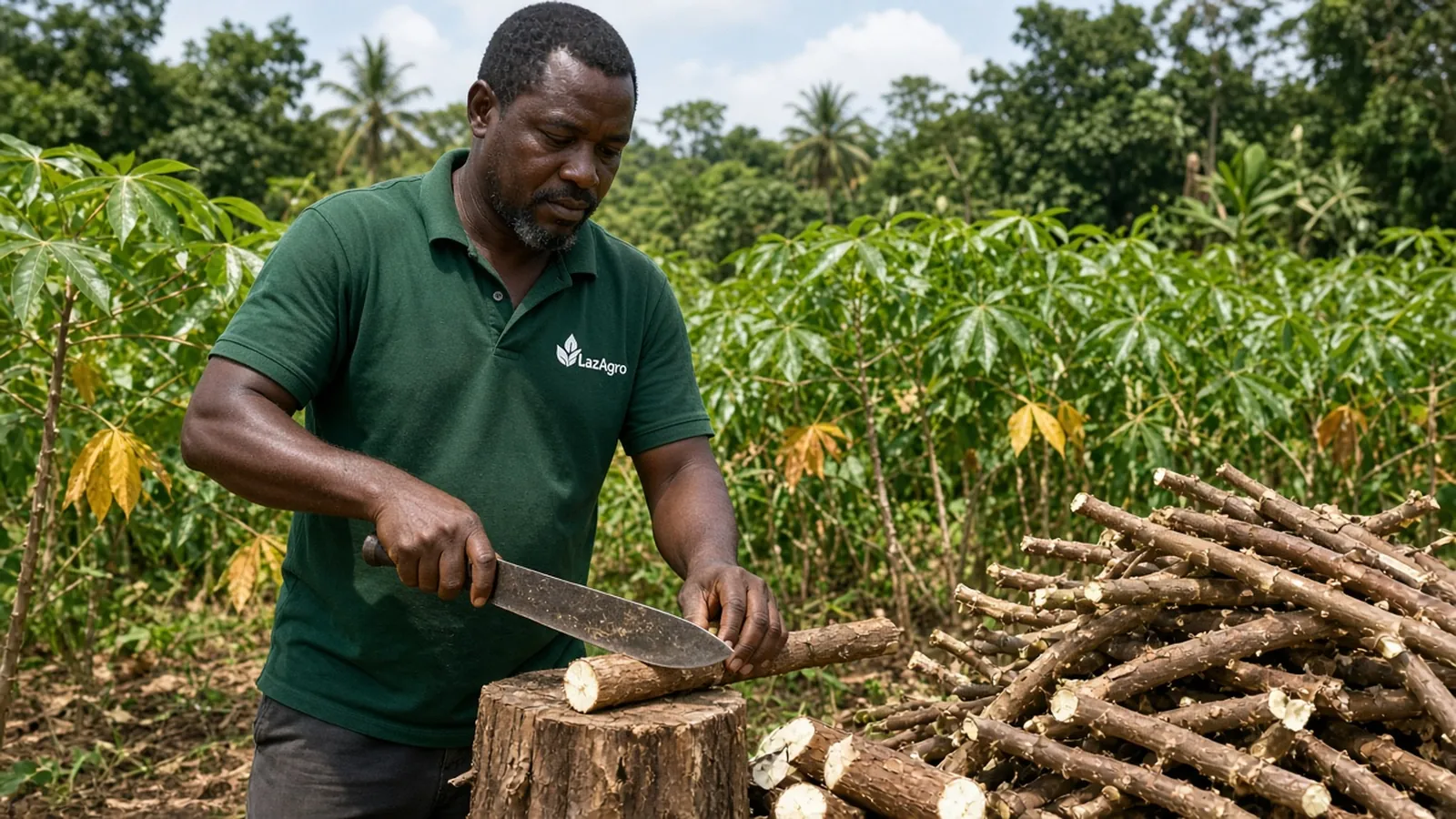
- Taken from mature stems, roughly 8 to 18 months old.
- From the middle of the stem, not the green, soft top.
- About 20–25 cm long with several nodes (buds).
- White, moist sap when you cut it. Dry, brown pith means the stem is too old or damaged.
- From a mother plant with clean, flat, green leaves, with no mottling or twisting.
Cut stems cleanly with a sharp machete. Crushed ends rot. If you cannot plant immediately, keep bundles upright in a shaded place and plant within a few days.
3. When to plant cassava in Cameroon
Plant when the soil has enough moisture for cuttings to root, and when the plant will get several months of rain to establish. That date depends on where you farm.
| Zone | Rainfall pattern | Typical planting window |
|---|---|---|
| Humid forest, bimodal (Centre, South, East) | Two rainy seasons, roughly March–June and August/September–November | Early in either rainy season, once rains are steady |
| Humid forest, monomodal (South West, Littoral) | One long, very wet season | Early in the rains, before the heaviest months |
| Western Highlands (West, North West) | One rainy season, cooler temperatures | Early rains; growth is slower at higher altitude |
| Guinea savannah (Adamawa) | Single rainy season | Start of the rains, so plants establish before the dry season |
Rainfall descriptions follow Cameroon's commonly used five agro-ecological zones. Local timing varies, so watch your own rains and talk to nearby farmers.
4. Land preparation and planting
Clearing
Clear without burning if you can. Burning wipes out organic matter that cassava needs on tired soils. On slopes, leave grass strips or plant along the contour to slow runoff; our guide on preventing soil erosion on farms explains simple methods.
Mounds, ridges or flat?
- Mounds and ridges help in waterlogged or heavy soils and make harvesting easier.
- Flat planting works on well-drained, loose soils and saves labour.
Spacing and planting angle
A spacing of about 1 m × 1 m is widely used for sole cassava and gives about 10,000 plants per hectare. Plant cuttings at an angle or upright with two-thirds of the length in the soil and the buds pointing up. Planting upside down is a surprisingly common reason for poor germination.
Intercropping
Cassava is often intercropped with maize, groundnut, egusi or beans. A short-season crop between rows uses the space before the cassava canopy closes and covers the soil. Just avoid crowding the cassava in its first months.
5. Weeding: the first four months decide your yield
Cassava starts slowly. For the first three to four months, weeds can easily outgrow it, and yield lost during that period is not recovered later. Most farmers who complain of "small roots" simply weeded too late.
- First weeding about three to four weeks after planting.
- Second weeding around two months.
- A third if needed before the canopy closes.
Mulching with crop residues, or intercropping with groundnut or egusi, reduces weeding work. If you use herbicides, use only products registered for cassava, read the label, and wear protective clothing.
6. Fertility: feeding a "hungry" crop
Cassava survives on poor soils, but it does not yield well on them. Continuous cassava on the same plot slowly drains potassium and organic matter.
- Rotate with legumes such as groundnut, beans or cowpea.
- Return peels and leaves as compost where possible.
- Use well-rotted manure or compost at land preparation.
- If you use mineral fertiliser, get local advice; cassava responds strongly to potassium on depleted soils.
7. Pests and diseases to watch
Cassava mosaic disease
Leaves become mottled yellow and green, twisted and smaller. Plants are stunted and roots are fewer. It spreads through infected cuttings and whiteflies. Remove badly affected young plants early and never take stems from them.
Cassava brown streak and root rots
Root rots are worse in waterlogged soils. Good drainage, mounds in wet spots and not leaving overmature roots in the ground for too long all help.
Mealybugs, green mites and grasshoppers
These attack leaves and growing points, especially in dry spells. Healthy, well-fed plants recover better. Natural enemies keep many of these pests in check, so blanket spraying often does more harm than good.
Rodents and animals
Cane rats and porcupines dig roots, especially near forest edges. Clean field margins and community trapping help.
8. Harvesting cassava at the right time
Most varieties can be harvested from about 9 to 12 months, and many are left up to 18 months. Earlier harvest gives smaller roots. Leaving them much longer can make roots woody and fibrous, and rot risk increases.
Harvest in pieces, not all at once
Because fresh roots spoil quickly, harvest only what you can sell or process within a day or two. Dig part of a plot each week rather than the whole field in one go. This also spreads your sales over time and protects you from bad price days.
Handle roots gently
Broken and bruised roots spoil faster. Lift with care, keep roots in the shade, and transport them quickly.
9. Adding value: garri, water fufu, miondo and chips
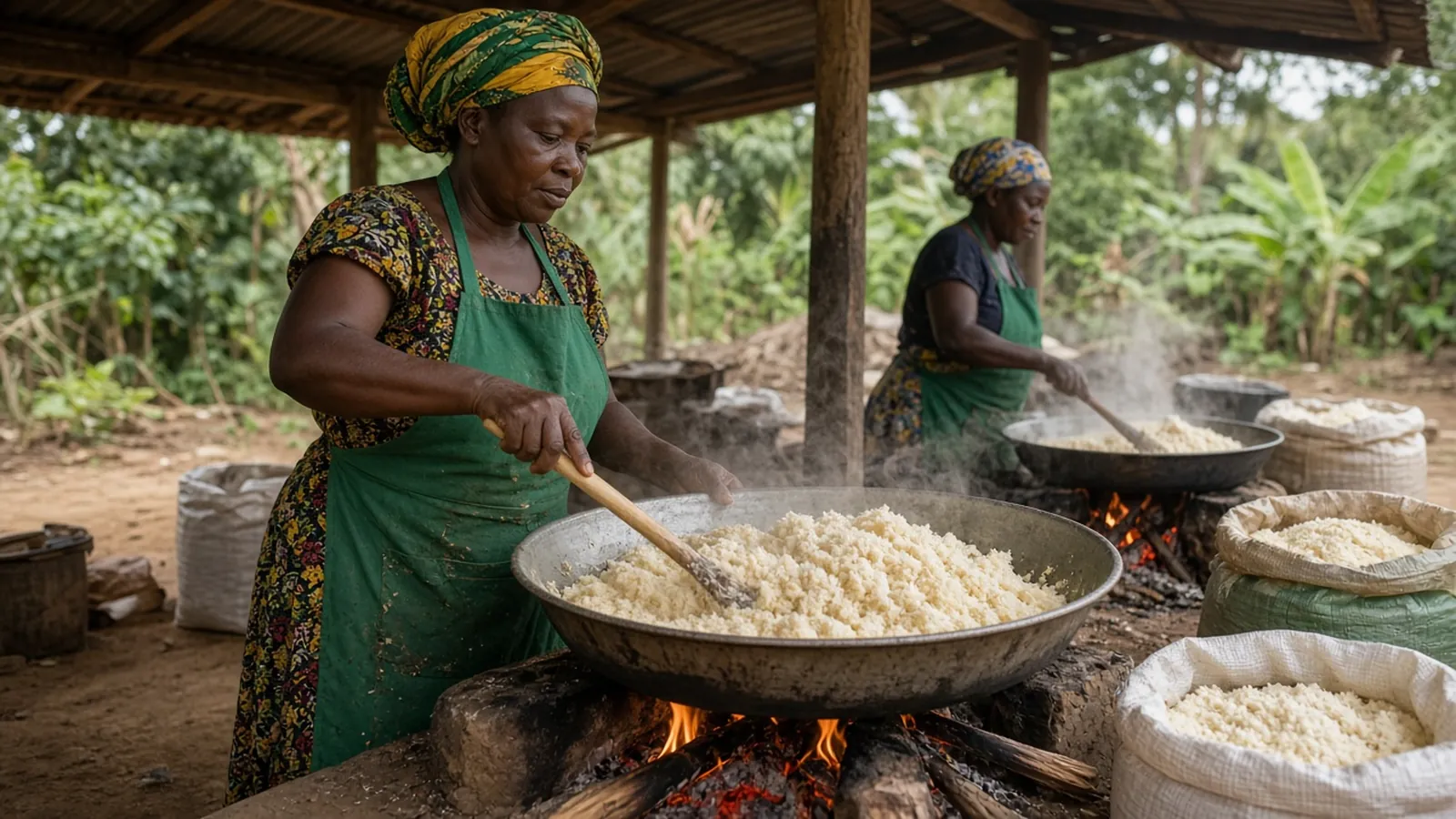
Processing is where many cassava farmers, especially women's groups, turn a low-value crop into a steady income. It also solves the spoilage problem.
| Product | Main steps | Why it sells |
|---|---|---|
| Garri | Peel, wash, grate, ferment in sacks, press, sieve, roast | Keeps for months; easy to transport |
| Water fufu | Peel, soak and ferment in water, sieve, press | Daily staple in many homes in the South West and Littoral |
| Miondo / bobolo | Soak, grind, wrap in leaves, boil | Ready-to-eat, high demand in Douala and Yaoundé |
| Dried chips / flour | Peel, slice, sun-dry, mill | Long shelf life; used for kumkum, baking blends and feed |
10. Planning cassava farming in Cameroon as a business
Before you expand, write down your real numbers for one plot: the cost of cuttings, labour for clearing, planting, weeding and harvesting, any manure or fertiliser, and transport. Then record what you sold and at what price. After one season you will know your cost per bag of roots or per bucket of garri.
Keeping track of plots, inputs and sales is easier on a phone than in scattered notebooks. The LazAgro app works offline in the field, which matters when your cassava plot is far from network coverage. See our guide on managing a farm without internet for how that works day to day.
11. Common cassava mistakes that cost farmers money
Planting whatever stems are lying around
Old stems left in the sun for weeks, green tops, or stems from a neighbour's diseased field all look like "free" planting material. They are the most expensive thing you can put in the ground, because the loss shows up a year later as a thin harvest.
Weeding when you have time, not when the crop needs it
Weeds in the first months take nutrients and light that the young cassava never gets back. If labour is short, plant less land and weed it on time rather than planting more and weeding late.
Harvesting the whole field for one buyer
A trader promises to take everything, the field is dug in a day, and then the truck does not come. Roots begin to spoil by the third day. Agree on the date, quantity and price before you dig, and keep part of the field in the ground as a buffer.
Growing cassava on the same plot for years
Yields fall slowly enough that many farmers do not notice. Rotating with legumes, adding compost and resting tired land keep yields up over time.
Not keeping any numbers
Without a record of what you spent on labour and cuttings, you cannot tell whether selling roots, garri or stems was the better decision this year.
Frequently asked questions about cassava farming in Cameroon
1. How long does cassava take to mature?
Most varieties are ready from about 9 to 12 months, and many can be left until 18 months. Check a few plants before deciding to harvest a whole plot.
2. How many cassava stems do I need for one hectare?
At 1 m × 1 m spacing you plant about 10,000 cuttings per hectare. Mature stems usually give several cuttings each, so count stems carefully when buying.
3. Where can I get improved cassava varieties in Cameroon?
Ask IRAD research stations (including Ekona in the South West), your divisional delegation of MINADER, local cooperatives and NGOs that run cassava projects. Buy only from sources that can show healthy mother plants.
4. Why are my cassava leaves yellow and twisted?
That is very often cassava mosaic disease. Remove badly affected young plants, control weeds that host whiteflies, and use clean cuttings next season.
5. Is it better to sell fresh roots or processed products?
Fresh roots are quick cash but spoil fast and fetch less. Processed products like garri and water fufu take labour but keep longer and usually earn more per kilo of roots.
Final thoughts
Cassava rewards the farmer who treats it as a real crop. Clean stems, early weeding, sensible spacing and staggered harvesting cost little extra, yet they separate a disappointing plot from a profitable one. Start with one well-managed plot, record what it gives you, and grow from there.
Know what every plot really earns
Use LazAgro to log planting dates, inputs, labour and sales for each field, even without network, and sync when you are back in range.
Discover LazAgro