 LazAgro

Running a farm involves much more than planting crops, raising livestock or selling agricultural products. Every day, money moves in and out of the business. You purchase feed, seeds, fertiliser, fuel and equipment. You pay workers, maintain buildings, transport products and receive money from customers.
But can you confidently say how much your farm spends every month? Do you know which crops, animals or farm activities generate the most income? And after paying all your bills, how much money does the business actually keep?
If you cannot answer these questions accurately, you may be operating without a clear picture of your farm's financial performance.
Learning how to track farm expenses and income is one of the most important steps towards running a financially organised farm. It helps you understand your costs, measure profitability, prepare for upcoming expenses and make better decisions about where to invest your money.
The good news is that you do not need complicated accounting software or advanced financial knowledge to get started. You need a consistent system for recording transactions, organising information and reviewing your numbers.
1. Why Is It Important to Track Farm Expenses and Income?
Many farmers remember their major purchases and sales but overlook smaller transactions. A few fuel purchases, packaging costs, transport payments or unrecorded sales may seem insignificant individually. Over time, however, these transactions can make a substantial difference to the farm's financial results.
Tracking your finances gives you a more accurate picture of what is happening inside your business.
Understand whether your farm is profitable
Revenue is not the same as profit. Selling a large quantity of produce does not automatically mean that the farm has made money. You must account for the costs involved in producing, storing and selling those products.
For example, a farmer might sell vegetables for $4,000 during a month. If the costs associated with producing and selling those vegetables amount to $3,200, the remaining amount before other applicable costs and adjustments is $800.
Without expense records, it is easy to mistake sales revenue for actual earnings.
Identify where your money goes
Expense tracking helps you identify which activities consume the largest share of your farm's budget. You may discover that animal feed, labour, fuel, fertiliser or transportation costs are increasing faster than expected.
Once you understand your spending patterns, you can investigate ways to control unnecessary costs without compromising production.
Make better business decisions
Good financial records help you decide whether to expand a particular crop, increase livestock production, purchase equipment, hire additional workers or reduce an unprofitable activity.
Instead of relying entirely on assumptions, you can use actual figures from your farm.
Prepare for seasonal expenses
Farm income is not always consistent throughout the year. A crop farmer may spend money on land preparation, seeds, fertiliser and labour months before receiving payment from harvested produce.
Livestock farmers may also face periods when feed, veterinary care and other operating expenses continue while animals are still growing.
Keeping records helps you anticipate these periods and plan how to meet upcoming financial obligations.
2. Separate Farm Income from Farm Expenses
The first step in building a useful farm financial record system is to separate money coming into the business from money going out.
What should count as farm income?
Farm income is money generated through the farm's business activities. Depending on the type of operation, it may include:
- Sales of harvested crops, vegetables, fruits and grains.
- Sales of livestock, poultry, fish and other farm animals.
- Sales of milk, eggs, honey and other animal products.
- Sales of processed agricultural products.
- Payments for agricultural services.
- Other business income generated by farm operations.
Record each sale separately rather than simply writing down the total money received at the end of the week.
For example, if you sell 50 crates of eggs to three different customers, record each transaction with its date, quantity, price and customer or sales reference.
What should count as farm expenses?
Farm expenses are the costs associated with operating the business. They can be organised into categories to make your records easier to understand.
| Expense category | Examples |
|---|---|
| Seeds and planting materials | Seeds, seedlings, cuttings and planting materials. |
| Fertiliser and crop inputs | Fertiliser, soil amendments and crop protection products. |
| Animal feed | Feed, supplements and feeding materials. |
| Animal health | Veterinary services, medicines and vaccinations. |
| Labour | Wages, casual workers and contract labour. |
| Fuel and transportation | Fuel, delivery costs and product transportation. |
| Equipment and maintenance | Repairs, spare parts and routine servicing. |
| Utilities and services | Electricity, water, communication and other services. |
| Packaging and marketing | Packaging materials, advertising and market-related costs. |
| Other operating costs | Rent, insurance, storage and other business expenses. |
Use categories that reflect the way your farm operates. A poultry business will have different expense categories from a vegetable farm or a dairy operation.
3. Record Every Farm Transaction
One of the biggest mistakes in farm financial management is relying on memory. A farmer may remember purchasing a large quantity of feed but forget several smaller purchases made throughout the month.
The most reliable approach is to record transactions as they happen, or as soon as possible afterwards.
For every expense, record the following information:
- Date: When the payment was made.
- Description: What was purchased or paid for.
- Category: The type of expense.
- Amount: How much money was spent.
- Supplier or recipient: Who received the payment.
- Farm or activity: Which farm, field, batch or enterprise used the money.
- Payment reference: Receipt number, transfer reference or other supporting document, where available.
For income transactions, record:
- Date: When the payment was received.
- Product sold: The crop, animal or product sold.
- Quantity: How much was sold.
- Unit price: The selling price per unit.
- Total amount: The money received.
- Customer or sales reference: Who purchased the product or the relevant transaction reference.
- Farm or enterprise: Which part of the business generated the income.
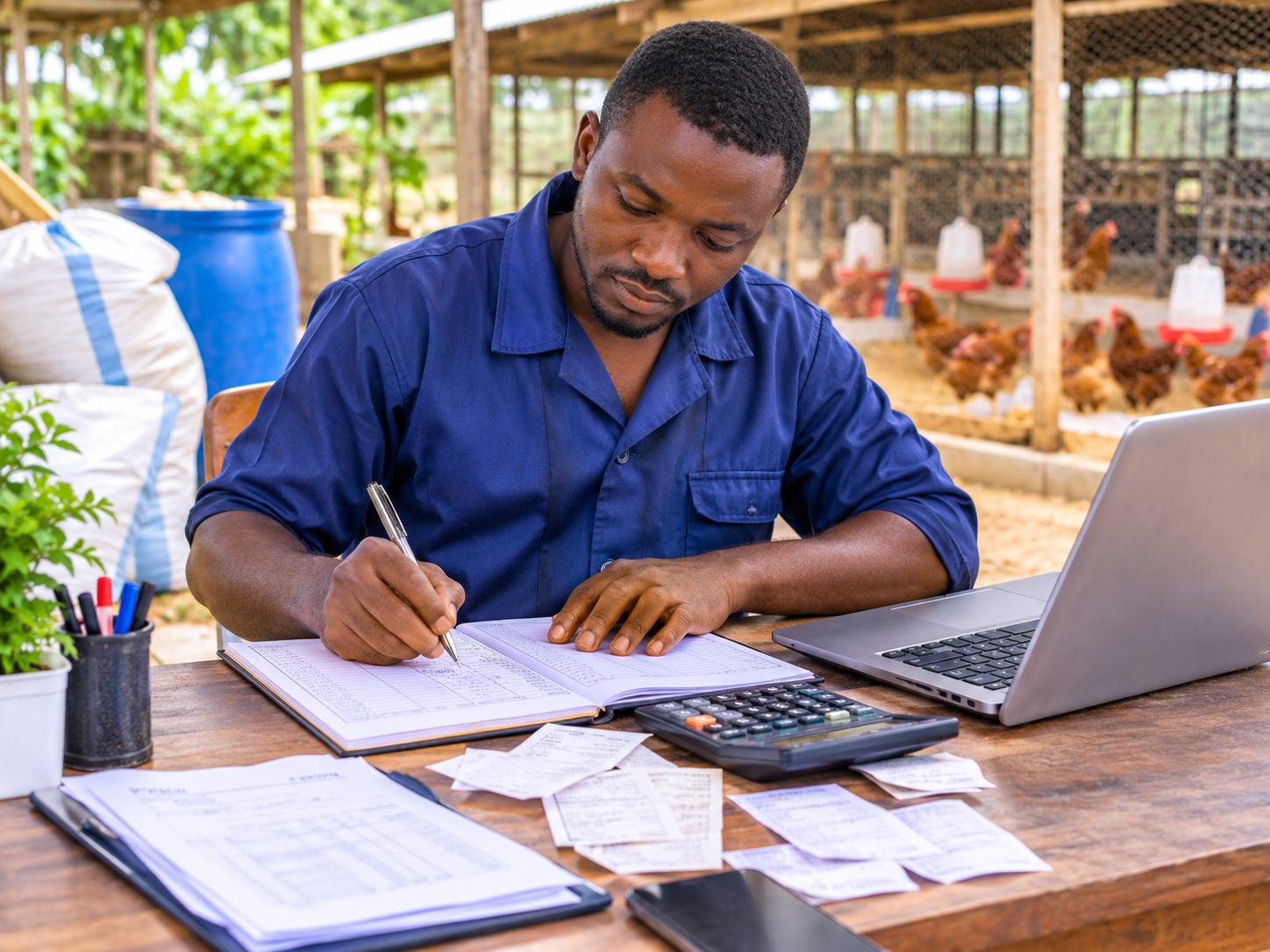
A small farm owner recording daily farm sales and expenses in a financial notebook, with receipts, a calculator and a laptop on the desk. The image illustrates the importance of writing down transactions instead of relying on memory.
For instance, instead of recording "farm supplies — $250", use a more informative entry such as "Purchased poultry feed — 10 bags — $250 — Poultry Unit A".
The second entry gives you useful information when you review your costs later.
4. Keep Receipts and Supporting Documents
Writing down transactions is important, but supporting documents help you verify that your records are accurate.
Keep receipts, invoices, payment confirmations, sales records and other relevant documents. They provide evidence of purchases and sales and make it easier to investigate errors.
You can organise these documents using:
- Physical folders separated by month or expense category.
- Envelopes labelled with the relevant month.
- Digital folders containing scanned receipts and invoices.
- Cloud storage or accounting applications where appropriate.
When you receive a receipt, connect it to the transaction in your records. You should be able to identify which expense the document supports.
For digital records, use clear filenames such as 2026-05-12-poultry-feed-purchase.jpg. This makes it easier to find a document later.
5. Track Expenses by Farm Activity
If your farm operates more than one enterprise, recording only total farm expenses may not give you enough information.
Imagine running a business that includes poultry, vegetable production and fish farming. You spend money on feed, seeds, labour, medicine, fuel and equipment. If all expenses are grouped together, you may struggle to determine which enterprise is generating the strongest financial results.
A better approach is to assign each transaction to the relevant farm activity.
| Farm activity | Expense examples | Income examples |
|---|---|---|
| Poultry | Chicks, feed, vaccines, bedding and labour. | Bird sales and egg sales. |
| Vegetable production | Seeds, fertiliser, irrigation and packaging. | Vegetable sales. |
| Fish farming | Fingerlings, feed, pond maintenance and labour. | Fish sales. |
| Fruit production | Seedlings, fertiliser, pruning and harvesting. | Fruit sales. |
This approach is useful because a profitable enterprise can sometimes hide the poor performance of another one when all financial figures are combined.
By tracking income and expenses separately, you can compare activities and decide where additional investment makes sense.
6. Understand the Difference Between Fixed and Variable Expenses
Another useful way to organise farm expenses is to separate fixed costs from variable costs.
Variable expenses
Variable expenses change depending on the level of production or business activity. When you produce more, these costs may increase. When production decreases, they may fall.
Examples include:
- Seeds and seedlings.
- Animal feed.
- Fertiliser and crop protection inputs.
- Packaging materials.
- Production-related casual labour.
- Fuel used for specific production activities.
Fixed expenses
Fixed expenses are costs that generally remain relatively stable over a particular period, regardless of short-term changes in production.
Examples may include:
- Land or building rent.
- Insurance premiums.
- Some administrative salaries.
- Property-related taxes and charges.
- Regular subscriptions and service fees.
Some costs can behave differently depending on the farm's arrangements, so classify them according to how your own business actually incurs them.
Understanding these categories helps you estimate the cost of increasing production and identify expenses that continue even during slower periods.
7. Calculate Your Farm's Income, Expenses and Profit
Once you have recorded your transactions, you can start calculating the financial performance of your farm.
Step 1: Calculate total farm income
Add all income generated by the farm during the period you are reviewing.
For example, suppose a farm generates the following revenue in one month:
| Income source | Amount |
|---|---|
| Vegetable sales | $1,500 |
| Egg sales | $900 |
| Livestock sales | $600 |
| Total income | $3,000 |
Step 2: Calculate total farm expenses
Add all expenses incurred during the same period, making sure you use consistent categories and avoid counting the same transaction twice.
| Expense category | Amount |
|---|---|
| Feed and animal care | $650 |
| Seeds and fertiliser | $400 |
| Labour | $500 |
| Fuel and transportation | $200 |
| Equipment maintenance | $150 |
| Packaging and other costs | $100 |
| Total expenses | $2,000 |
Step 3: Calculate the difference
A simple cash-based calculation is:
Using the example above:
The farm has $1,000 more in recorded operating cash receipts than operating cash payments for that month.
However, this figure should not automatically be treated as the farm's complete accounting profit. Timing differences, unpaid bills, unsold inventory, depreciation, capital purchases, loan repayments and other adjustments may affect the actual financial result.
Step 4: Review the results by activity
After calculating the overall figures, examine the performance of each enterprise separately. This can help you identify whether poultry, vegetable production, fish farming or another activity is contributing most to the business.
For more detailed financial reporting, an income statement can help measure profitability over an accounting period. A cash flow statement, on the other hand, shows when money enters and leaves the business.
8. Do Not Confuse Cash Flow with Profit
This is one of the most important concepts in farm financial management.
Cash flow describes the movement of money into and out of your farm. Profit measures the financial performance of the business after accounting for the relevant income and costs under the accounting method being used.
They are connected, but they are not identical.
Consider a farmer who receives a $5,000 loan and uses $3,000 to purchase equipment. The bank account may show a substantial amount of money coming in, but the loan is not sales revenue. It creates a liability that must be repaid.
Similarly, purchasing a long-lasting asset such as a tractor or major piece of equipment may involve a large cash payment. For accounting and profitability analysis, capital purchases are generally treated differently from ordinary operating expenses. Depreciation may also need to be considered.
Loan principal repayments should also be distinguished from operating expenses, while interest costs are treated separately in financial reporting.
For this reason, review both your income and expense records and the timing of your cash receipts and payments.
9. Review Your Farm Finances Every Week and Month
Recording transactions is only part of the process. You must also review the information regularly.
Weekly review
At the end of each week:
- Check that all purchases and sales have been recorded.
- Organise receipts and payment confirmations.
- Check for missing or duplicate entries.
- Confirm outstanding customer payments.
- Review unexpected expenses.
Monthly review
At the end of each month:
- Calculate total income received.
- Calculate total expenses paid.
- Compare spending across expense categories.
- Review income generated by each farm activity.
- Check outstanding bills and customer payments.
- Compare actual spending with your budget.
- Identify costs that need attention in the coming month.
Monthly reviews help you notice patterns early. For example, if feed costs have increased for three consecutive months, you can investigate the cause before the increase becomes a serious financial problem.
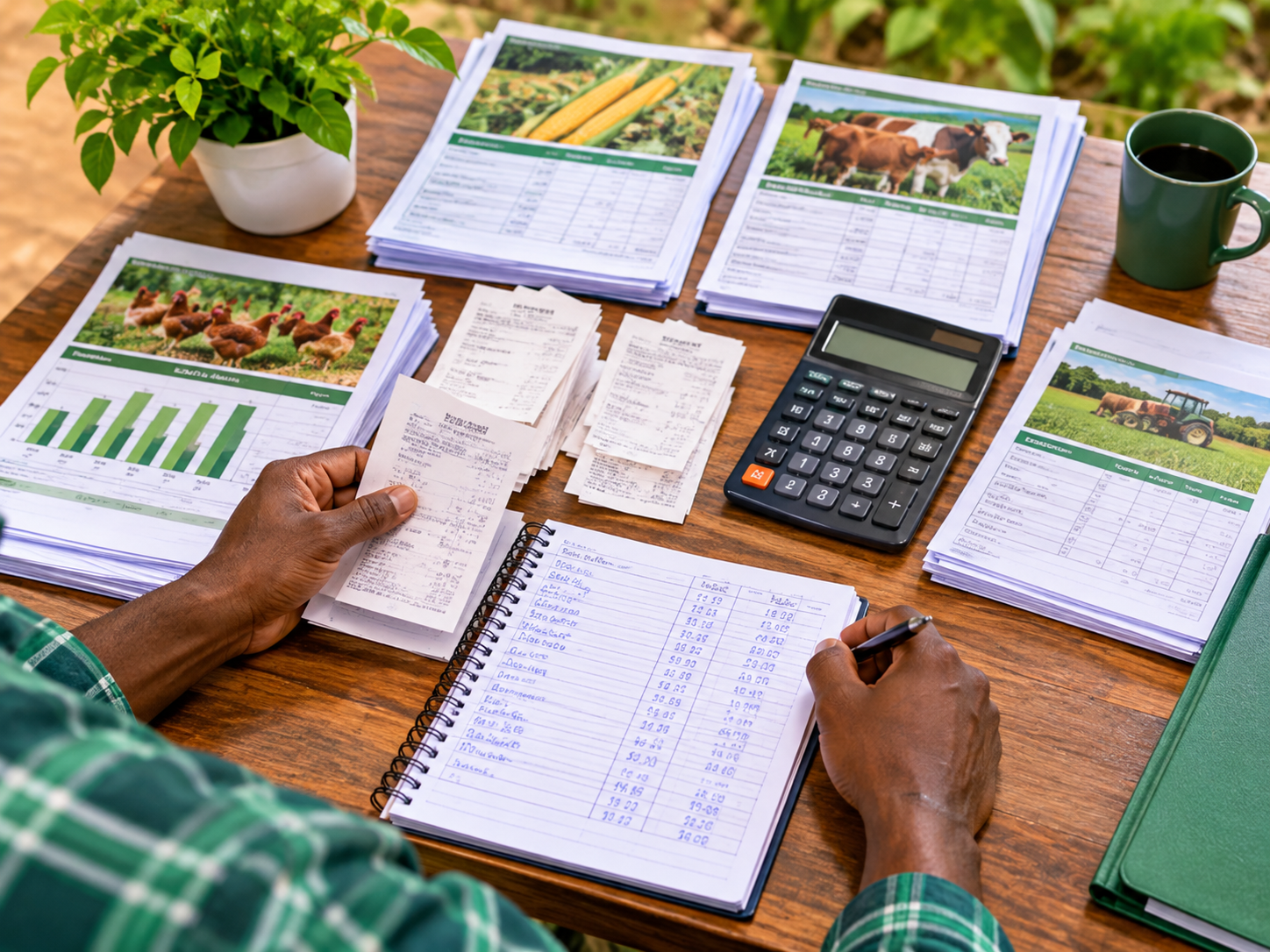
An overhead view of organised farm financial records, including sales invoices, receipts for feed and seeds, labour records, maintenance bills and a calculator. The image should visually explain how farmers can group and organise different income and expense categories.
10. Use a Farm Budget to Plan Future Spending
Once you understand your historical income and expenses, you can use that information to create a farm budget.
A farm budget is a financial plan that estimates how much money you expect to receive and spend during a particular period. It helps you prepare for upcoming production costs and make more informed investment decisions.
For example, before starting a new vegetable production cycle, estimate the cost of:
- Land preparation.
- Seeds and seedlings.
- Fertiliser and other crop inputs.
- Irrigation and water supply.
- Labour.
- Harvesting and packaging.
- Transportation and marketing.
Then estimate how much revenue you expect to generate from the harvest.
These estimates will not guarantee a particular result. Weather, pests, market prices, production problems and other factors can affect the actual outcome. However, a budget gives you a starting point for planning and comparing expected results with what really happens.
11. Choose a Farm Expense and Income Tracking Method
You do not need to begin with expensive accounting software. The best system is one that fits the size of your farm and that you can maintain consistently.
Option 1: A physical farm record book
A notebook or printed record book can be enough for a small operation with a manageable number of transactions.
You can create separate sections for income, expenses, receipts and monthly summaries.
Advantages:
- Simple to start using.
- Does not require electricity or internet access.
- Can be inexpensive.
Limitations:
- Calculations must often be done manually.
- Searching older transactions can take time.
- Records can be damaged or lost.
- Comparing multiple farm activities can become difficult.
Option 2: A spreadsheet
Tools such as Microsoft Excel or Google Sheets can help farmers organise income and expenses in rows and columns.
A basic spreadsheet might include the date, transaction description, category, amount, payment method and farm activity.
Advantages:
- Can automatically calculate totals using formulas.
- Easy to organise transactions by date or category.
- Can be customised for different farm operations.
- Useful for monthly summaries and comparisons.
Limitations:
- Requires some spreadsheet knowledge.
- Information must be entered correctly.
- Access and synchronisation may depend on the device and software being used.
- It can become difficult to manage when a farm has many activities and transactions.
Option 3: Farm management software
Farm management applications provide a more organised way to manage different parts of an agricultural business. Depending on the software, farmers may be able to manage farm activities, production records, inventory, purchases, sales and financial information in one system.
This can be particularly useful when several people are involved in operating the farm or when the business manages multiple farms, fields, batches or production cycles.
Before choosing an application, check whether its features match your actual recordkeeping needs. Do not assume every farm management app provides full accounting, tax reporting, invoicing or bookkeeping functionality.
12. Why Offline Farm Recordkeeping Matters
Farm work does not always happen in places with reliable internet access. You may be recording a purchase at a feed store, checking stock in a poultry house, monitoring a field or documenting a sale at a remote market.
If your recordkeeping system requires a continuous internet connection, you may delay entering information until you return to an area with connectivity. That creates opportunities for forgotten transactions, incomplete records and inaccurate figures.
An offline-capable farm management application allows farmers to enter information on a supported device without depending on a constant internet connection. Where the application supports offline storage and synchronisation, records can be saved locally and synced when connectivity becomes available again.
When comparing apps, check these details carefully:
- Can you enter records when the device is offline?
- Are those records saved locally?
- Does the application synchronise changes when internet access returns?
- Which features are actually available offline?
- How does it handle changes made on multiple devices?
- Can you confirm that records have successfully synchronised?
Offline support should not be treated as a vague marketing label. Check whether the particular features you need, such as purchases, sales, inventory or production records, work without internet access.

A farmer working in a field or livestock area and reviewing farm financial records on a smartphone. The phone should show a simple farm recordkeeping interface with a subtle offline status indicator. The image should communicate that farm records can be entered while working away from a reliable internet connection.
13. Common Farm Financial Recordkeeping Mistakes to Avoid
Even farmers who record transactions regularly can make mistakes that reduce the usefulness of their financial information.
Mixing personal and farm expenses
Using the same money account for household purchases and farm operations can make it difficult to understand how much the business actually spends.
Where practical, maintain separate farm financial records and accounts. If you use personal funds to pay a farm expense, record the transaction clearly rather than leaving it out.
Recording transactions too late
Waiting until the end of the month to enter transactions increases the risk of forgetting details. Record purchases and sales promptly, even if you use a simple notebook.
Failing to record small expenses
Small purchases can accumulate. Transport fares, packaging, repairs, cleaning supplies and other minor costs should be included when they relate to farm operations.
Ignoring unpaid sales and bills
If a customer takes products and promises to pay later, record the sale and the outstanding amount appropriately. Likewise, track bills that your farm has received but not yet paid.
For cash-based records, distinguish money received from amounts still owed. More complete accrual-based financial statements can account for these timing differences.
Counting loans as farm income
Borrowed money may increase the amount of cash available to the farm, but it is not revenue generated from selling products. Record loans separately so that your sales and profitability figures remain meaningful.
Not reviewing the records
Financial records are most useful when you analyse them. A notebook full of transactions will not automatically tell you which activities are profitable or where costs are increasing.
Set aside time every week and month to review your figures.
14. A Simple Farm Financial Tracking Routine
If you are starting from scratch, use this routine to build a consistent recordkeeping habit.
| Frequency | What to do |
|---|---|
| Every transaction | Record income or expenses, including the date, amount, category and activity. |
| Daily | Check that important purchases and sales have been entered. |
| Weekly | Organise receipts, check missing records and review outstanding payments. |
| Monthly | Calculate income, expenses and cash movement. Compare spending categories. |
| Quarterly | Review enterprise performance, budgets and major cost trends. |
| Annually | Prepare year-end financial summaries and organise documents for tax or professional accounting support. |
The routine does not have to be complicated. Consistency is more important than creating an elaborate system that you stop using after a few weeks.
15. Manage Your Farm Records More Easily with LazAgro
Keeping accurate farm records becomes more challenging as your operation grows. You may be managing several production activities, recording purchases, monitoring inventory, tracking sales and keeping information about different batches or farm locations.
Using separate notebooks and scattered spreadsheets can make it harder to maintain a clear picture of your operation.
LazAgro is designed to help farmers and farm teams organise important farm activities and records in one place. It supports an offline-first workflow, allowing users to save supported records on their devices while offline and synchronise when an internet connection becomes available.
For farmers who want to move away from relying entirely on paper records, a digital farm management system can provide a more organised way to manage day-to-day farm information.
Instead of waiting until the end of the month to remember what happened, you can build the habit of recording farm activities as they occur.
Explore LazAgro and see how a more organised approach to farm management can help you keep better records.
Take Control of Your Farm Records
Better farm management starts with knowing what is happening on your farm. Record your activities, organise your information and build a clearer picture of your operation.
Never lose field data again.
Discover LazAgroFrequently Asked Questions
How do I keep track of farm expenses?
Record every farm purchase and payment with its date, description, category, amount and the activity that used the money. Keep receipts and review your expenses weekly or monthly. A notebook, spreadsheet or farm management application can help you organise the information.
How do I calculate farm profit?
At a basic level, compare farm revenue with the costs associated with generating that revenue. A simple cash calculation is cash income received minus cash expenses paid, but a complete profit calculation may also require adjustments for inventory, unpaid bills, depreciation, capital assets and other accounting items.
What expenses should a farmer record?
Farmers should record relevant operating costs such as seeds, feed, fertiliser, animal health, labour, fuel, transportation, packaging, utilities, rent and equipment maintenance. They should also track major capital purchases separately from ordinary operating expenses.
How often should I update my farm financial records?
Ideally, record transactions as they happen or as soon as possible afterwards. Review records weekly and prepare a more detailed financial summary each month.
Can I track farm income and expenses in Excel?
Yes. A spreadsheet can track dates, descriptions, income, expenses, categories and farm activities. Formulas can calculate totals and help you prepare monthly summaries. As your farm grows, you may prefer dedicated farm management or accounting software.
What is the difference between farm income and farm profit?
Farm income refers to money generated by the farm's business activities. Profit measures what remains after accounting for the relevant expenses and other required adjustments. High sales do not necessarily mean high profit.
Why should I separate expenses by farm activity?
Separating expenses by enterprise helps you understand how much each activity costs and compare its financial performance. This is especially useful when a farm operates several activities, such as poultry, crop production and fish farming.
Can I manage farm records without internet access?
Yes, if you use a recordkeeping tool that supports offline data entry and local storage. Check which features work offline and how the application synchronises records when connectivity returns.
Final Thoughts
Tracking farm expenses and income is not just an accounting exercise. It is a practical way to understand your business, control spending, plan production and make better decisions.
Start with a simple system. Record every sale and purchase, organise your transactions into useful categories, keep supporting documents and review your financial figures regularly.
As your farm grows, consider using digital tools that make it easier to manage records across different activities. The important thing is to build a system that gives you reliable information about where your money comes from, where it goes and how your farm is performing.
A farm that understands its numbers is in a much stronger position to plan for the future.
Further Reading and References
- Mississippi State University Extension – Small Farm Business Basics: Planning, Records, Finances, and Pricing
- University of Minnesota Extension – Farm Finance
- University of Wisconsin Extension – Preparing an Income Statement
- University of Missouri Extension – Farm Accounting
- FAO – Small-Scale Dairy Farming Manual: Dairy Farm Accounting