 LazAgro
Soil Erosion on Farms: Causes, Prevention and Practical Land Conservation Methods
Every farming season depends on something that is easy to overlook: the soil beneath the crops. It supports plant roots, stores water, supplies nutrients and provides the physical foundation for agricultural production. Yet valuable topsoil can gradually disappear when farmland is exposed to uncontrolled rainfall, runoff, wind and poor land management.
Soil erosion is not only an environmental problem. It can reduce the productive capacity of a farm, expose plant roots, damage field access routes, carry nutrients away and deposit sediment in streams and drainage channels.
In tropical farming regions, intense rainfall can make poorly protected fields particularly vulnerable. The good news is that farmers can reduce many forms of erosion through thoughtful land preparation, vegetation management, water control and long-term soil conservation.
This guide explains how erosion develops, how to recognise it early and how to protect agricultural land using practical methods that can be adapted to different farm conditions.
1. What Is Soil Erosion?
Soil erosion is the detachment and movement of soil particles from one location to another by agents such as water, wind and gravity. On farms, water erosion is a common concern, particularly where rainfall strikes bare ground and runoff flows across exposed slopes.
The upper layer of soil often contains valuable organic matter, nutrients and biological activity that support crop growth. When this layer is removed, farmers may be left with less productive soil that is harder to manage.
Erosion can happen slowly over many seasons or develop rapidly during intense rainfall. A field may initially appear healthy even while small amounts of topsoil are being lost. Over time, the damage can become more visible through exposed roots, shallow channels and declining soil condition.
Why topsoil is so important
Topsoil provides a favourable environment for many crop roots and soil organisms. It also helps regulate water movement and nutrient availability.
Losing topsoil can mean losing:
- Organic matter that supports soil structure.
- Plant nutrients that contribute to crop growth.
- Soil organisms involved in decomposition and nutrient cycling.
- The soil's ability to absorb and retain water.
- The fine soil material needed for a suitable crop-rooting environment.
Rebuilding these properties can take time. Preventing avoidable soil loss is generally more practical than trying to restore badly degraded land after the damage has occurred.
2. The Main Causes of Soil Erosion on Farms
Erosion usually results from several interacting factors. Rainfall, slope, soil condition, vegetation cover and land management all influence how easily soil is detached and transported.
Heavy rainfall on exposed soil
Rainfall can dislodge soil particles when drops strike bare ground. Once particles become detached, flowing water may carry them downslope.
Fields that remain bare between planting seasons are especially vulnerable when intense rain arrives before protective vegetation has established.
Farming up and down slopes
Planting rows, ridges or furrows directly downhill can create pathways that help runoff travel quickly across a field. As water gains speed, it may remove more soil and deepen small channels.
Working across the slope, following suitable contour lines, can interrupt runoff pathways and reduce the distance water travels without obstruction.
Removing too much vegetation
Grass, crop residues, shrubs and trees help protect the ground. Their leaves intercept rainfall, while their roots help bind soil and improve its structure.
Clearing an entire field and leaving it bare for long periods removes this natural protection. Burning crop residues can also leave the soil exposed when the next rainfall arrives.
Overgrazing and livestock movement
Livestock can contribute to erosion when animals repeatedly graze an area beyond its ability to recover. Heavy trampling may compact soil, reduce vegetation cover and create paths that channel runoff.
This is especially important around watering points, gateways, hillsides and narrow livestock routes.
Poor drainage and uncontrolled water discharge
Water from roofs, roads, irrigation outlets and neighbouring land can become concentrated at one point. If the discharge is not safely managed, it may cut channels through farmland or undermine embankments.
Repeated disturbance of the soil
Intensive cultivation can leave soil aggregates exposed and reduce protective surface cover. The effect varies with soil type, machinery, moisture and tillage method.
Repeated operations that leave fine, bare soil before heavy rain can increase vulnerability to erosion and surface crusting.
3. How to Recognise Soil Erosion Before It Becomes Severe
Farmers should inspect their fields regularly, particularly after heavy rainfall. Early signs are often easier and less expensive to address than large gullies or major soil losses.
Sheet erosion
Sheet erosion occurs when a relatively thin layer of soil is removed across a broad area. It can be difficult to notice because the ground may not contain obvious channels.
Possible warning signs include:
- Gradual exposure of plant roots.
- Changes in topsoil colour or depth.
- Soil accumulating near fences or at the bottom of a slope.
- Reduced crop performance in areas that previously produced well.
Rill erosion
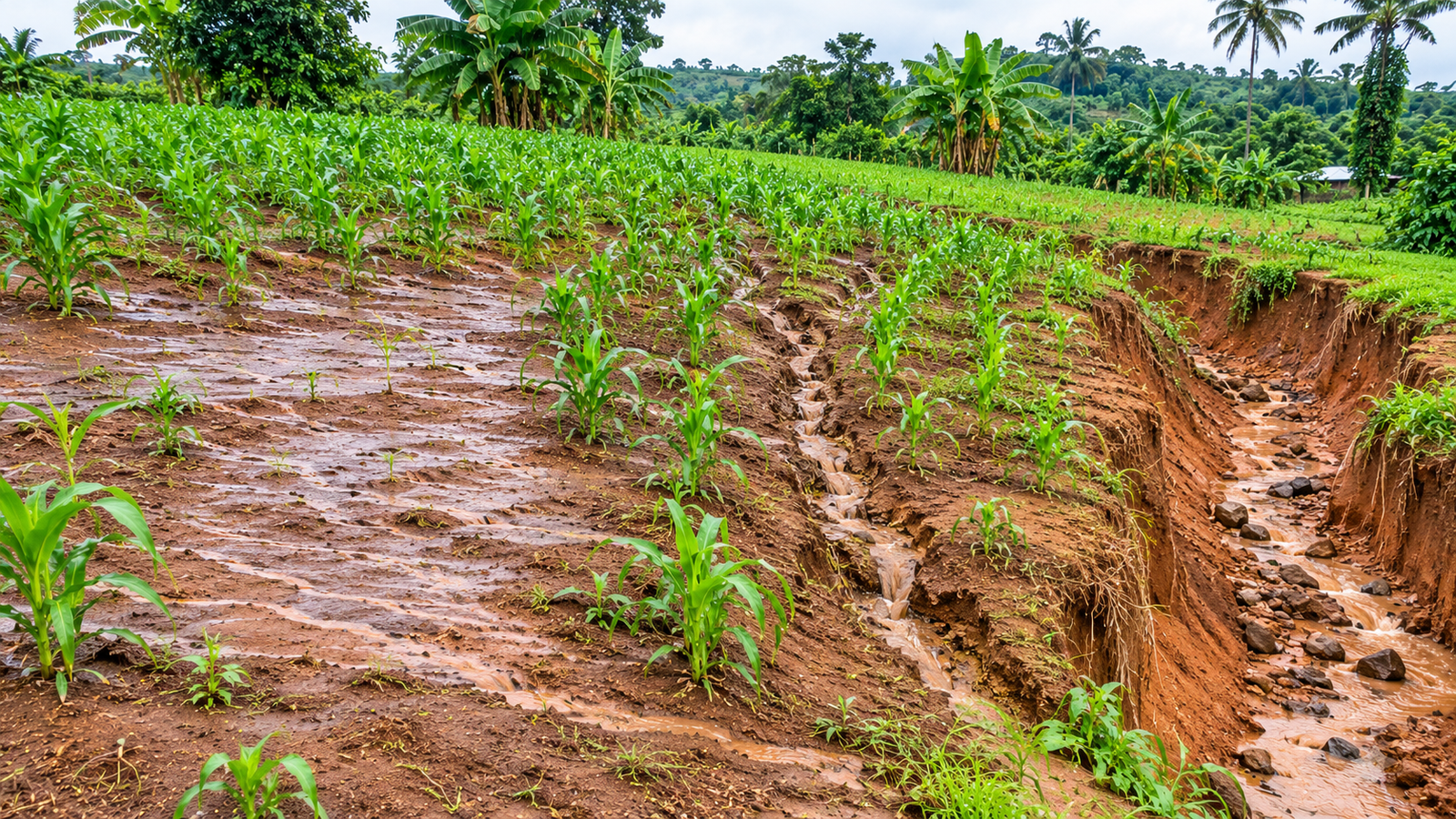
Rill erosion develops when runoff forms small channels across the field. These channels may be shallow enough to remove or level during ordinary land preparation, but repeated erosion can make them deeper.
Gully erosion
Gullies are larger channels created by concentrated flowing water. They can become deep and wide enough to divide fields, damage access routes and make cultivation difficult.
Established gullies require more careful intervention than small surface channels. Simply filling a gully with loose soil without controlling the water entering it may lead to further erosion.
Wind erosion
In exposed or dry fields, wind can lift and transport loose soil particles. Warning signs may include dust movement, exposed roots and soil collecting along fences or vegetation barriers.
4. How to Assess Erosion Risk on Your Farm
Before selecting conservation methods, understand how water moves across the property. A solution that works on a gently sloping field may be unsuitable for a steep hillside or a low-lying area that becomes waterlogged.
Walk the field after rainfall
Inspect the land after a substantial rainfall event, when it is safe to do so. Look for places where water enters the field, where it begins to concentrate and where it exits.
Pay attention to:
- Areas where water flows downhill in visible paths.
- Places where soil has accumulated.
- Exposed roots and small channels.
- Damaged ridges or embankments.
- Blocked drains and poorly protected outlets.
- Locations where livestock paths direct water through the field.
Understand the slope
Slope influences runoff speed and erosion risk. Longer and steeper slopes can allow water to gather momentum, particularly where the surface is bare or compacted.
Farmers should identify the direction of the slope before creating planting rows, drainage channels, terraces or barriers. For larger or steeper areas, a qualified land-conservation technician should help establish safe contour alignments and drainage designs.
Check the soil condition
Observe whether water enters the soil or remains on the surface. Compaction, crusting and poor soil structure may reduce infiltration and increase runoff.
Soil texture also matters. Sandy, clayey and loamy soils behave differently when exposed to rainfall. A soil assessment can help determine which conservation measures are appropriate.
5. Keep the Soil Covered With Mulch and Crop Residues
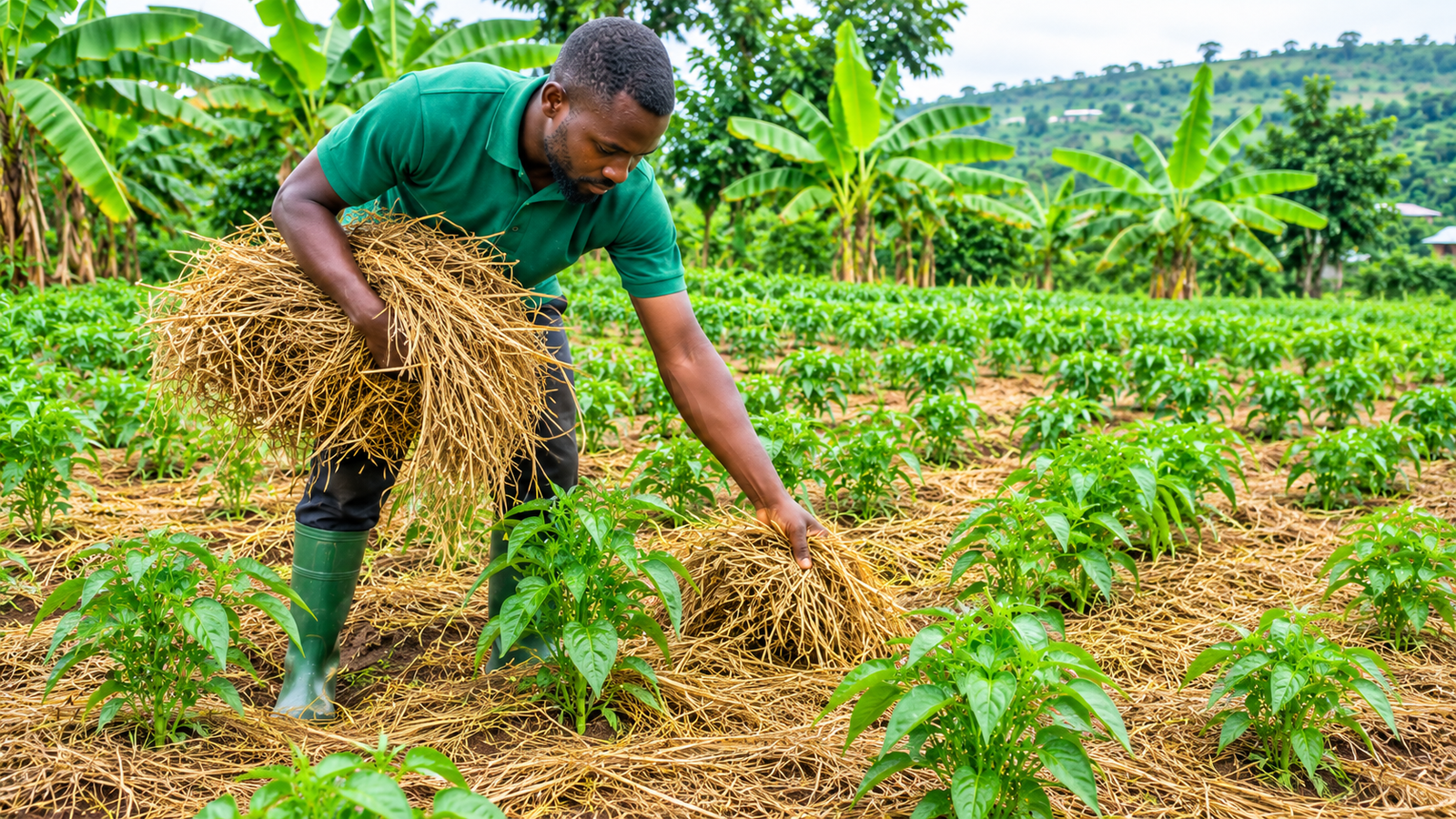
One of the most practical ways to protect farmland is to avoid leaving the soil unnecessarily exposed. Mulch and crop residues form a protective layer between rainfall and the soil surface.
Materials used as mulch may include suitable dry grass, leaves, crop residues and other clean organic materials that are safe for the intended crop.
How mulch helps
- Reduces the direct impact of raindrops on the soil.
- Slows surface runoff in suitable conditions.
- Helps reduce moisture loss from the soil surface.
- Can contribute organic matter as it decomposes.
- May reduce the need for repeated weeding.
Using crop residues effectively
After harvesting, some crop residues can be retained and spread across the field rather than burned or removed entirely.
However, residue management must consider livestock feed needs, pest and disease risks, planting operations and local farming conditions. Diseased plant material should not automatically be left in the field.
Where residues are insufficient, farmers can explore suitable cover crops or other locally available organic materials.
6. Grow Cover Crops to Protect Bare Land
A cover crop is grown primarily to protect and improve the soil rather than being harvested as the main commercial crop. It can be planted between production seasons, beneath suitable permanent crops or alongside other crops where the arrangement is appropriate.
Cover crops help protect soil by providing living vegetation, roots and surface biomass.
Potential benefits of cover crops
- Protect the soil from direct rainfall impact.
- Reduce the amount of bare ground exposed to runoff.
- Help hold soil particles together through root growth.
- Contribute organic matter when plant material decomposes.
- Help suppress some weeds.
- Some leguminous species can contribute nitrogen through biological nitrogen fixation.
Choosing a suitable cover crop
Farmers may consider locally adapted legumes, grasses or other cover species. Examples used in conservation agriculture include mucuna and lablab, but the right choice depends on climate, soil, planting season, intended main crop and livestock management.
A cover crop should not become a new source of problems. Some species can compete with the main crop for water or nutrients, become difficult to control or host pests. Select species with advice from local agricultural extension services.
7. Farm Across the Slope Using Contour Practices
Contour farming involves carrying out suitable field operations across a slope rather than directly up and down it. Planting rows, ridges or other barriers can follow the natural contour of the land.
The aim is to interrupt the downhill movement of water, reduce runoff speed and encourage more water to infiltrate into the soil.
Why contour farming can help
- Reduces the length of uninterrupted downhill runoff paths.
- Can slow water moving across sloping fields.
- Helps reduce the formation of rills in suitable conditions.
- Can improve water retention around crop rows.
Contour farming is not simply drawing straight lines across a hillside. Contour lines must be identified correctly, and the layout must account for rainfall, slope, soil type and safe drainage.
8. Use Grass Strips and Vegetative Barriers
Vegetative barriers are strips of suitable grass, shrubs or other plants established across a field to slow runoff and help trap transported soil.
They can be particularly useful when incorporated into a wider land-management plan.
Where vegetative barriers can be used
- Along suitable contour lines on sloping fields.
- Between cultivated sections of farmland.
- Along selected field boundaries.
- Near drainage areas where vegetation can safely stabilise the ground.
- Along livestock routes where soil disturbance needs to be controlled.
Selecting the right vegetation
The chosen plants should establish well locally, provide adequate ground cover and tolerate the site's rainfall and soil conditions. Some grasses can also provide useful fodder, but their growth and management should not interfere with the main crops.
Vegetative barriers require maintenance. Gaps, damaged sections and uncontrolled livestock access can reduce their effectiveness.
9. Consider Terraces and Structural Conservation Measures
On some sloping farms, vegetation and crop management alone may not be sufficient. Structural measures can help manage runoff by shortening the slope, reducing water speed or directing excess water towards safe outlets.
Stone lines and stone bunds
Where suitable stones are available, carefully arranged stone lines can act as barriers across a slope. They slow runoff and can help trap sediment moving downslope.
Earth bunds
Earth bunds are raised soil barriers designed to influence how runoff moves across a field. Their dimensions, alignment and drainage arrangements must suit local rainfall and soil conditions.
Terraces
Terraces reshape sloping land into a series of more manageable sections. Depending on their design, they may reduce slope length, create level or gently graded cultivation areas and manage excess water.
Terracing is a significant construction activity. Poorly designed terraces can fail, become waterlogged or redirect runoff in harmful ways. Professional site assessment is particularly important on steep slopes and in high-rainfall environments.
10. Manage Farm Drainage and Runoff
Even well-covered farmland can experience erosion if water from surrounding land or infrastructure is concentrated into one uncontrolled flow path.
Drainage management should therefore be part of the farm's soil conservation plan.
Inspect water entry points
Identify whether runoff enters the farm from roads, neighbouring properties, roofs, hillsides or other elevated areas. Water entering from outside the field may carry additional sediment and may require a carefully designed diversion or collection system.
Protect drainage outlets
Water should leave the farm through a route that does not create new erosion problems. Suitable outlets may require stable vegetation, stone protection or other engineered measures depending on the volume and speed of the water.
Maintain drains and channels
- Remove blockages that prevent safe water movement.
- Repair damaged sections before heavy rainfall.
- Prevent livestock from damaging vulnerable channel edges.
- Check outlets for signs of scouring or undermining.
- Do not discharge concentrated water onto an unprotected slope.
11. Protect Soil From Livestock-Related Erosion
Crop farmers are not the only people who need to think about soil conservation. Livestock farms can also experience erosion when grazing pressure, animal movement and water access are poorly managed.
Manage grazing pressure
Allowing vegetation time to recover can reduce the risk of bare ground developing. Rotational grazing or other controlled grazing arrangements may help where they are suited to the livestock system and available pasture.
Protect watering areas
Repeated animal movement around a single watering point can create bare, compacted ground. Where practical, provide stable access and prevent runoff from carrying loose soil into water bodies.
Maintain livestock paths
Frequently used paths can become channels for runoff. Inspect them during wet periods and consider whether their layout needs adjustment or whether vulnerable sections require stabilisation.
Use suitable ground cover
Maintain vegetation in areas that do not need to be cultivated. Grass cover can protect soil around livestock facilities, along selected boundaries and on land unsuitable for regular cropping.
12. Restoring Land That Has Already Been Damaged
Soil conservation is not limited to preventing future damage. Farmers may also need to restore fields where erosion has already removed topsoil or created channels.
Start by identifying the source of the problem
Before repairing visible damage, determine where the water comes from and why it is concentrating. If the runoff source remains uncontrolled, repairs may fail during the next heavy rainfall.
Re-establish vegetation
Where the land is suitable, establish grass, cover crops, shrubs or other appropriate vegetation. Protect newly planted areas from excessive grazing and disturbance while plants establish.
Improve soil organic matter
Suitable compost, manure and crop residues can contribute organic matter and support improvements in soil condition. Materials should be properly handled and applied according to crop needs and local recommendations.
Repair small erosion channels carefully
Minor rills may be manageable through a combination of runoff control, vegetation and suitable land preparation. Larger gullies require a site-specific restoration plan that addresses water flow, channel stability and safe discharge.
13. Create a Seasonal Soil Conservation Plan
Soil protection should be part of the annual farm calendar. Waiting until erosion becomes visible can make management more expensive.
| Period | Farm activities | Conservation objective |
|---|---|---|
| Before the rainy season | Inspect drains, repair damaged barriers, prepare cover crops and check exposed slopes. | Reduce vulnerability before heavy rainfall. |
| At planting | Maintain suitable ground cover, plan rows carefully and avoid unnecessary soil disturbance. | Protect the soil while crops establish. |
| During the rainy season | Inspect runoff routes, repair minor damage and maintain vegetative barriers. | Identify problems before they develop into major channels. |
| After harvest | Manage crop residues, establish suitable cover and assess areas with exposed soil. | Prevent fields from remaining bare unnecessarily. |
| During the dry season | Repair appropriate structures, plan field improvements and prepare the next rotation. | Build long-term resilience and improve soil management. |
Adjust this calendar to local rainfall patterns, crop cycles and the needs of the particular farm. In some areas, the rainy season may be split into distinct periods, while other locations have different planting windows.
14. Common Soil Conservation Mistakes to Avoid
A conservation method can fail when it is poorly selected, incorrectly installed or not maintained. Watch out for these common mistakes:
- Leaving soil bare for too long: Exposed soil is vulnerable when heavy rain arrives.
- Planting directly downhill on sloping land: Rows can become channels that accelerate runoff.
- Ignoring small erosion channels: Minor rills can develop into larger problems.
- Burning all crop residues: Removing protective material can leave the surface exposed.
- Overgrazing vulnerable areas: Repeated grazing can remove the vegetation needed to protect soil.
- Building drainage channels without a safe outlet: This can transfer erosion to another part of the farm.
- Constructing terraces without proper design: Poorly designed structures can fail under runoff pressure.
- Planting unsuitable cover crops: Some species can compete with crops or become difficult to control.
- Ignoring maintenance: Grass strips, bunds, drains and terraces need regular inspection.
- Using the same method everywhere: Soil type, slope, rainfall and land use determine which measures are appropriate.
15. A Practical Soil Conservation Checklist
Use this checklist when assessing a farm or planning improvements to an existing field.
- Identify sloping and erosion-prone areas.
- Inspect fields after substantial rainfall.
- Mark water entry points and runoff routes.
- Identify sheet, rill and gully erosion.
- Reduce unnecessary periods of bare soil.
- Retain suitable crop residues where practical.
- Choose cover crops adapted to local conditions.
- Consider contour-based cultivation on suitable slopes.
- Maintain grass strips and other vegetative barriers.
- Inspect and maintain drainage outlets.
- Manage livestock movement on vulnerable ground.
- Seek technical advice for major earthworks or gullies.
- Review conservation measures throughout the season.
16. How Farm Records Can Support Better Land Management
Soil conservation involves repeated decisions across planting seasons. Farmers need to know which parts of the land are vulnerable, what interventions were carried out and whether those interventions improved the condition of the field.
A simple field record can include:
- The location and size of erosion-prone areas.
- Dates when erosion was observed.
- Drainage repairs and maintenance activities.
- Cover crops or grass barriers established.
- Crop rotations and planting dates.
- Materials and labour used for conservation work.
- Observations made after rainfall.
Photographs taken from the same location over several months can also help farmers compare changes in vegetation cover, erosion channels and field condition.
Digital farm management tools can help organise farm activities, purchases, expenses and inventory information. For farmers who manage multiple farms or production activities, LazAgro offers a way to organise broader farm operations, with offline-first record capture for situations where internet access is unreliable.
These tools do not measure soil erosion automatically or replace soil assessments. Their value is in helping farmers keep organised records of the work they perform and the resources they use.
17. Frequently Asked Questions About Soil Erosion
1. What is the main cause of soil erosion on farms?
Water runoff is a major cause of soil erosion on many farms, particularly where heavy rainfall strikes bare ground or flows over exposed slopes. Wind, poor vegetation management, overgrazing and unsuitable cultivation practices can also contribute.
2. What is the easiest way to prevent soil erosion?
A practical starting point is to keep the soil covered with suitable vegetation or mulch and avoid creating uninterrupted downhill runoff paths. The best combination of measures depends on the soil, slope, rainfall and farming system.
3. Can planting grass prevent soil erosion?
Grass can help protect soil by covering the surface and binding soil particles with its roots. Grass strips established across suitable slopes can also slow runoff and trap sediment. Their effectiveness depends on correct placement, plant establishment and maintenance.
4. Does mulch help prevent soil erosion?
Yes. Suitable mulch protects the soil from direct rainfall impact and can reduce runoff and moisture loss. It should be managed carefully to avoid introducing pests, diseases or other problems.
5. What is contour farming?
Contour farming involves carrying out suitable cultivation and planting operations across a slope, following the land's contour rather than working directly downhill. It can slow runoff and reduce soil movement when correctly designed.
6. What is the difference between rill erosion and gully erosion?
Rill erosion creates relatively small channels across the soil surface. Gully erosion creates larger and deeper channels that are more difficult to repair and may require engineered drainage and restoration measures.
7. Can soil damaged by erosion be restored?
Some degraded land can be improved through vegetation establishment, organic matter management, runoff control and suitable restoration work. However, severe topsoil loss may take a long time to address, and some damage can be difficult to reverse completely.
8. Is soil erosion a problem in Cameroon?
Soil erosion can affect agricultural land in Cameroon, particularly where exposed slopes, intense rainfall, poor drainage or vegetation removal create vulnerable conditions. The severity and suitable response vary by location and soil type.
9. Are terraces suitable for every farm?
No. Terraces are useful in some sloping environments, but they require appropriate design and maintenance. Soil type, slope, rainfall and safe drainage must be considered before construction.
10. How often should farmers inspect their fields for erosion?
Farmers should inspect vulnerable areas regularly, particularly before and during rainy periods and after substantial rainfall. Frequent observation helps identify small problems before they become severe.
Build Better Habits for Managing Your Farm
Successful farming involves more than planting and harvesting. Organised activities, purchases, expenses and production records help farmers understand their operations and plan improvements.
Discover LazAgroFinal Thoughts
Soil is one of the most valuable resources on any farm, and protecting it should be part of everyday agricultural management. Once productive topsoil is removed, restoring the land can be difficult and expensive.
Farmers can reduce erosion by keeping suitable ground cover, managing crop residues, establishing cover crops, controlling runoff and choosing cultivation methods appropriate to the slope.
There is no universal conservation method for every field. Observe how water moves across your land, understand the soil conditions and combine practical measures that suit your farm. Where erosion is severe or structural work is required, seek professional guidance.
A farm that protects its soil is investing in its future productivity. Good land management today helps preserve the resources that future growing seasons will depend on.