 LazAgro
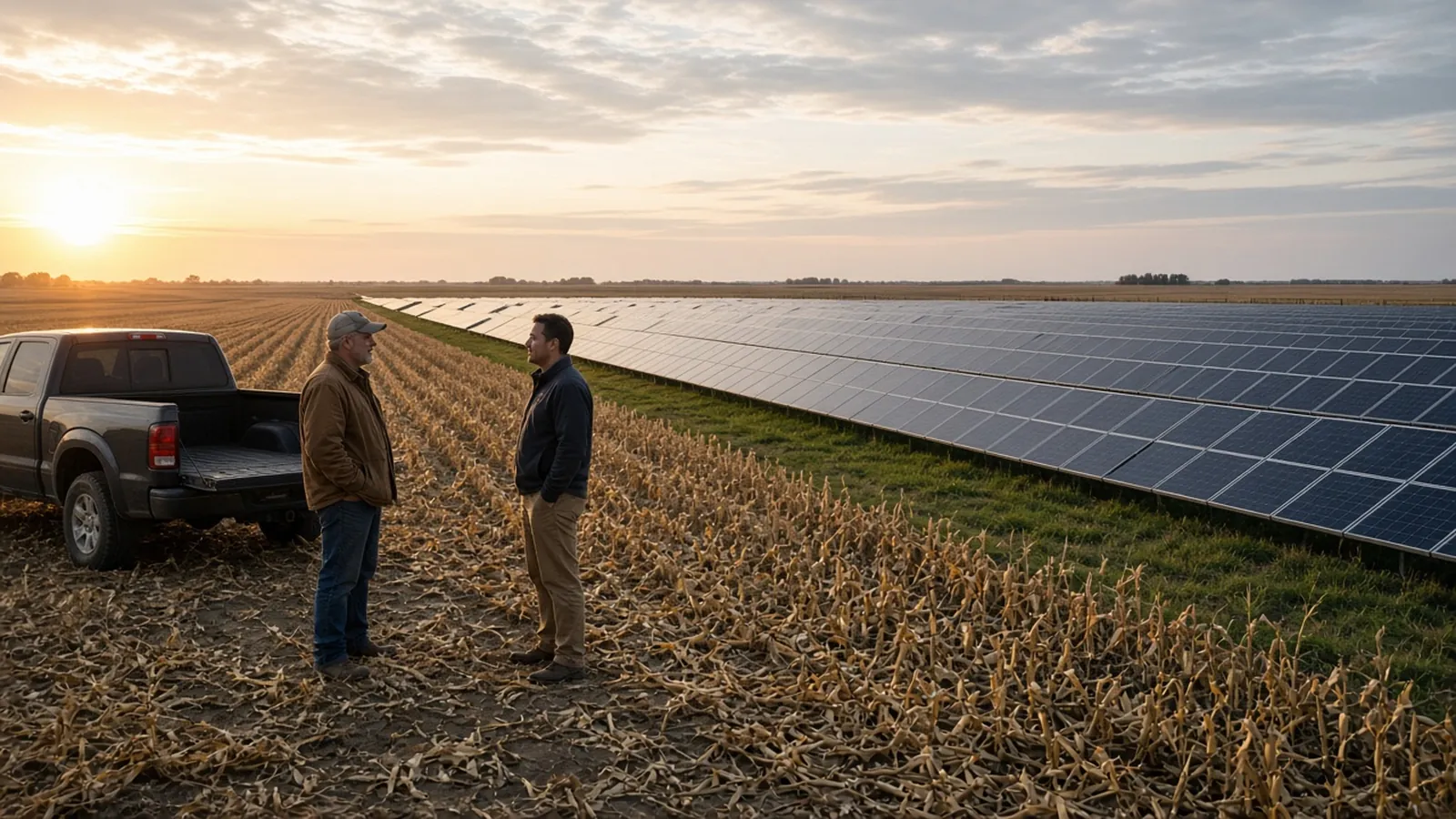
The letter usually arrives in a plain envelope, or a land agent knocks on the farmhouse door with a map and a number. Something like $1,200 an acre, every year, for 25 years or more. On ground that rents for a fraction of that to the neighbour who farms it, that figure is hard to ignore. It should not be ignored. It should be read slowly, because a solar lease on farmland is rarely a simple rent agreement. It is usually an option to tie up your land for years first, followed by a lease that can run half a century once the extensions are counted, with clauses on drainage tile, roads, taxes and decommissioning that matter far more than the headline rate.
Last checked November 12, 2026. Rate ranges below come from the Illinois Society of Professional Farm Managers and Rural Appraisers mid-year 2026 survey (as reported by AgriNews), a University of Missouri RaFF policy brief (August 2026), a Carolinas DASH report (March 2026), and University of Wisconsin Extension. This is general education, not legal, tax or financial advice. Solar leases are long, state-specific contracts; have an attorney who reviews energy leases in your state read any offer before you sign anything, including an option.
The short version. Utility-scale solar offers in the Corn Belt and Mid-Atlantic commonly sit somewhere around $1,000 to $2,000 per acre per year, with some higher. In the Illinois survey, 62.5% of farm managers who saw new solar or wind contracts in early 2026 reported $1,000–$1,999 per acre, 31.2% reported $2,000–$2,999, and 6.2% reported more than $3,000. No one reported less than $1,000 there. Other regions are lower: Wisconsin Extension cites roughly $500 to $1,500+, and a Carolinas review suggests up to about $1,500. The rate matters, but so do the option payments, the escalator, the term, the crop-damage and tile clauses, and above all a funded decommissioning guarantee.
1. How a farmland solar deal is actually structured
Most landowners picture one contract and one rent. In practice there are usually three phases, and each pays differently.
The option period
The developer pays a modest sum for the exclusive right to study your land and, later, to sign it into a lease. This is when they run interconnection studies with the utility, chase permits, line up a power buyer and look for finance. The Illinois State Bar Association’s 2026 review of solar leases notes that option periods often span two to five years. During that time you usually keep farming, but you cannot sign with anyone else, and if the developer walks away you keep only the option money. A Carolinas DASH analysis describes the same pattern: a nominal option payment that steps up as the option is extended in increments, until the developer either starts construction or lets the option lapse.
Construction
Once the developer exercises the option, your land converts to the full lease. Construction can take months. Some leases pay full rent from the start of construction; some pay a reduced construction rate; some only pay the operating rate once the array is energized. This is one of the easiest clauses to improve. A commenter in a 2026 Reddit thread about an 85-acre offer made the practical point well: you lose the use of the land when the fences go up, not when the panels start producing, so negotiate for payment from the day you lose access.
Operations and extensions
The operating term is often around 20 to 30 years, roughly matching panel warranties and power purchase agreements, followed by renewal options. Read carefully who holds those options. In many templates the extensions are exercisable by the developer, not by you. Add two or three five-year extensions to a 25-year term and a four-year option period, and your “25-year lease” becomes a commitment of 40 years or more. The University of Missouri brief notes that solar leases often span 25 to 50 years.
2. What solar lease rates look like in 2026, and why yours may differ
Developers rarely publish rates, and many leases include non-disclosure clauses, so most numbers come from surveys of farm managers, extension specialists and attorneys. The table brings together the published 2026 figures we could verify.
| Source (2026) | Area | Annual rent reported | Notes |
|---|---|---|---|
| ISPFMRA mid-year survey, via AgriNews (Sept 2026) | Illinois managed farmland | 62.5% of respondents: $1,000–$1,999/acre; 31.2%: $2,000–$2,999; 6.2%: over $3,000 | Covers new utility-scale solar or wind contracts. 48% of respondents had a managed farm sign a new wind or solar agreement in the first half of 2026. |
| University of Missouri RaFF policy brief (Aug 2026) | Corn Belt and Mid-Atlantic | Frequently $1,000–$2,000/acre | Cites industry media and calls those figures illustrative, not definitive. Compares with 2026 NASS average cash rent of $146/acre non-irrigated cropland. |
| Carolinas DASH report (Mar 2026) | North and South Carolina | Evidence suggests up to about $1,500/acre; another estimate $750–$1,400 | Notes NDAs make composite data hard to gather. |
| University of Wisconsin Extension (RESET) | Wisconsin | About $500 to over $1,500/acre | Compares with Wisconsin farmland rents of $158 (2024) and $183 (2025). |
Why do two farms 20 miles apart get very different offers? Mostly because of the grid. The single biggest driver is how close your land is to a substation or transmission line with capacity to take the project’s power. After that come flat, open, well-drained ground, few wetlands or trees, county zoning, state incentives, and whether several developers are competing in your area. Soil productivity matters less than many landowners expect; in fact the RaFF brief cites research finding that solar arrays more often land on lower-productivity acreage than on the very best ground.
One more caution. A Reddit landowner with about 1,800 acres under solar warned that some “landmen” cold-call with above-market rates simply to tie up land and flip the project. A lower rent from a developer with a real interconnection position and finance may be worth more than a higher rent that never gets built.
3. Compare the offer with what the land really earns now
A fair comparison is not solar rent against gross crop revenue. It is solar rent against the net income the ground gives you today, after you account for taxes, risk and what you give up.
Illustrative example, not an offer. Suppose 100 acres of non-irrigated cropland currently cash-rents at the 2026 U.S. average of $146 an acre, so $14,600 a year. A developer offers $1,100 an acre, rising 2% a year, on 80 fenced acres, with the other 20 acres staying in crops.
- Year-one solar rent: 80 × $1,100 = $88,000.
- Remaining farm rent: 20 × $146 = $2,920.
- Gain over today in year one, before tax: roughly $76,320.
- With a 2% escalator, the solar rent in year 25 would be about $1,100 × 1.0224 ≈ $1,770 an acre. With no escalator it stays at $1,100, and inflation erodes it every year.
These figures use national averages for illustration only. Your county rent, the real fenced acreage, the option and construction payments and your tax position will change the result. Run your own numbers with a CPA.
If you are weighing this against selling, or against leasing to a neighbour who farms well, our guide to cash rent, crop-share and flex leases covers how ordinary farm rents are set, and the farmland investing guide explains how lease income affects land value. The Illinois survey adds one useful data point here: 72% of respondents said an active wind, solar or battery lease added a 1% to 15% premium when farmland sold, 8% said more than 15%, and none reported a discount.
4. The clauses that matter more than the rate
Escalator
Ask for a fixed annual increase, commonly 1.5% to 2.5%, or an inflation link. Over 25 or more years, the escalator can add more value than haggling an extra $50 off the starting rate.
Payment from loss of use
Ask for full or near-full rent from the start of construction, not from commercial operation, and for crop-loss payments on any acres disturbed by survey work, cable routes or construction staging.
Acreage and fenced area
Developers typically lease more land than they build on. A solar estimator commenting on a January 2026 Reddit thread said they usually use about 50% to 75% of offered land, depending on terrain, woods and wetlands. Find out whether rent is paid on all leased acres or only on fenced acres, and whether unused acres are released back to you after construction.
Drainage tile, soil and roads
Buried tile is easy to crush and expensive to fix. The ISBA review stresses clear damage formulas, repair obligations and restoration standards for crop damage, soil compaction and tile. In Illinois, projects must follow an Agricultural Impact Mitigation Agreement (AIMA) under state law, but the bar association advises writing those protections into the lease itself so that you can enforce them privately.
Property tax and conversion penalties
Solar often changes how the land is assessed. In some states, taking land out of agricultural use triggers rollback taxes or ends preferential valuation. The lease should say clearly that the developer pays any increase in property tax caused by the project, including rollback or conversion penalties.
Farm programme and lender effects
Land enrolled in the Conservation Reserve Program, or pledged to a lender, needs attention. The ISBA article specifically warns about consequences under federal farm programmes such as CRP. Talk to your FSA office and your mortgage lender before you sign; many mortgages require lender consent for a long-term lease.
Assignment and change of owner
Expect the developer to keep the right to assign the lease to a buyer or financier. That is normal, because projects are sold. Ask for notice, for the assignee to assume every obligation, and for the original party to stay liable until the new owner has posted any required security.
5. Decommissioning: the clause to fight hardest for
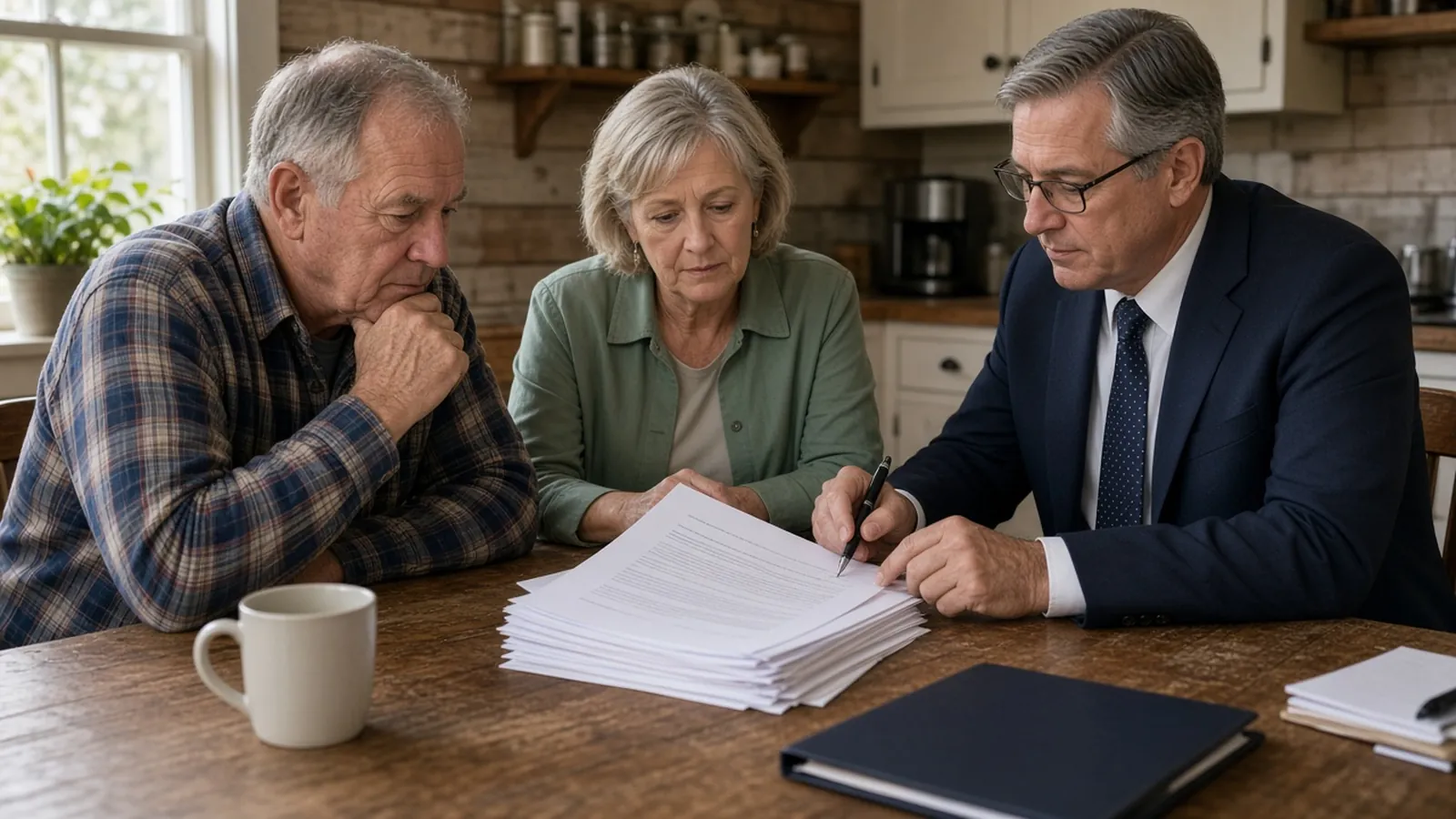
At the end of the lease, someone has to remove panels, racking, inverters, cabling, fences, roads and concrete, and return the soil to farmable condition. The ISBA review calls decommissioning one of the most consequential parts of a solar lease, and says a well-drafted agreement should specify the full scope of removals, soil and drainage restoration standards, deadlines, and robust financial security such as bonds, letters of credit or escrow.
Practical points to ask for:
- Removal to a stated depth (many county ordinances specify one) of piles, cables and foundations, not just above-ground equipment.
- A restoration standard that names topsoil replacement, decompaction and tile repair.
- Financial security in your favour, posted before construction, reviewed every few years, and not reduced by an assumed “salvage value” you cannot control.
- A deadline (for example, within 12 to 18 months after the lease ends) and your right to do the work and draw on the security if they miss it.
- A trigger if the project stops producing for a set period, so a dead array does not sit on your land indefinitely.
One Reddit contributor pointed out that when developers fail, the financiers usually sell the operating asset rather than abandon it, because it is tied to the utility. That may be true in most cases. Security is there for the cases where it is not.
6. Tax points to raise with your CPA
Lease income is generally rental-type income, not crop income, and how it is reported depends on your situation. Option payments, lump-sum signing bonuses, crop-damage payments and easement payments may each be treated differently. The Reuters Practical Law overview of solar ground leases notes that an option can delay some tax consequences of a long-term ground lease. Estate and succession planning also change: a 40-year lease is an asset your heirs will inherit, along with every obligation in it. If succession is on your mind, ask your estate attorney how a long-term lease affects land values and the federal estate tax exemption ($15 million per person in 2026). Ask your adviser about state income tax, self-employment tax exposure, and whether a portion of the land should be held in a separate entity.
7. Dual use: sheep, pollinators and agrivoltaics
Many developers now plant pollinator-friendly ground cover and contract sheep grazing to manage vegetation. Wisconsin Extension lists grazing sheep and other agricultural activities within solar projects as dual-use options that can give farmers affordable land access. If you or a neighbour keeps sheep, ask whether the lease allows you to bid for the vegetation contract. Do not assume you can grow row crops between rows; a landowner with a large utility-scale lease summarised it bluntly in a 2026 thread: farming under the panels was a no.
8. Neighbours, community and good-neighbour agreements
Solar is local politics. Counties set setbacks, screening and decommissioning rules, and some states have restrictions on high-value farmland. Oregon, for example, caps solar projects on high-value farmland at 160 acres without additional review, according to the RaFF brief. Neighbouring landowners who are not in the project sometimes negotiate good-neighbour agreements covering screening, noise or compensation. If you farm rented ground nearby, remember the other side of the coin: the brief and Wisconsin Extension both note that solar rents can push up local land rents and reduce land available to tenants.
9. Common mistakes
- Signing the option as “just a formality.” The option already contains the lease terms. Negotiate everything before the first signature.
- Comparing solar rent with gross revenue. Compare it with net farm income or current rent, after tax and risk.
- Ignoring extensions. Count the full possible term, including developer-held renewals.
- Accepting decommissioning promises without security. A promise from a project company that may be sold three times is not the same as a bond.
- Forgetting the tenant. If someone farms the ground, give proper notice under your current lease and state law.
- Talking terms by text or voicemail. A January 2026 commenter advised not to signal acceptance in any form until counsel has reviewed the papers.
10. A checklist before you call the developer back
- Map the exact parcels and acres offered, and ask for the likely fenced area.
- Ask for the option payments by year, the construction rent and the operating rent.
- Ask who holds the renewal options and the total maximum term.
- Ask how far the nearest substation is and where the project stands in the utility interconnection queue.
- Get your county’s solar ordinance and any state rules (for example, AIMA in Illinois).
- Call your lender, your FSA office (for CRP or loans) and your CPA.
- Hire an attorney who reviews solar leases, and ask for a redline, not just comments.
Know what your land earns before you negotiate
LazAgro helps you record yields, input costs and rent by field, online or offline, so you can compare a solar offer with real numbers rather than guesses.
Discover LazAgroFrequently asked questions
1. What is a good solar lease rate per acre in 2026?
It depends heavily on grid access and region. In Illinois’ 2026 farm-manager survey, most new utility-scale offers were $1,000–$1,999 per acre, and about a third were $2,000–$2,999. Wisconsin and the Carolinas report lower ranges. A rate is “good” only after you add the escalator, construction payments and decommissioning security.
2. How long do farmland solar leases last?
Typically an option period of a few years, then an operating term of about 20 to 30 years, plus renewal options. Total commitments of 40 to 50 years are possible.
3. Can I keep farming the land?
Usually not inside the fence. You can often keep farming during the option period and on acres the developer does not use. Sheep grazing is sometimes allowed, often under a separate contract.
4. What happens if the solar company goes bankrupt?
The project is usually sold to another owner, who takes over the lease. Payments may lapse in the meantime. Strong assignment terms and decommissioning security protect you if no buyer appears.
5. Will a solar lease lower my land value?
Not necessarily. In the 2026 Illinois survey, most respondents said an active energy lease raised sale prices modestly, and none reported a discount. Local results vary, and a buyer will look closely at the remaining term and the decommissioning terms.
6. Do I need a lawyer for a solar option agreement?
Yes. The option normally fixes the lease terms you will be bound by later. Ask for an attorney experienced in energy leases in your state, and ask whether the developer will reimburse legal fees, which many do.
7. How is solar lease income taxed?
It depends on how payments are structured and your situation. Treat option payments, rent, damages and easements as separate items and ask a CPA before you sign, not after the first payment arrives.
Final thoughts
A solar offer can be one of the best financial opportunities a farm family sees in a generation. It can also tie up land for longer than most of the people at the kitchen table will be alive. Treat the first draft as the opening of a negotiation, get the decommissioning security in writing, and count the full term. The rate is the headline. The clauses are the story.
Rates and rules in this guide were last checked on November 12, 2026. Solar markets move quickly, so check current local data and your state’s rules before you rely on any figure here.
Sources and further reading
- AgriNews, Farm managers surveyed on renewable energy agreements (10 Sept 2026), ISPFMRA Mid-Year Snapshot.
- University of Missouri RaFF, Solar Energy and Agricultural Production: Land Use Conflict, Synergy, or Compromise? (Aug 2026).
- Carolinas DASH, Solar PV Development of Agricultural Land (Mar 2026).
- Illinois State Bar Association, Key Issues for Attorneys Reviewing Solar Leases in Illinois (Mar 2026).
- University of Wisconsin Extension RESET, Economic impacts.
- Reuters Practical Law, Solar Ground Leases: Key Considerations for Landowners.