 LazAgro

Drive through Bamenda, Santa, Mbouda or Dschang at harvest time and you will see sacks of Irish potatoes stacked by the road, waiting for buyers from Douala, Yaoundé and as far as Gabon and Equatorial Guinea. Irish potato farming in Cameroon is a serious business in the Western Highlands. Yet many farmers harvest only a fraction of what the same land could give.
According to the Organic Africa potato guide for Cameroon, average yields are often around 4 to 6 tonnes per hectare, compared with a potential of 15 to 20 tonnes. The same guide names the reasons: low soil fertility, infested planting material, limited inputs, and heavy pest and disease pressure. Those are problems a farmer can work on.
This guide focuses on the practical levers: better seed, choosing the right season, soil and rotation, planting and hilling, controlling late blight and other problems, and harvesting and storing so you sell at a good time.
1. Where and when potatoes grow in Cameroon
Irish potato is a cool-climate crop. In Cameroon it is grown mainly at higher altitudes in the West and North West regions, roughly between 1,000 and 3,000 metres above sea level, with smaller production in parts of Adamawa. Lowland heat reduces tuber formation and increases disease.
Seasons
Most farmers plant with the rains, which start around March or April. The main production period runs roughly from March to mid-July. Some farmers plant a second crop later in the rains, and farmers with irrigation can produce in the dry season, when prices are often better because fewer people are harvesting.
| Season | Advantages | Challenges |
|---|---|---|
| First (main) rainy season | Reliable moisture, familiar timing | Late blight builds up as rains intensify; many farmers harvest at once |
| Second season (late rains) | Uses land after a first crop | Very high blight pressure in the wettest months; risk of rains ending early |
| Dry season with irrigation | Lower blight, often better prices | Needs water, pumps and labour; more pests like tuber moth |
2. Varieties: Cipira and beyond
In the early 1990s, IRAD and the International Potato Center (CIP) introduced improved varieties for Cameroon. Cipira, released in 1992, was bred for resistance to late blight and adapted to cool tropical highlands. Tubira was introduced around the same time. Both were widely adopted, and Cipira remains one of the most common varieties.
Other varieties grown in Cameroon include so-called "European" types such as Spunta, Désirée, Diamant and Cardinal, and newer introductions like Dosa, Jacob and Panamera. Each differs in yield, cycle length, skin colour, cooking quality and disease tolerance.
How to choose
- Market preference: ask buyers which skin colour, size and cooking type they pay more for, for example for chips or boiling.
- Disease tolerance: in the rainy season, blight tolerance matters a lot.
- Cycle length: shorter varieties may fit before rains end or let you plant two crops.
- Seed availability: a good variety is useless if you cannot get clean seed of it.
Research continues. A trial at IRAD Upper Farm, Bambui, published on HAL, screened 16 potato genotypes and found several promising lines with lower late blight and higher yields than the check varieties. Ask IRAD stations in Bambui and Dschang about newly released varieties.
3. Seed potatoes: the foundation of the crop
Potatoes are planted from tubers, not true seed. Any virus or disease in the mother tuber goes straight into the new plant. Farmers who save their own small tubers season after season see yields fall as viruses build up. The Organic Africa guide describes exactly this degeneration in Cameroonian varieties.
Better seed options
- Buy certified or quality-declared seed from IRAD, approved seed multipliers or projects when available, at least every few seasons.
- Positive selection: in your own field, mark the healthiest, strongest plants during the season, and keep tubers only from those plants for seed.
- Separate seed plot: grow your seed in a separate, well-managed plot with extra care for aphids and disease.
Preparing seed tubers
- Use medium tubers, roughly egg-sized, with several eyes.
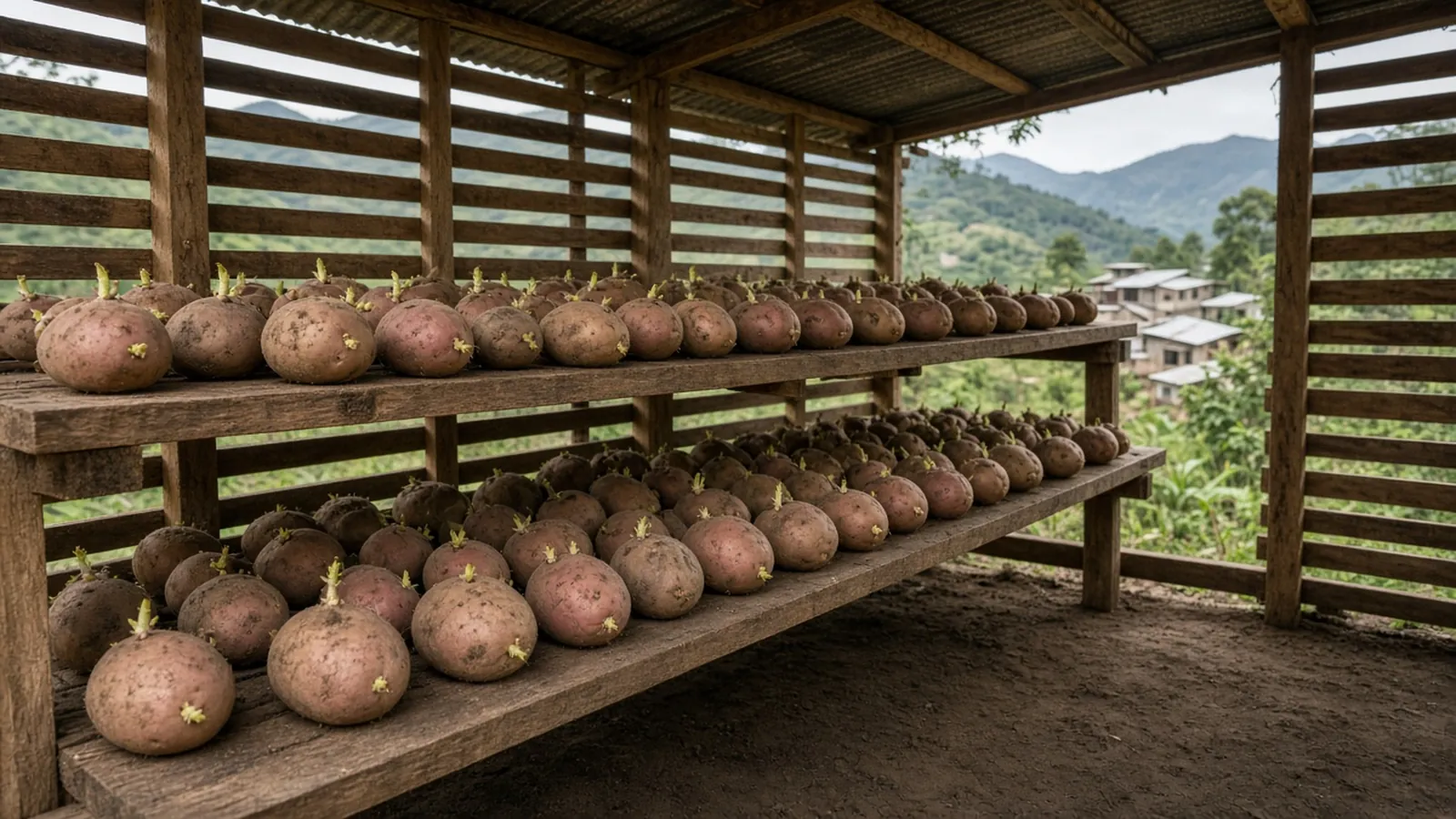
- Store seed in diffuse light (a shaded, airy shed), not in the dark. This produces short, strong, green sprouts.
- Plant when sprouts are short and sturdy, not long and white.
- Discard soft, rotten or shrivelled tubers.
- If cutting large tubers, make sure each piece has at least two eyes, and let cut surfaces dry before planting.
4. Soil, rotation and fertility
Potatoes like deep, loose, well-drained soil rich in organic matter. Highland soils in the West and North West are often fertile but can be acidic and exhausted after years of continuous cropping.
Rotation
Do not plant potatoes after potatoes, tomatoes, huckleberry (njama njama), pepper or garden egg. These share late blight, bacterial wilt and other diseases. Rotating with maize, beans, cabbage or a grass fallow for at least two to three seasons reduces disease build-up.
Organic matter
Apply well-rotted manure or compost before planting. Poultry manure is popular in the highlands but must be well decomposed. Our guide on how to make compost on the farm explains a simple method.
Fertiliser
Potatoes respond well to balanced fertiliser, especially phosphorus and potassium. Rates depend on your soil, so ask your extension agent or a reliable input dealer, and if possible test your soil.
On slopes
Much potato land in the highlands is steep. Ridges running up and down the slope channel water and carry away soil. Make ridges across the slope and keep grass strips; see our guide on soil erosion prevention.
5. Planting and hilling
- Plant on ridges or mounds that drain well.
- A common spacing is about 70–80 cm between rows and 25–35 cm between plants, adjusted for variety and soil.
- Plant tubers about 10 cm deep, sprouts up.
- Hill up (earth up) soil around the stems once or twice as plants grow. Hilling protects tubers from light (which turns them green), from tuber moth and from blight spores washing down from leaves.
- Weed early, before plants close the rows.
6. Late blight: the main enemy
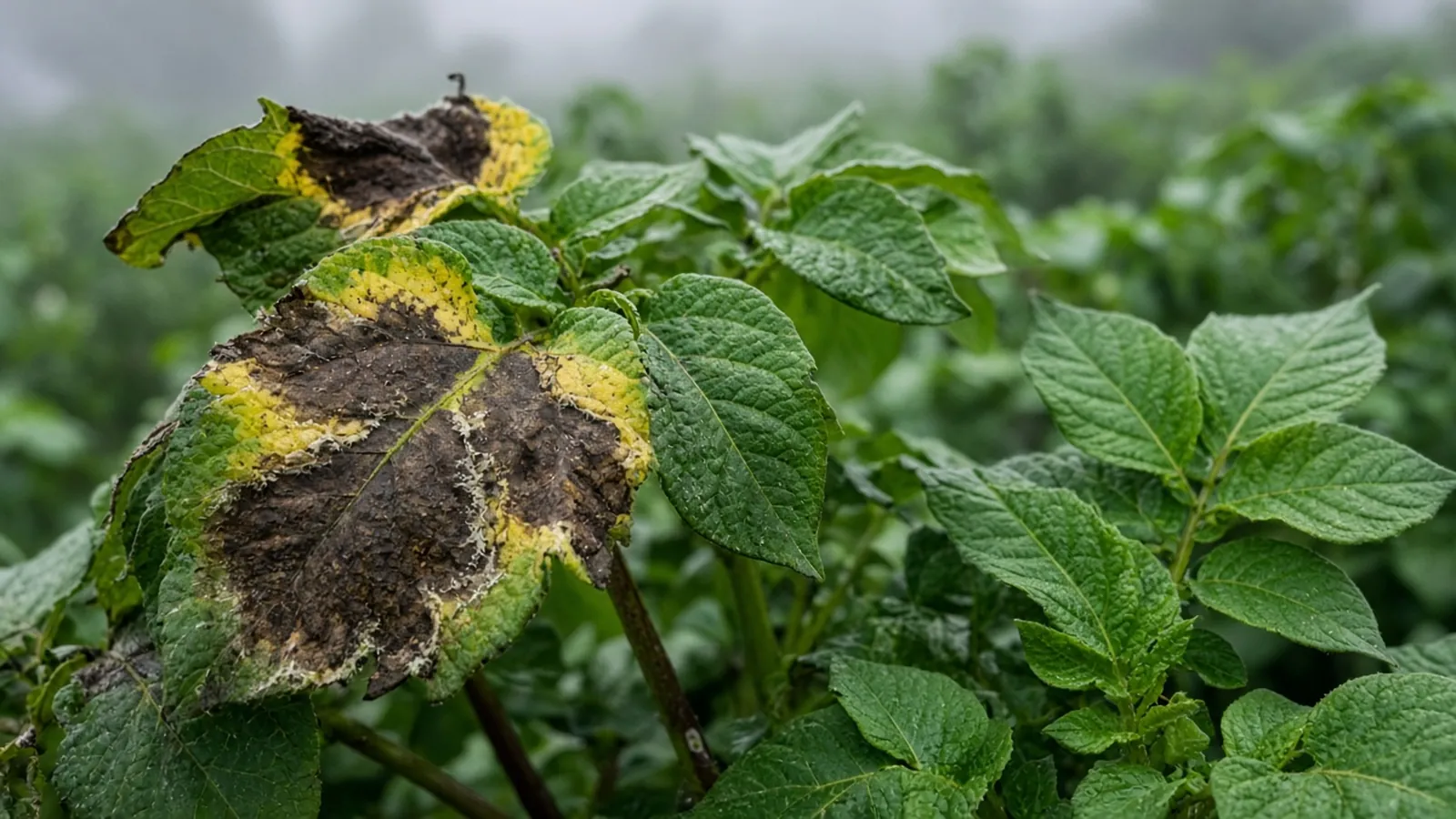
Late blight, caused by Phytophthora infestans, is the most important disease of potato in the Cameroon highlands. It can destroy the foliage of a field within days in cool, wet weather.
Signs
- Dark, water-soaked spots on leaves, often starting at the edges.
- White, fuzzy growth on the underside of leaves in humid mornings.
- Brown, dying patches spreading through the field.
- Firm brown rot in tubers, sometimes showing only in storage.
Control
- Tolerant varieties and clean seed.
- Rotation and removing volunteer potatoes left from earlier crops.
- Good spacing and hilling.
- Preventive fungicides started before symptoms in high-risk weather, using products registered in Cameroon and following labels.
- Remove badly infected plants early.
- Cut down haulms (vines) a couple of weeks before harvest if blight is present, to protect tubers.
Blight pressure seems to have grown over the years. A review of Cipira performance in the Western Highlands reported that the number of fungicide sprays per season rose from two to sixteen over 24 years, with production costs rising sharply as a result. That is one more reason to combine clean seed, rotation and tolerant varieties rather than relying on spraying alone.
7. Other pests and diseases
- Bacterial wilt: plants wilt suddenly while green; tubers ooze when cut. Use clean seed, rotate, and remove infected plants.
- Black leg: black, rotting stem bases. Plant healthy seed in well-drained soil.
- Cutworms: young plants cut at soil level. Clean fields and monitor early.
- Potato tuber moth: larvae tunnel into tubers in the field and in storage. Hill well, harvest promptly and keep stores clean.
- Aphids and viruses: aphids spread viruses that cause seed degeneration. Rogue out virus-infected plants, especially in seed plots.
8. Harvesting
- Harvest when vines have yellowed and died back, and tuber skins no longer rub off easily.
- If you must harvest early for a high price, handle tubers even more gently because the skin is thin.
- Dig carefully to avoid cutting and bruising tubers.
- Harvest in dry weather if possible, and do not leave tubers in the sun.
- Sort immediately: market size, seed size, small, damaged and rotten.
9. Storage and timing your sales
Prices are usually lowest when everyone harvests at the same time. Storing some potatoes for a few weeks or months can earn more, but only if storage is good.
Eating (ware) potatoes
- Cure for about a week in a cool, shaded, airy place so skins toughen and small wounds heal.
- Store in the dark, cool and well ventilated. Highland temperatures help.
- Use raised slatted shelves or crates, not heaps on the floor.
- Inspect regularly and remove rotting tubers.
Seed potatoes
Store separately in diffuse light, as described above.
The LazAgro app lets you record harvests, storage and sales per field, even in highland farms with weak network. Comparing seasons shows when storing pays.
11. Selling potatoes: farm gate, markets and exporters
Highland potato farmers have several selling options, and each suits a different situation.
- Farm-gate traders come with trucks at harvest time. Selling this way is fast and avoids transport costs, but prices are usually lowest when many farmers are harvesting.
- Local and regional markets such as those in Bamenda, Bafoussam, Mbouda and Dschang let you compare offers and sell graded produce.
- Urban buyers in Douala and Yaoundé, including wholesalers, restaurants and fast-food outlets making chips, often pay more for consistent size and quality.
- Cross-border traders buy for Gabon, Equatorial Guinea and other neighbours, usually in bulk.
- Seed buyers pay a premium for clean, well-stored seed tubers if you build a reputation for quality.
Grading helps in every channel. Separate large, clean tubers from small and damaged ones, and sell each grade to the buyer who values it. Farmers' groups that pool their harvest can negotiate better with large buyers and share transport and storage costs.
Keep a simple log of the price you are offered each week through the season. After two or three seasons, those records show you when prices usually rise in your area, which is valuable when deciding how much to store. If your farm has weak network, our guide on managing a farm without internet explains how to keep records offline.
12. Common potato farming mistakes
- Replanting small, diseased tubers year after year.
- Planting potatoes after potatoes or tomatoes.
- Skipping hilling, leading to green and moth-damaged tubers.
- Spraying only after blight has spread.
- Harvesting carelessly and storing bruised tubers.
- Ridges running straight down steep slopes.
Frequently asked questions about Irish potato farming in Cameroon
1. Where is Irish potato grown in Cameroon?
Mainly in the highlands of the West and North West regions, at roughly 1,000 to 3,000 metres altitude, with some production in Adamawa.
2. What is the best potato variety in Cameroon?
Cipira, released by IRAD and CIP in 1992, is widely grown for its late blight resistance. Other varieties suit specific markets. Ask local buyers and IRAD for current recommendations.
3. Why are my potato yields falling every year?
The usual causes are degenerated seed, continuous cropping on the same land, declining soil fertility and increasing disease. Clean seed, rotation and organic matter are the first fixes.
4. How do I control late blight?
Combine tolerant varieties, clean seed, rotation, hilling, early removal of infected plants, and preventive sprays with registered fungicides in high-risk weather.
5. How long can I store potatoes?
Well-cured, healthy tubers stored cool, dark and ventilated can keep for weeks to a few months. Check them often and remove rotten ones.
Final thoughts
Irish potato farming in Cameroon has room to grow, and most of it comes from basics: clean seed, rotation, organic matter, good hilling and timely blight control. Improve one of these each season, keep your numbers, and you will see the gap between your yield and the potential start to close.
Know what each field and season gives you
LazAgro helps you record seed, inputs, harvests and sales per field, online or offline.
Discover LazAgro