 LazAgro

The first time many maize farmers in Cameroon saw fall armyworm, they thought it was just another stem borer. Then the young maize started looking like someone had attacked it with a hole punch, and the funnel of each plant filled with sawdust-like droppings. Good fall armyworm control starts with knowing exactly what you are dealing with, and acting while the plants are still young.
Fall armyworm (Spodoptera frugiperda) is a caterpillar pest from the Americas. In Cameroon, it was first noticed damaging maize in Foumbot, West Region, in December 2015, and formally reported to the International Plant Protection Convention in 2017. That report recorded it in the West, Centre, Far North, Littoral and South West regions, with plant infestation between 25% and 75% at the sites surveyed. By 2018, FAO reported it in all five of Cameroon's agro-ecological zones.
It is now a permanent part of maize farming here. The farmers who lose least are not the ones who spray most. They are the ones who scout their fields, act early, and combine several simple methods.
1. Know your enemy: identifying fall armyworm
The caterpillar
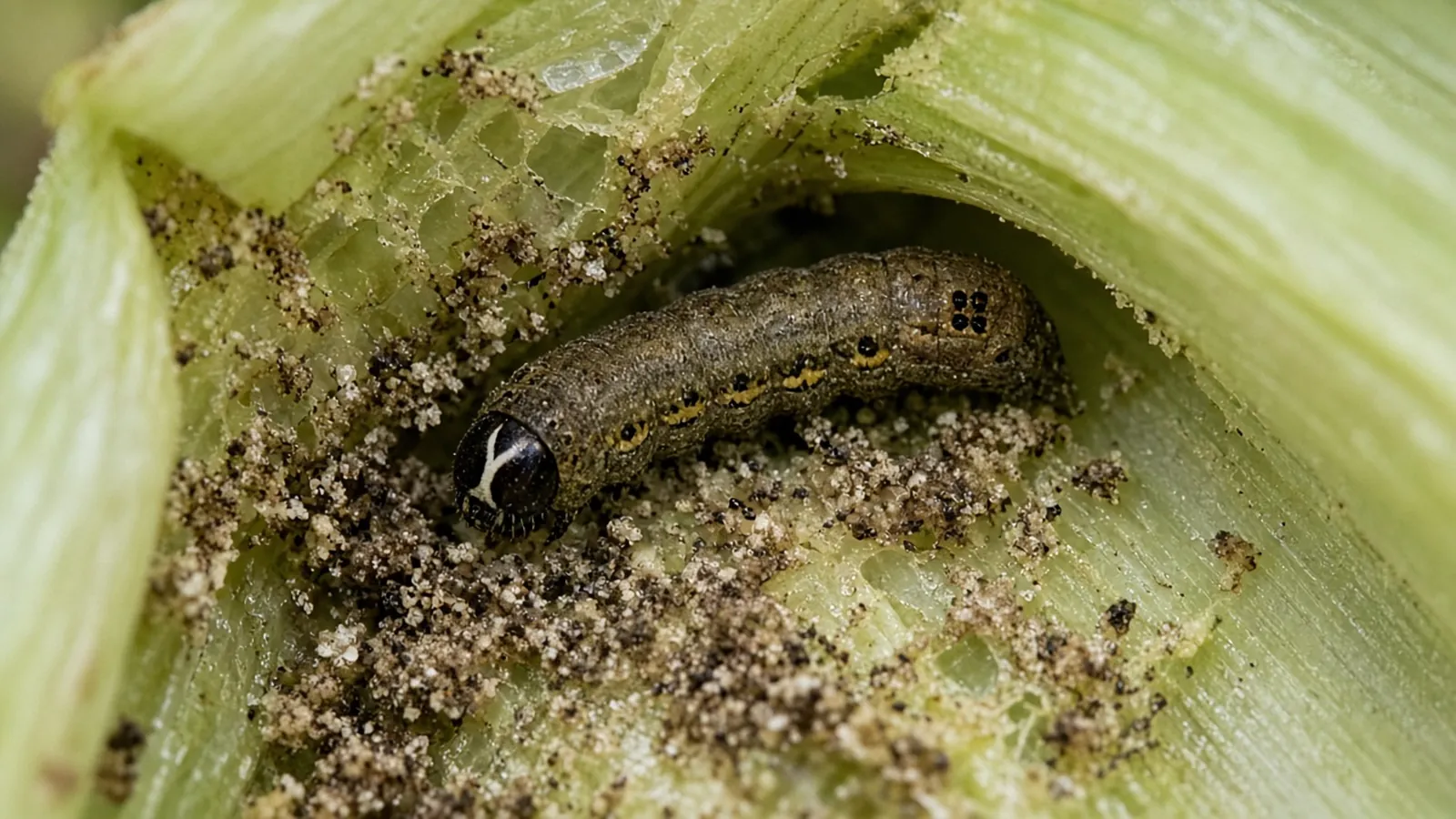
The larva is the damaging stage. Older caterpillars can be several centimetres long, ranging from greenish to dark brown. Look for two features together:
- An inverted "Y" in a pale colour on the front of the dark head.
- Four dark spots arranged in a square on the top of the second-to-last body segment.
The damage
- Windowpane patches: small caterpillars scrape leaf tissue, leaving thin, papery, transparent spots.
- Ragged holes: as they grow, they eat through leaves, leaving irregular holes that appear as leaves unroll.
- Frass in the whorl: moist, sawdust-like droppings in the funnel of the plant.
- Damage to tassels and cobs: in later stages, caterpillars may bore into ears.
The moth and eggs
Adult moths fly at night and are strong travellers. FAO notes they can cover up to 100 km in a night. Females lay egg masses covered with fine scales on leaves. One female can lay many hundreds of eggs, which is why populations explode quickly in a warm season.
2. How fall armyworm damages maize
Maize can tolerate a surprising amount of leaf damage at some stages. Not every holey leaf means lost yield. The risk is highest when:
- Many plants are attacked in the early whorl stage and growing points are destroyed.
- Caterpillars move into tassels and young ears, damaging grain directly.
- Damaged ears are later invaded by moulds, which affects grain quality and storage.
That last point links fall armyworm to storage problems. Ears with insect holes are more likely to carry mould, so good field control also protects the grain you store. See our guide on how to store maize properly for what to do after harvest.
3. Scouting: the 20-minute field walk
You cannot manage what you have not measured. A simple scouting routine twice a week tells you whether damage is rising and where.
- Walk the field in a "W" pattern, so you cover the edges and the middle.
- Stop at five points spread across the field.
- At each point, check 10 plants in a row: look into the whorl, check the leaves for fresh windowpanes, holes and frass, and look for live caterpillars.
- Count how many of the 50 plants show fresh damage, and note whether caterpillars are small or large.
- Write the numbers down with the date and the crop stage.
Fresh damage (moist frass, live caterpillars) matters more than old damage. A plant with old holes and no caterpillar has often recovered.
4. Cultural practices that reduce attacks
These methods cost little and make your field less attractive to fall armyworm.
Plant on time and together
Early, timely planting with the first steady rains, ideally at the same time as neighbours, helps maize get past the most sensitive stages before populations build. Late or staggered plantings in a village give the pest a continuous supply of young maize.
Feed the crop
Healthy, well-fed maize grows through damage better. Use compost, manure and balanced fertiliser as recommended locally.
Intercrop
Maize intercropped with beans, groundnut, cowpea or other legumes often suffers less than maize alone, partly because natural enemies have more habitat. The "push-pull" system developed by icipe in East Africa uses a repellent legume (desmodium) between maize rows and an attractive border grass (brachiaria) to pull moths away. Ask local research and extension services whether trials exist near you.
Keep fields clean around the edges
Weedy borders with wild grasses can host the pest. Clear them, especially before planting.
Avoid continuous maize where possible
Rotating with non-grass crops like cassava, beans or groundnut breaks the pest's food supply.
5. Mechanical and traditional methods
On small farms, hand methods are realistic and effective in the early stages.
- Handpicking: crush caterpillars and egg masses during scouting. Children and family members can help after a short demonstration.
- Sand, ash or soil in the whorl: many farmers across Africa apply a pinch of fine dry soil, sand or wood ash into the funnel. It can make conditions harder for small caterpillars. It is cheap and harmless to try on young plants.
- Destroy badly damaged plants: in a heavily attacked spot, removing a few hopeless plants reduces the local population.
6. Natural enemies and biopesticides
Fall armyworm has natural enemies in Africa: parasitic wasps, earwigs, ants, spiders, birds and diseases that kill caterpillars. Heavy, repeated spraying with broad-spectrum insecticides kills these helpers and can make problems worse later.
Biological options
- Bacillus thuringiensis (Bt) products target caterpillars and are safer for people and beneficial insects.
- Neem-based products and neem seed extracts are used by some farmers.
- Other biopesticides based on viruses or fungi are increasingly registered in some countries.
Biopesticides work best on small caterpillars and must reach the whorl. Ask your input dealer or agricultural post which products are registered in Cameroon.
7. Chemical control: last line, done right
Sometimes infestation is severe and rising fast in young maize, and an insecticide is justified. Make it count.
- Use only insecticides registered for fall armyworm on maize in Cameroon.
- Spray when caterpillars are small, early morning or late afternoon when they are active.
- Direct the spray into the whorl, where caterpillars hide.
- Rotate between products with different modes of action to slow resistance.
- Never mix random chemicals in the hope of a "strong" result.
- Wear protective clothing and respect the pre-harvest interval, especially if you sell fresh maize.

8. Using digital tools for fall armyworm control
FAO developed the FAMEWS app for farmers and extension agents to record scouting results and trap catches, building a map of fall armyworm across Africa. On your own farm, a simple record of scouting results, sprays and yields by field is just as valuable.
The LazAgro app lets you log field activities, inputs and harvests per plot, even when you are in a maize field with no signal. Comparing seasons tells you whether early planting, intercropping or a particular product made a real difference. If network is a problem on your farm, our guide to managing a farm without internet explains offline recording.
9. A season plan for fall armyworm control
| Stage | What to do |
|---|---|
| Before planting | Clear weedy edges, plan rotation or intercrop, prepare compost or manure, agree planting dates with neighbours |
| Emergence to early whorl | Scout twice a week, handpick, apply sand or ash in whorls, act early if fresh damage rises fast |
| Late whorl | Continue scouting; target sprays or biopesticides into whorls only if needed |
| Tasselling to cob formation | Check tassels and ears; avoid late sprays near fresh-maize harvest |
| After harvest | Remove or plough in residues, dry grain well, review records |
10. Common mistakes in fall armyworm control
- Spraying on a fixed calendar without scouting.
- Spraying over the top of the plant, missing caterpillars in the whorl.
- Waiting until caterpillars are large and hidden in ears.
- Using the same insecticide all season.
- Panicking over old leaf holes when the plant has already recovered.
- Planting late after all neighbours, giving the pest a fresh crop to move into.
11. Fall armyworm in other crops
Maize is the main target, but fall armyworm feeds on more than 80 plant species, including sorghum, millet, rice, sugarcane and some vegetables. In the north, sorghum and millet farmers should use the same scouting approach. In vegetable gardens close to maize fields, watch for caterpillars on leaves after maize harvest when the pest looks for new food.
12. First season, second season: why timing changes the risk
In the bimodal Centre, South and East, many farmers plant maize twice a year. In the Western Highlands and the South West, there is usually one main maize season, with some off-season planting in valleys. Fall armyworm pressure is often different between these plantings.
When a village plants its first-season maize together, the pest arrives into fields of roughly the same age. When maize is planted again a few months later, the population that built up on the first crop may still be around, ready to move into the young second-season plants. Some farmers report heavier attacks on late or second-season maize for this reason. Your own scouting records are the best way to see the pattern on your farm.
Practical adjustments
- Scout second-season maize even more closely in the first four weeks.
- Avoid planting a new maize field right next to a maturing one if you can.
- Remove or plough in first-season residues before planting again.
- Consider rotating part of the second season into beans, groundnut or vegetables.
Strong soil, stronger plants
Maize on poor, eroded soil struggles to outgrow leaf damage. Building organic matter with compost and protecting topsoil from runoff make the crop more tolerant of pests. Our guides on soil erosion prevention and making compost on the farm cover both.
Frequently asked questions about fall armyworm control
1. How do I know it is fall armyworm and not stem borer?
Fall armyworm caterpillars are easy to find in the whorl, with an inverted "Y" on the head and four dark spots in a square near the tail. Stem borers usually tunnel inside the stem and are hard to see without cutting it.
2. When is the best time to control fall armyworm?
Early, when plants are in the whorl stage and caterpillars are small. Scout twice a week from emergence and act when fresh damage is rising.
3. Does ash or sand in the whorl really work?
Many smallholders use it and it is cheap and safe on young plants. It works best combined with scouting, handpicking and good crop management, not as the only method.
4. Which insecticide is best for fall armyworm?
Use only products registered for fall armyworm on maize in Cameroon, and rotate modes of action. Ask your MINADER agricultural post or a trusted dealer for current recommendations.
5. Can fall armyworm be eradicated?
No. It is now established across Africa. The goal is to keep damage low through integrated management season after season.
Final thoughts
Fall armyworm is here to stay, but it does not have to take your maize. Scout often, act early, protect the natural enemies working for you, and spray only when it makes sense. Keep notes on what you see and what you did, and every season you will manage it a little better.
Record every scouting walk and spray
LazAgro helps you keep field activities, inputs and harvests organised, online or offline.
Discover LazAgro