 LazAgro
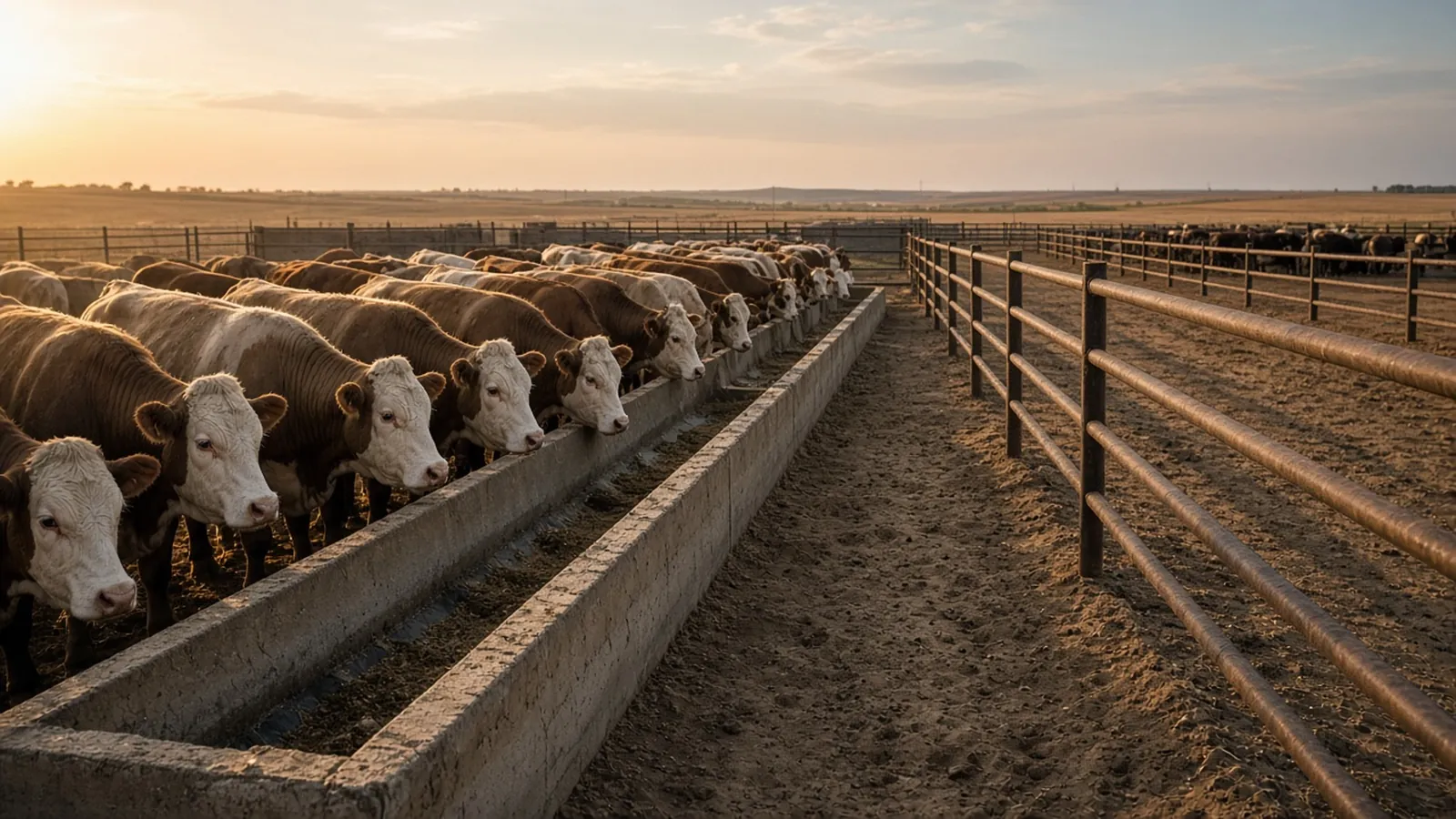
Livestock Risk Protection is not a death policy, and it is not a promise that your own sale barn check will match the indemnity. It is a federally reinsured, daily-offered insurance plan that pays when a published ending value falls below the coverage price you locked on a Specific Coverage Endorsement. For a cattle feeder or a cow-calf producer staring at a winter or spring sale date, that is often the relevant question: what happens if the market, as RMA measures it, breaks before those cattle are ready.
Last checked November 2026. We are in the Livestock Risk Protection 2027 crop year, which runs from 1 July 2026 to 30 June 2027 (the crop year is named for the calendar year in which it ends). Figures and procedures below come from the USDA RMA Livestock Risk Protection Handbook for 2027 and succeeding crop years (issued 17 June 2026), Product Management Bulletin PM-26-024 (30 April 2026), and the CY2026 Livestock Insurance Offer Calendar. This is educational, not insurance advice or a quote. Only a licensed livestock insurance agent can bind coverage on a day’s offer.
What LRP does. You buy a Specific Coverage Endorsement (SCE) during a daily sales period, choosing a livestock class and type, a target weight, an endorsement length, a coverage level and a coverage price from that day’s actuarial offer. If, at the end of the endorsement, the actual ending value is below that coverage price, an indemnity is due on the insured hundredweight, multiplied by your share. It does not insure your basis, your death loss, or the exact cheque you receive at the sale.
1. Where LRP sits next to other livestock and crop policies
Crop insurance — MPCI, crop-hail, Whole-Farm Revenue Protection — is a different family of policies, with sales closing dates that sit months before planting. If that is the decision you are making, see our MPCI vs crop-hail vs WFRP guide. LRP is a livestock price plan. It is offered in all counties in all states, through Approved Insurance Providers, under the Livestock Price Reinsurance Agreement.
It also sits next to Livestock Gross Margin (which is built around a margin, not only an output price) and, for dairy, Dairy Revenue Protection. PM-26-024, which applies to 2027 and succeeding crop years, allows concurrent coverage between similar livestock programmes, under the policy rules. That is a change from older “one or the other” habits. It is not a reason to buy two policies without an agent walking through what would actually be paid.
LRP will not replace farm liability cover, and it will not pay a veterinary bill. For the liability side of a livestock operation, see farm liability insurance for small farms.
2. The 2027 crop year rules that changed
Because today’s endorsements fall in the 2027 crop year, do not rely on a 2025 fact sheet. The 2027 handbook replaced the 2026 handbook. PM-26-024 lists the livestock-policy changes that took effect for 2027. The ones that matter on a cattle endorsement include:
- Beginning farmer or rancher is now an individual who has not actively operated and managed a farm or ranch, with an insurable interest, for more than 10 crop years (the 2026 handbook used five). Years under age 18, in full-time U.S. military service, or in post-secondary education may be excluded at the insured’s request, under the handbook definition. A change in that definition can decide whether a premium benefit applies, so have the agent run the current test, not the one you remember from a meeting two years ago.
- Subsidy percentages were updated to conform with the One Big Beautiful Bill Act. The official rate still varies by coverage level and is applied from the actuarial documents on the day of sale. The 2027 handbook’s premium examples use a 35% subsidy only as an illustration. That 35% is not treated here as the schedule for every coverage level, because the handbook itself does not publish a full table of rates.
- Fed cattle target weight is in the range of 10 to 18 cwt. Cull dairy cows have a target-weight range of 8 to 17 cwt, and cull-cow endorsement lengths now run with the other fed-cattle lengths, including up to 52 weeks (they were previously limited to 13 weeks).
- Additional unborn feeder-cattle types were added in a heavier weight band (6.0 to 9.0 cwt) for unborn bulls and heifers, unborn Brahman and unborn dairy, as described in PM-26-024 and the 2027 underwriting rules.
- Policies that earn no premium for three consecutive crop years must be cancelled.
LRP does not pay because your particular load brought a disappointing bid. The indemnity is triggered by the actual ending value specified in the endorsement — a published value — compared with your coverage price. You can have a poor sale and no indemnity, or a decent sale and an indemnity, depending on that index. Basis risk is real. That is why LRP is a hedge, not a marketing plan.
3. Feeder cattle, fed cattle and cull cows
The endorsement has to name a class and type that matches the animals. For feeder cattle, the 2027 handbook still splits types by sex and breeding, and by weight band. Typical feeder target-weight bands are 1.0–5.99 cwt and 6.0–10.0 cwt (with the heavier unborn types using 6.0–9.0 cwt). Steers, heifers, predominantly Brahman, and predominantly dairy types are treated separately, and a price adjustment factor may already be built into the published coverage prices and ending values for some types. Read the offer; do not apply a feeder-steer price to a dairy heifer in your own spreadsheet and call it a quote.
For fed cattle, the handbook covers steers and heifers raised for meat production, expected to grade Select or higher, that are marketable by the end date, and cull dairy cows removed from the herd and marketed for beef. Replacement cows, breeding stock, beef cows, and dairy cows sold at herd dispersal auctions are not eligible under the cull-cow endorsement. That last sentence is in the handbook for a reason: a cow-calf dispersal is not a cull-cow SCE.
You must have an ownership interest in the livestock during the insurance period, or, for unborn livestock, an ownership interest in the pregnant females, as the policy allows. The animals have to be marketable by the end date. The insurance period you choose should end within 60 days of the date the livestock are to be marketed or will reach the target weight. Feeder and fed endorsements are offered for 13, 17, 21, 26, 30, 34, 39, 43, 47 and 52-week periods (with the heavier unborn feeder types starting at 30 weeks).
Head limits
The 2027 handbook keeps these cattle limits:
| Class | Maximum per Specific Coverage Endorsement | Maximum per crop year |
|---|---|---|
| Feeder cattle | 12,000 head | 25,000 head |
| Fed cattle (including cull cows under that endorsement) | 12,000 head | 25,000 head |
| Swine (for context; this article is about cattle) | 70,000 head | See the swine underwriting rules — a separate limit structure |
Crop-year limits add animals insured under this policy and under other LRP policies in which you, or a person with a substantial beneficial interest in you, have an SBI, in proportion to that interest. If you operate through more than one entity, this is a conversation to have with the agent before you are told a later SCE cannot be accepted.
4. How a daily sale actually works
Coverage prices and rates change daily and are posted on RMA’s livestock reports. They apply only to that effective date. The CY2026 offer calendar, and the 2027 handbook’s definition of the sales period, say daily LRP sales end the following day at 8:25 a.m. Central Time. Friday sales end Saturday at 8:25 a.m. CT. All LRP sales are suspended on CME holidays. Feeder and fed cattle sales are also suspended on USDA NASS Cattle on Feed report dates.
The SCE has to reach the Approved Insurance Provider’s system by the end of that sales period. The handbook also describes when an insured may revise or withdraw an SCE, and when an agent’s or insured’s signature may be obtained up to 14 calendar days before the end of the sales period, provided the substantive fields are complete. Those mechanics are why “I’ll call the agent next week about yesterday’s price” is not a purchase. If you want a specific day’s floor, you need an agent who is watching that day’s offer with you.
Coverage levels authorised in the handbook are 75%, 80%, 85%, 87.5%, 90%, 92.5%, 95%, 96%, 97%, 98%, 99% and 100%. Not every level is offered every day for every type and length. The coverage price is the offer at the level you choose, for that effective date.
Conservation compliance still matters. The handbook ties eligibility to conservation provisions and, where relevant, to beginning-farmer or veteran status, because those determinations can change the premium. File the conservation paperwork your Approved Insurance Provider requires; do not assume a livestock-only operation is automatically outside those rules.
5. A worked premium and indemnity example (from the handbook, labelled as such)
These numbers are the 2027 handbook’s own feeder-cattle example, not a quote for your cattle and not today’s offer. Offers change every business day. An agent will use the coverage price and rate on the effective date of your SCE.
The 2027 handbook’s feeder-cattle example uses 100 head of heifer feeder cattle, a target weight of 8.0 cwt, a 90% price adjustment factor, and a 100% share. The expected ending value for steers in the 6.0–10.0 cwt band is $345.44; the heifer expected ending value is $310.90 (90% of $345.44). The insured selects a coverage price of $310.90. The rate in the example is 0.043235. The example premium subsidy is 35%. The handbook’s arithmetic is:
- 100 head × 8.0 cwt = 800 cwt.
- 800 cwt × $310.90 = $248,720 insured value (share is 100%).
- $248,720 × 0.043235 = $10,753 total premium.
- $10,753 × 0.35 = $3,764 example subsidy.
- $10,753 − $3,764 = $6,989 producer premium.
In the matching indemnity example, the actual ending value prints at $297.00 (90% of a $330.70 steer ending value). Because $297.00 is below the $310.90 coverage price, an indemnity is due: 800 cwt × $13.90 = $11,120 at a 100% share. If five head have died and the insured fails to notify the Approved Insurance Provider, the count falls to 95 head and the indemnity falls to $10,564. Death loss is not a covered peril, and failing to report a change in head count can shrink a price indemnity you were otherwise due.
These dollars are the handbook’s teaching set, not a quote from a November 2026 daily offer. The useful part is the shape: hundredweight × coverage price, times the rate, minus the official subsidy; then, at the end date, hundredweight × the shortfall against the actual ending value.
Premium is billed according to the policy; indemnities can be offset against premium that is due. None of that is a reason to treat LRP as a trading account. Subsidy-capture rules in the 2027 handbook are explicit: using the policy to exploit differences against futures or other contracts for the purpose of capturing the subsidy is treated as an abusive practice. The SCE includes insured and agent certifications against that.

6. How to use LRP without turning it into a guess
- Pick the sale or weight window first, then the endorsement length that ends within 60 days of that date.
- Match the type — steer, heifer, Brahman, dairy, unborn, fed, cull — to the animals you will actually own.
- Watch RMA’s daily LRP report or a calculator that pulls those offers, then have the agent submit the SCE inside the sales period.
- Record the effective date, end date, head count, target weight, coverage price and share, and keep the signed SCE.
- Tell the agent promptly if head count changes, if cattle are sold early, or if you need a transfer of the right to an indemnity.
- Do not expect LRP to replace a marketing plan, a death-loss policy, or a conversation with your lender about margin calls on the cattle note.
- If you may qualify as a beginning or veteran farmer or rancher under the 10-year 2027 definition, ask the agent to apply the current benefit, not an old one.
Lenders sometimes want to see a price floor on a financed set of feeders. An assignment of indemnity is a policy form, not a handshake. If the cattle are part of a broader credit file, the insurance conversation and the loan conversation should happen in the same week; our Farm Credit vs FSA vs bank comparison is about the loan side of that file.
Common mistakes
- Buying LRP and then being angry that a light, off-colour, or poorly timed load sold under the index — that is basis, not a failed policy.
- Missing the 8:25 a.m. CT cutoff, or calling after a Cattle on Feed release day when sales are suspended.
- Insuring the wrong type or a target weight the animals will not reach.
- Treating the handbook’s 35% example subsidy as your quote.
- Failing to report dead or sold animals and then seeing the indemnity reduced.
- Using a five-year beginning-farmer definition after the 2027 handbook moved it to ten years, or the other way around.
Price insurance still needs a head count you can stand behind
LazAgro helps you keep livestock numbers, movements and sales in one place, online or offline, so the count on an endorsement is not a guess from last week’s chalk board.
Discover LazAgroFrequently asked questions
1. Is LRP the same as livestock mortality insurance?
No. LRP is price insurance against a decline in the actual ending value below your coverage price. It is not a mortality or veterinary policy. If animals die, the insured head count can be reduced, which can reduce a price indemnity. It does not pay a death benefit.
2. When can I buy LRP?
On days offers are posted, during the sales period, which ends at 8:25 a.m. Central Time the following day (Saturday at 8:25 a.m. CT for Friday offers). Sales are suspended on CME holidays and, for feeder and fed cattle, on Cattle on Feed report dates. There is no single spring sales closing date the way there is for many MPCI crops.
3. Does LRP pay if I sell my cattle for less than the coverage price?
Only if the actual ending value used by the endorsement is below the coverage price. Your own sale price is not the trigger. That is the most common misunderstanding, and it is why the policy can feel “unfair” if you have never had the index explained.
4. What subsidy will I get?
The subsidy rate varies by coverage level and is taken from the actuarial documents on the effective date. Beginning and veteran farmers or ranchers may receive an additional subsidy under current RMA rules. The 35% figure in the handbook is an example used to show the arithmetic, not a published rate for every endorsement. Ask the agent for the subsidy on the offer you are actually buying.
5. How many cattle can I insure?
For feeder cattle and for fed cattle, 12,000 head on one SCE and 25,000 head in a crop year, counting proportional interests in other LRP policies as the handbook requires. Those are maxima, not a target.
6. Can I insure unborn calves?
Yes, under the feeder-cattle unborn types, if you have the ownership interest the policy requires in the pregnant females, and if you choose an endorsement length and target-weight band the actuarial documents offer. The 2027 handbook added heavier unborn types (6.0 to 9.0 cwt). Proof and location rules apply; this is not a loose estimate of next year’s calf crop.
7. I already have a futures hedge. Can I still buy LRP?
PM-26-024 allows concurrent coverage between similar livestock programmes under the 2027 rules, but subsidy-capture provisions prohibit using the policy to exploit differences versus exchange contracts for the purpose of capturing the subsidy. Tell the agent what else you have on the same cattle, and do not build a trade around the subsidy.
Final thoughts
LRP is one of the few tools a cattle producer can pick up on a Tuesday and have in force by the next morning, with a published floor and a known, subsidised premium. It is also one of the easiest tools to misunderstand. The policy follows an index, a type, a weight and a clock that ends at 8:25 a.m. Central Time. Used that way, with an agent and a marketing date in mind, it can do the job its name describes: protect against a decline in livestock prices. Used as a substitute for a sale plan, or as a mortality policy, it will disappoint you.
Re-check the current handbook and that day’s RMA livestock report before you treat any coverage price as current. These procedures were last checked in November 2026, during the 2027 crop year.
Sources and further reading
- USDA RMA, Livestock Risk Protection Handbook, 2027 and succeeding crop years (issued 17 June 2026).
- USDA RMA, PM-26-024 (30 April 2026), modifications effective for 2027 and succeeding crop years.
- USDA RMA, Livestock Insurance Offer Calendar, CY2026 (calendar version 26-1, 8 December 2025).
- USDA RMA, LRP coverage prices, rates and actual ending values (daily report).
- USDA RMA, Livestock insurance plans.