 LazAgro

Federal crop insurance and private crop-hail cover are often mentioned in the same breath, and they do not do the same job. A hail cell that flattens one field can leave a multi-peril policy untriggered if the rest of the unit yields well. That is not a trick in the fine print that nobody mentions. It is the main reason many farms buy both.
This guide explains how Multiple Peril Crop Insurance (MPCI), crop-hail, and Whole-Farm Revenue Protection (WFRP) differ, when a beginning farmer gets extra premium help, and how to read a sales closing date. It is written for farmers and ranchers in the United States shopping for cover in late 2026 and into the next crop year.
Last checked: November 2026. Policy provisions, subsidy rates and sales closing dates are crop-, county- and year-specific. Confirm everything with a licensed crop-insurance agent and the USDA Risk Management Agency. This is general information, not insurance, legal or financial advice, and it is not an offer to sell a policy.
1. MPCI: the federal policy most people mean by “crop insurance”
Multiple Peril Crop Insurance is sold by private companies that are approved to write the Federal Crop Insurance Program. The Risk Management Agency sets the premium rates and the rules. You do not get a different price on the same MPCI coverage by shopping the 15 or so approved companies the way you would shop a car policy. You shop the agent for service, knowledge of your county, and how well they explain unit structure and endorsements.
What MPCI is built to cover is a widespread production problem: drought, excess moisture, freeze, heat, and named plant diseases and insects, as the policy and special provisions allow. Revenue Protection, the form many grain farms buy, also covers a drop in the harvest price relative to the projected price, subject to the policy. Catastrophic (CAT) coverage is the floor: 50% of yield at 55% of the price, with the premium fully subsidized and an administrative fee per crop per county. Many farms buy up to 70–85% coverage because CAT leaves a lot of a crop’s production cost exposed.
Coverage is measured on a unit: an optional unit (often a farm or section you report separately), a basic unit, or an enterprise unit (generally all your acreage of that crop in the county). That choice changes both the premium subsidy and the way a loss is averaged. After the 2025 amendments to the Federal Crop Insurance Act, RMA published these premium subsidy rates for 2026-crop policies with a sales closing date on or after 1 July 2025:
| Coverage level | Optional or basic unit subsidy | Enterprise unit subsidy |
|---|---|---|
| 50% | 67% | 80% |
| 55–60% | 69% | 80% |
| 65–70% | 64% | 80% |
| 75% | 60% | 80% |
| 80% | 51% | 71% |
| 85% | 41% | 56% |
Those figures come from RMA Manager’s Bulletin MGR-25-006. They are the share of the premium paid by the government, not a discount on your crop. Enterprise units are cheaper for a reason: a loss on one farm is averaged with the rest of your acres of that crop in the county.
The sales closing date is not a suggestion
You must apply for MPCI by the sales closing date for that crop in that county. For many spring-planted crops in much of the Midwest, that date has often been 15 March — but it is not universal, and it moves with the crop and the county. Winter wheat, fruit, and livestock products have different calendars. Look up the date in RMA’s Actuarial Information Browser or ask an agent, and do it before you are busy in the shed. A policy bought late is not a policy.
2. Why hail on one field may not trigger MPCI — and what crop-hail is for
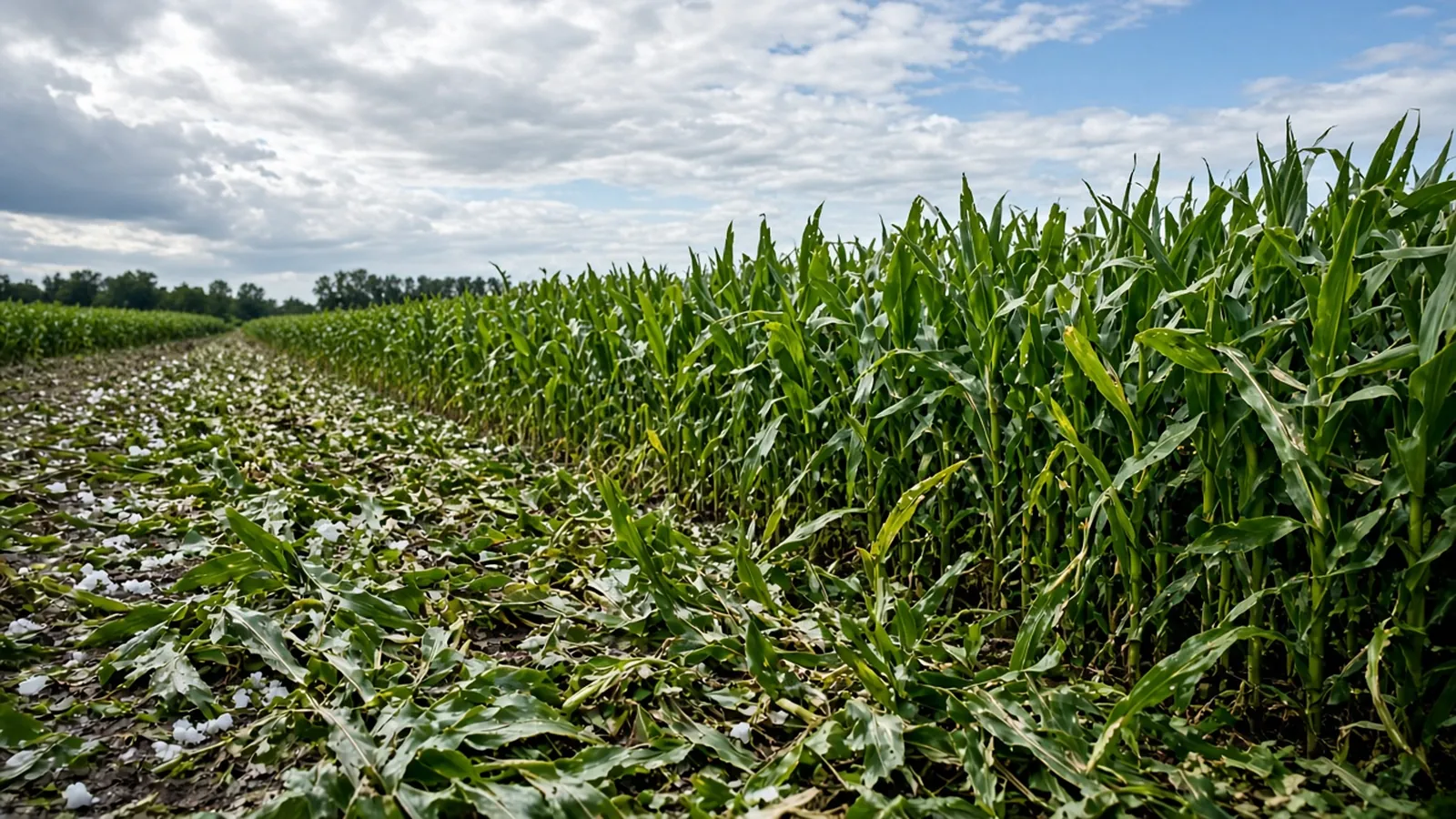
This is the question that brings people to comparison articles, and it is a fair one. MPCI losses are measured against the guarantee for the unit. If you carry an enterprise unit on 800 acres of corn and a hailstorm wrecks 40 acres, the other 760 acres can hold the unit average above the trigger. You have a real loss on those 40 acres and no MPCI cheque.
Private crop-hail insurance is written to fill that hole. It is not part of the federal programme, it is not premium-subsidized, and the price is set by the company, not by RMA. It is usually bought by the acre, often with a small deductible, and it pays for hail (and, in many forms, fire or transit) on the ground that was actually hit. In hail-prone counties, farms commonly carry MPCI as the base and add crop-hail on the acres they cannot afford to average away.
| MPCI (federal) | Crop-hail (private) | |
|---|---|---|
| Main job | Protect a yield or revenue guarantee on a unit against many named perils, including drought | Pay for hail (and often fire) on the specific field or acreage that was damaged |
| Drought, flood, freeze, disease | Generally yes, as the policy allows | Generally no |
| Premium subsidy | Yes, at published rates | No |
| Who sets the price | RMA (same rate, same coverage, any approved company) | The private insurer; shop and compare |
| When you can buy it | On or before the sales closing date, usually before planting | Often during the growing season, after a waiting period. Confirm with the issuer |
| Loss measurement | By unit, against a guarantee | Typically field-by-field or acre-by-acre |
Crop-hail is not a substitute for MPCI, and MPCI is not a substitute for farm property or liability cover on buildings, visitors or equipment. For those, see farm liability insurance for small farms.
3. Whole-Farm Revenue Protection, and who it is for
WFRP insures the revenue of the whole farm — crops, livestock and, subject to the policy, commodities you actually produce — rather than a yield on a single crop. It is built for farms that sell many things, or things that do not have a strong individual MPCI offering, including many fruit, vegetable and mixed operations.
The 2025 amendments raised the maximum WFRP coverage level from 85% to 90%. RMA has said the 90% level carries the same premium subsidy rates as the 85% level. Those changes apply to policies with a sales closing date on or after 1 July 2025. WFRP still leans on your tax records. If you are taking over a farm, you may be able to use a prior operator’s history in defined situations (including, in RMA’s WFRP FAQ, when you take over at least 90% of an operation and have permission to use those records). If you have no Schedule F and no predecessor history, WFRP can be hard to start in year one. That is a conversation with an agent, not a reason to skip MPCI or NAP (the Noninsured Crop Disaster Assistance Program, administered by FSA) if those are the tools that actually fit.
WFRP can sit alongside some individual crop policies, with rules about what can be double-insured. Do not assume you can stack everything. Have the agent map the farm as it really is: a CSA and two grain fields is a different file from 2,000 acres of corn and soybeans.
4. Beginning-farmer benefits (2026 crop year rules)
If you qualify as a beginning farmer or rancher, the federal programme now pays a larger share of the premium for a period of years, and it waives the administrative fee on CAT and buy-up policies. Under the rules RMA implemented after the 2025 Act, for policies with a sales closing date on or after 1 July 2025, the additional premium subsidy for beginning farmers is:
- 15 percentage points in the first and second crop years;
- 13 percentage points in the third year;
- 11 percentage points in the fourth year;
- 10 percentage points in years five through ten.
A beginning farmer, for RMA, is now defined around not having actively operated and managed a farm or ranch, with an insurable interest, for more than 10 crop years. Veteran farmers have a related but not identical benefit (an additional 10 percentage points, for fewer years). If you qualify as both, RMA’s basic provisions use the beginning-farmer (higher or equal) subsidy. You have to complete the Beginning Farmer and Rancher application with your agent, generally by the sales closing date, or the extra subsidy will not apply to that crop year.
Other BFR benefits that still matter: you may, with permission and if you were previously involved on the farm, use a previous producer’s actual production history on acreage transferred to you; and the substituted yield used in a yield adjustment is 80% of the transitional yield, rather than 60%.
5. A worked example (illustrative, not a quote)
Example. A farm has 600 acres of corn in one county, all in an enterprise unit, with a Revenue Protection policy at the 80% coverage level. A June hailstorm destroys 50 acres on the west side of the road. The remaining 550 acres are an average crop. When actual production is harvested, the unit average stays above the 80% revenue guarantee, so the MPCI policy does not pay. A crop-hail policy written on those 50 acres, if the farm had bought it, would be the policy that responds to the hail itself.
The same farm, if it instead grew vegetables on 40 acres and sold into a CSA, a wholesaler and a farm stand, might be a poor fit for a long list of tiny MPCI policies and a better candidate for WFRP, plus a conversation about liability cover on the farm stand. The grain example and the CSA example should not use the same insurance shopping list.

6. How to shop without wasting a closing date
- List the commodities, acres (or head), counties and legal descriptions you will actually farm this year.
- Find the sales closing date for each crop in each county in RMA’s tools, or have an agent pull them.
- Decide whether you want yield protection or revenue protection on crops that offer both, and whether enterprise units are worth the averaging.
- Ask, as a separate question, whether crop-hail is justified on some or all acres in your hail history.
- If you are diversified or a beginning specialty grower, ask whether WFRP or NAP fits better than a stack of individual policies.
- If you may qualify as a beginning or veteran farmer, complete that application before the closing date.
- File AD-1026 if it is not already on file.
Lenders on operating lines often expect MPCI on the mortgaged crop. If an FSA or Farm Credit operating loan is in your plan, ask the lender what assignment of indemnity they will require, so the policy and the loan are not fighting at claim time.
Common mistakes
- Waiting until after a storm to think about MPCI. The sales closing date has usually already passed.
- Assuming a neighbours’ hail cheque means your enterprise unit will pay too.
- Buying crop-hail and dropping MPCI, then taking a drought year with no federal policy.
- Missing the beginning-farmer application and leaving subsidy on the table for an entire crop year.
- Forgetting AD-1026 and losing the premium subsidy at billing.
Frequently asked questions
1. Why didn’t my hail damage trigger a crop-insurance payment?
If you only have MPCI, the loss is measured on the unit, not on the field that was hit. A local hail streak can be a bad day on 30 acres and still leave the unit above its guarantee. That is the situation private crop-hail is meant to cover. Read the loss on the production report, not on the windshield, and call your agent promptly so the adjuster can see the damage.
2. When is the sales closing date?
It depends on the crop and the county. Many spring crops in many Midwestern counties have used 15 March, but you should not rely on that date for wheat, perennial crops, or another state. Get the date from RMA or an agent for the crop year you are insuring.
3. Can I buy crop-hail after the season has started?
Often yes, from a private insurer, usually with a short waiting period. That flexibility is one of the points of the product. It is not a reason to delay MPCI past the sales closing date.
4. How does beginning-farmer status change the premium?
It waives the administrative fee and adds the extra subsidy percentages listed above for up to ten crop years, if you apply on time. It does not change the coverage level you chose, and it does not replace the need to file AD-1026.
5. Is WFRP useful if I am just getting started?
It can be, if you have (or can lawfully use) enough tax history to support a revenue guarantee, or if you are taking over an operation under the policy’s transfer rules. If you have almost no records, an agent may steer you toward individual policies, NAP, or a later WFRP application. Bring whatever Schedule F, invoices and production logs you have; do not assume a start-up has no path.
6. Do I still need farm liability or property insurance if I have crop insurance?
Yes. Crop insurance does not cover a visitor injured at a farm stand, a barn fire (except where a crop-hail form includes fire on the crop itself), or a tractor accident on the road. Those are separate policies.
Final thoughts
Buy the federal policy that matches how you actually farm, on time, with the unit structure you can live with in a bad year. Then ask, as a second and narrower question, whether a hail swath on your best ground would be an MPCI event or just a hole in the unit average. That second question is how a lot of farms decide on crop-hail. Everything else — WFRP, beginning-farmer subsidy, endorsements — should be built on that honest picture, with an agent who will still take your call in July.
Keep the production history insurance and lenders both ask for
LazAgro helps you record yields, inputs and sales by field or flock so you are not reconstructing a year from memory at claim or loan time.
Discover LazAgro