 LazAgro

Ask any market woman at Mile 16 or Mvog-Mbi how plantain prices have moved over the years and you will get a long answer. Demand keeps growing, and supply often struggles to follow. That gap is the opportunity in plantain farming in Cameroon. It is also why so many new plantain farms disappoint: people rush to plant whatever suckers they can find, and the weevils and nematodes come along for free.
Plantain is a staple across the South West, Littoral, Centre, South, East and West regions. It is boiled, fried as dodo, pounded, roasted, and processed into chips. Unripe bunches travel to every major town and across borders to Gabon and Equatorial Guinea. A well-managed plantation can produce for several years from the same mats.
This guide focuses on what decides success: clean planting material (including the PIF technique developed in Cameroon), field layout, soil cover, desuckering, pest control and marketing.
1. Why plantain farming in Cameroon is worth planning properly
Plantain fits smallholder farming well. It grows in the humid forest and highland fringes, it can be intercropped with cocoyam, maize or young cocoa, and once established it keeps producing as each mother plant is replaced by a follower sucker.
The challenge is that yields on many farms fall quickly after the first harvest. A CIRAD study on the spread of the PIF technique noted that plantain supply in Cameroon has not kept up with demand, and named the lack of healthy planting material as one of the main limits on production. Fix that, and you are already ahead of most of the market.
2. Choosing plantain varieties
Plantains in Cameroon are commonly grouped by bunch type:
- French types have many fingers per bunch and keep producing many hands. They are widely grown and well liked.
- Horn and False Horn types have fewer but larger fingers, which some buyers prefer for roasting and frying.
- Improved hybrids have been bred by research centres such as CARBAP for better tolerance to black leaf streak (black Sigatoka).
Talk to buyers in your nearest market before choosing. If traders in your area pay more for big-fingered bunches, that should guide your choice. The Centre Africain de Recherches sur Bananiers et Plantains (CARBAP) at Njombé, in the Littoral Region, is the regional reference for plantain varieties and planting material.
3. Planting material: suckers, PIF plantlets or tissue culture
Traditional suckers
Most farmers dig sword suckers (narrow leaves, wide base) from existing farms. They are cheap and familiar, but they carry whatever pests the mother farm had. If you use suckers:
- Take them from vigorous, healthy mats with no snapped or toppled plants.
- Prefer sword suckers over water suckers (broad leaves, small corm).
- Pare the corm: cut away roots and the outer layer until you see clean, white tissue. Discard suckers with many dark tunnels from weevils.
- Many extension programmes recommend dipping pared suckers in hot water (or boiling water briefly) to kill nematodes and weevil eggs. Get the exact method from your extension agent, because too much heat kills the sucker.
- Plant within a few days of paring.
The PIF technique: a Cameroonian innovation
PIF stands for Plants Issus de Fragments de tige (plants from stem fragments). CARBAP developed it in the 1990s to help farmers produce large numbers of clean plantlets without a laboratory. The method is described in a CORAF technical sheet and in CARBAP's research publications.
In simple terms:
- Small suckers are dug up, washed and pared to clean tissue.
- The leaf sheaths are removed to expose dormant buds, and the growing point is destroyed with a cross-shaped cut to wake those buds up.
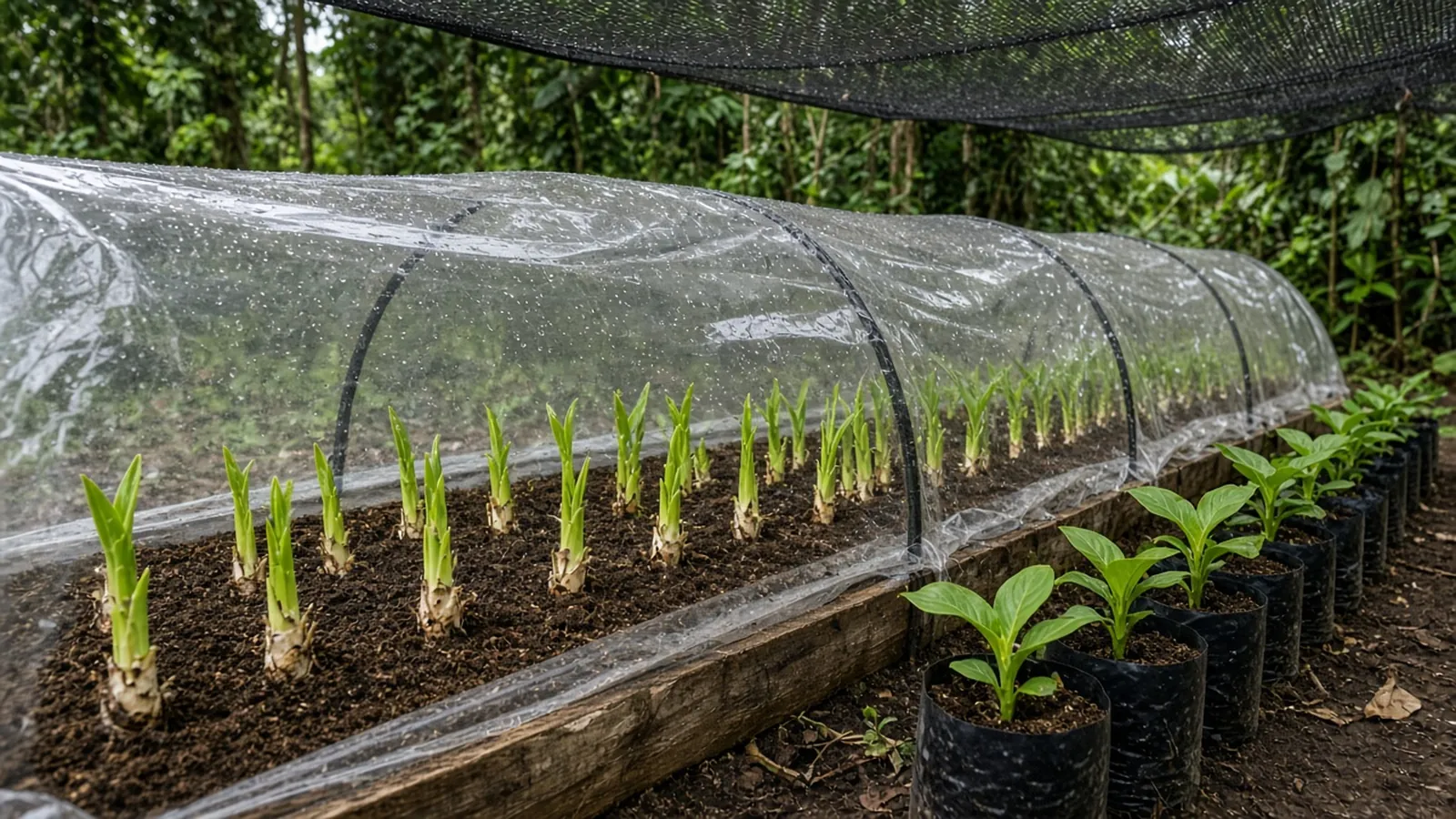
- The prepared corms go into a germinator, a raised bed filled with clean, moist sawdust, covered by a plastic tunnel to keep humidity and warmth high, under shade.
- After a few weeks, many shoots appear. Each is separated, potted in a nursery bag and hardened under shade before planting out.
The CORAF sheet reports an average of about fifty plants per corm in three to four months. Results vary with variety and skill. For a farmer planning a hectare or more, or someone who wants to sell plantlets as a business, PIF is worth learning properly through a training session with CARBAP, IRAD, an NGO or an experienced nursery operator.
Tissue-culture plantlets
Laboratory-produced plantlets are clean and uniform, but they cost more, need careful hardening and are harder to find in rural areas. They make sense for commercial farms with irrigation and good management.
If you already run or plan a nursery, many of the handling principles in our guide to starting a seedling nursery carry over: clean media, shade, regular watering and good records of each batch.
4. Choosing and preparing the field
Plantain likes deep, fertile, well-drained soil rich in organic matter, steady moisture and shelter from strong wind.
- Avoid waterlogged land. Roots rot and plants topple.
- Avoid fields recently in plantain or banana if they had weevil or nematode trouble.
- Forest fallow or land coming out of a long rest usually gives the best first cycles.
- Don't burn if you can avoid it. Leave cut vegetation as mulch.
Spacing
Common spacings range from about 2 m × 2 m to 3 m × 2 m. At 2.5 m × 2.5 m you get about 1,600 plants per hectare. Wider spacing suits intercropping; closer spacing gives more bunches per hectare in the first cycle but more competition later.
Planting holes
Dig generous holes, around 40–60 cm wide and deep. Mix topsoil with well-rotted manure or compost before planting. Set the sucker or plantlet upright and firm the soil around it.
5. Timing with the rains
Plant early in the rainy season so young plants establish while soil moisture is reliable. In the bimodal Centre and South, that means the start of either rainy season. In the monomodal South West and Littoral, plant early in the long rains. Plants that face their first dry season too small suffer badly unless you can water them.
6. Mulch, fertility and weeds
Plantain is a heavy feeder with shallow roots. Mulch is one of the cheapest ways to raise yields.
- Spread cut grass, crop residues and old plantain leaves around each mat, keeping a small gap from the pseudostem.
- Mulch keeps soil moist into the dry season, feeds soil life and suppresses weeds.
- Add compost or manure around mats each year. Our guide on how to make compost on the farm explains how to produce it cheaply.
- Weed carefully. Deep hoeing near the mat cuts shallow roots.
7. Desuckering and mat management
Each plantain mat produces many suckers. If you leave them all, they compete, bunches shrink and the field becomes a thicket.
- Keep the mother plant and one strong follower (sometimes two in later cycles).
- Remove extra suckers by cutting them at ground level and destroying the growing point.
- Choose followers on the same side to keep rows tidy.
- Remove dead and diseased leaves, and cut the male bud after the last hand forms.
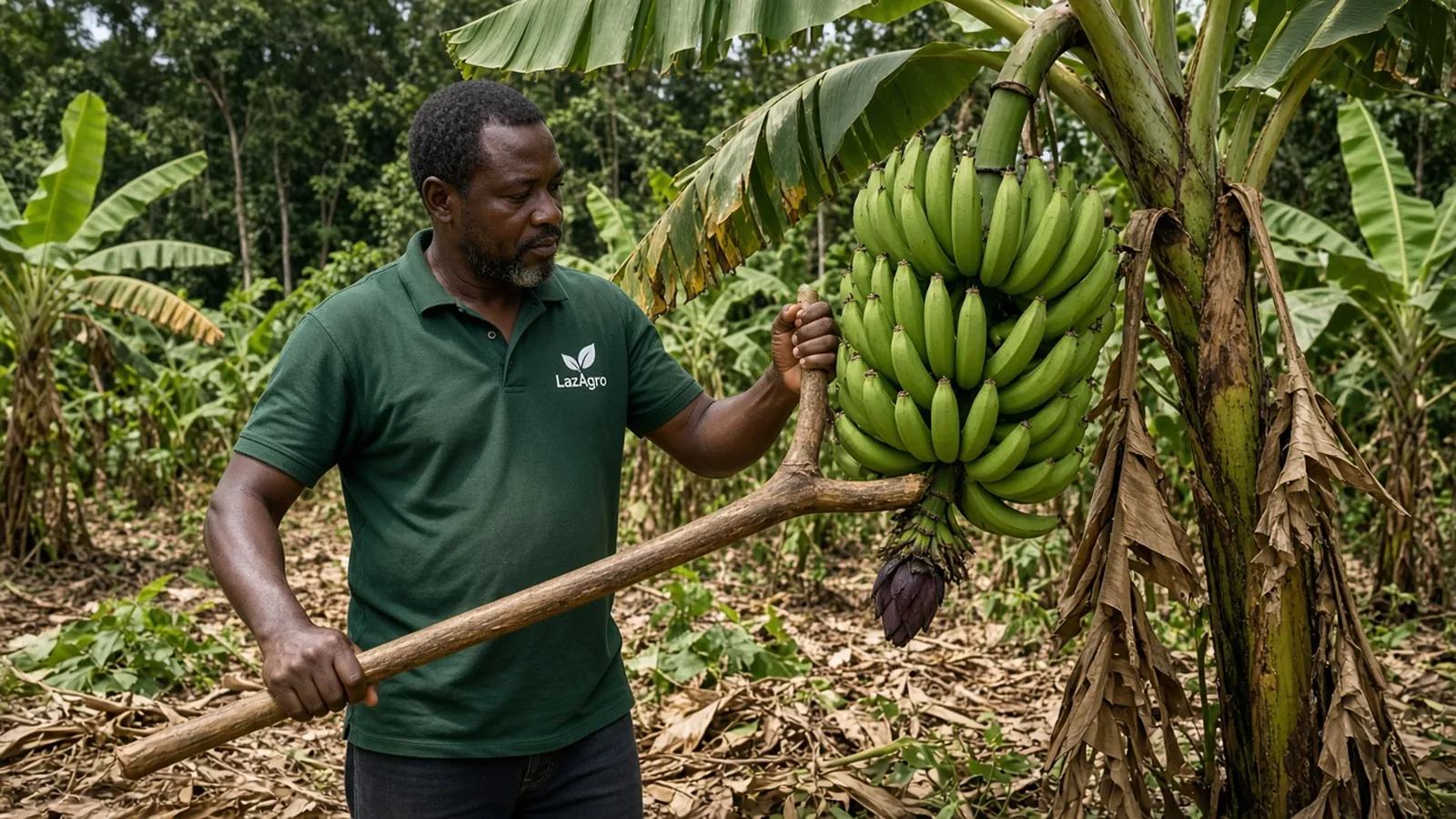
Plants carrying heavy bunches often topple in wind. Prop them with forked poles or tie them with string to neighbouring plants.
8. Pests and diseases
| Problem | What you see | Practical response |
|---|---|---|
| Banana weevil | Tunnels in the corm, weak plants, toppling | Clean planting material, field hygiene, chop old pseudostems after harvest, trapping with split pseudostem pieces |
| Nematodes | Poor root systems, toppling, small bunches | Paring and hot-water treatment, clean plantlets, rotation, organic matter |
| Black leaf streak (black Sigatoka) | Dark streaks on leaves, spreading to large dead patches | Remove badly affected leaves, good spacing and drainage, tolerant hybrids where available |
| Banana bunchy top (where present) | Bunched, narrow, upright leaves | Uproot and destroy infected plants; report to agricultural services |
9. Harvesting and selling bunches
Harvest when the fingers have filled out and lost their sharp angles, but before they ripen on the plant. Cut the bunch carefully, ideally with two people so it does not fall and bruise. Cut down the harvested pseudostem and chop it into pieces to reduce weevil breeding.
Getting a better price
- Know the market calendar. Plantain prices change through the year as supply rises and falls. Record what you are offered each month so you learn your local pattern.
- Sort by size. Large, clean bunches fetch more. Selling all bunches as one lot hides your best fruit.
- Handle with care. Bruised fingers ripen and spoil faster.
- Sell suckers and plantlets. A clean plantation is also a source of planting material for neighbours.
- Process surplus. Plantain chips are a growing product in towns.
11. Intercropping and mistakes to avoid
What grows well with plantain
In the first months, before the canopy closes, the space between plantain rows can carry a short crop. Maize, groundnut, egusi, cocoyam and vegetables are all common. Many farmers in the South West and Centre also use plantain as temporary shade for young cocoa, which gives income while the cocoa establishes. Keep intercrops away from the base of the mats and avoid crops that need deep digging near plantain roots.
Mistakes that shorten a plantation's life
- Buying suckers from a roadside pile without knowing which farm they came from.
- Skipping paring because it "wastes" part of the sucker. That outer layer is where weevil eggs and nematodes hide.
- Leaving every sucker to grow. Overcrowded mats give small bunches and more disease.
- Leaving harvested pseudostems standing. They become breeding sites for weevils.
- No mulch in the dry season. Shallow roots dry out, and bunches fill poorly.
- Selling on the farm without knowing the town price. A quick call to a contact in the nearest market before a buyer arrives helps you negotiate.
A plantation that starts clean and is kept clean can produce well for several cycles. One that starts dirty often needs replanting after the first or second harvest, which doubles your cost of planting material.
12. Keeping records for a plantain farm
Plantain is a long-cycle crop, so memory is not enough. Record planting date and source of material for each block, fertiliser and manure applied, pest problems and treatments, bunches harvested, and sale prices. After two or three cycles you will know which block, variety and material source paid best. Our guide on keeping accurate farm records is written for livestock, but the same habits apply to crops. The LazAgro app keeps these records on your phone even in fields with no network, and syncs them later.
Frequently asked questions about plantain farming in Cameroon
1. How long does plantain take to produce a bunch?
The first bunch usually comes roughly a year or more after planting, depending on variety, material and growing conditions. Follower suckers produce the next bunches.
2. What is the PIF technique?
PIF (Plants Issus de Fragments de tige) is a method developed by CARBAP in Cameroon to multiply many clean plantain plantlets from small suckers using a humid sawdust germinator, without a laboratory.
3. Why do my plantain plants fall over?
Toppling is often caused by weevils and nematodes damaging the corm and roots, made worse by wind and heavy bunches. Clean planting material, hygiene and propping help.
4. How many plantain suckers do I need per hectare?
It depends on spacing. At 2.5 m × 2.5 m you need about 1,600 plants per hectare. Add a few extra to replace failures.
5. Where can I learn the PIF technique?
CARBAP at Njombé, IRAD, agricultural training centres and several NGOs run PIF training. Hands-on practice with an experienced nursery operator is the fastest way to learn.
Final thoughts
Plantain rewards patience and cleanliness. Clean material, generous planting holes, thick mulch and disciplined desuckering will do more for your yield than any expensive input. Start one well-kept block, learn its rhythm, and expand with plantlets you produced yourself.
Track every block, from sucker to bunch
LazAgro helps you record planting dates, inputs, harvests and sales for each field, even without network.
Discover LazAgro