 LazAgro
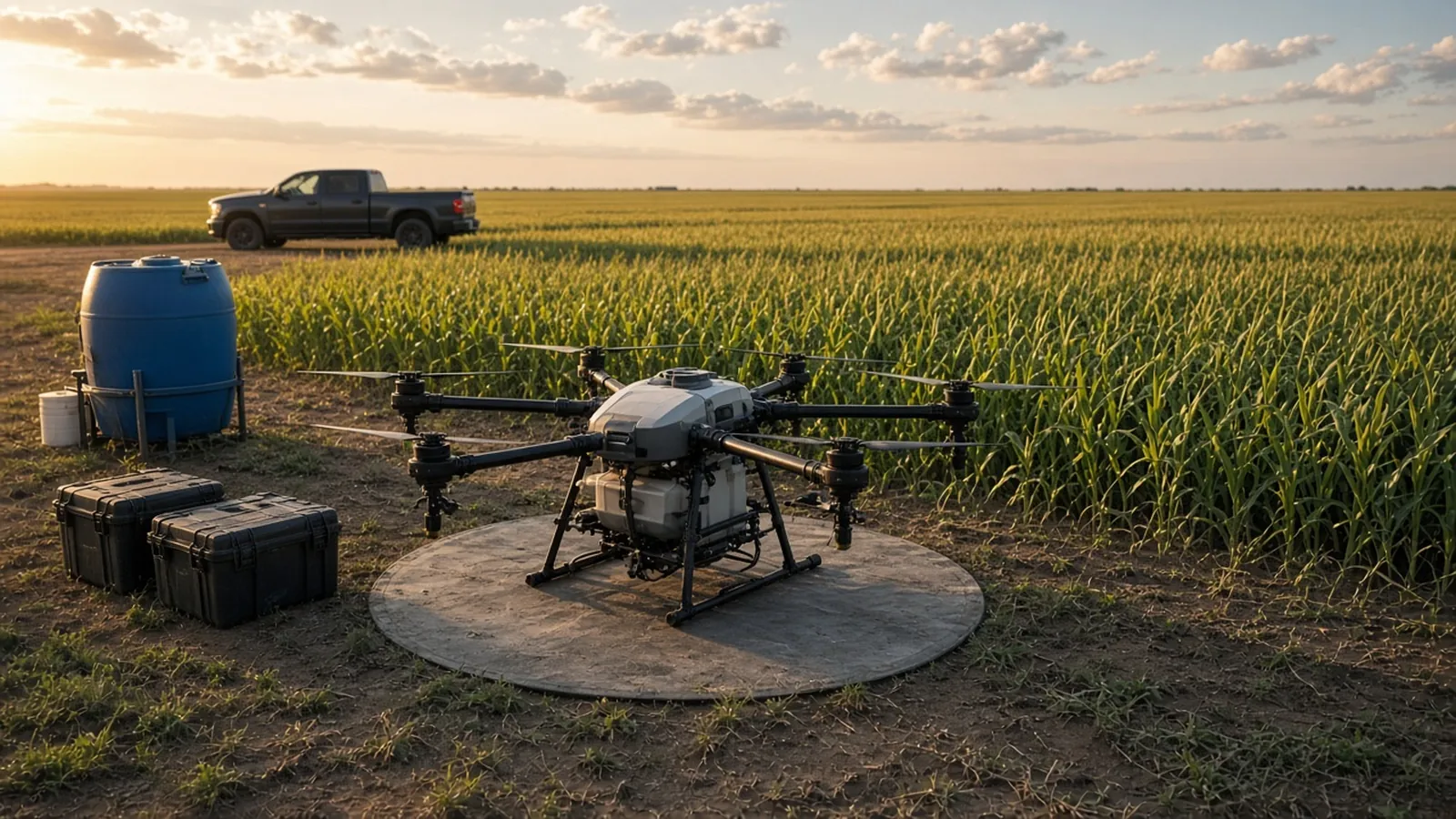
The question farmers actually ask, sometimes in these exact words, is whether it is cheaper to hire a spray drone or to buy one. The honest answer depends on acres, on how often the ground is too wet for a boom, and on costs that do not appear in a hardware advertisement: licences, insurance, batteries, a second set of tanks, and the days the aircraft is on the bench. A university cost study and a couple of blunt r/farming threads are a better starting point than a product launch video.
This guide is for commercial farmers in the United States, Australia and Canada (with notes that will still help in the United Kingdom) who are trying to do that arithmetic. It is not a review of a current drone model, and it is not advice to spray without the licences your country requires.
Last checked: November 2026. Hardware prices, aviation rules and pesticide labels change. Figures from University of Missouri Extension publication G1274 and from farmer discussions are attributed and should be read as planning aids, not as your cost. This is general information, not aviation, pesticide or financial advice.
1. What a spray-drone system really costs to own
A farmer on r/farming who asked when to hire versus buy was told that a DJI Agras-class system was, at that time, a $30,000–$50,000 decision before you were ready to spray, and that the licence path included at least a Part 107 remote-pilot certificate plus additional approvals for spraying and for heavier aircraft. Another 2025 thread put a spray drone “just shy of $40,000 CAD” for the aircraft alone. Those are operator reports, not a price list, and list prices have moved since some of those posts. Use them only as a warning that the aircraft is a mid-five-figure item, not a gadget, and then get a current quote that includes batteries, a charger, a generator or a field power plan, spare props, a transport case or trailer, and a second tank if you will mix at the edge of the field.
The costs that decide the per-acre number are often not the airframe:
- Licences and ratings. In the United States, a remote pilot certificate under FAA Part 107 is the usual starting point, and applying agricultural products from an aircraft is a further regulatory step (including FAA and state pesticide-applicator rules). Australia, Canada and the UK have their own aviation and chemical rules. Budget the courses, the exam time, and the renewals, not only the first licence fee.
- Insurance. Hull cover for the aircraft, and liability for a spray job gone wrong, are not optional extras if you are spraying other people’s land, or your own land next to a neighbour’s crop. Ask an aviation or agri-liability broker, not only the farm mutual that insures the barn. See also farm liability — a standard farm policy may not automatically include unmanned spraying.
- Batteries, time and downtime. Cycle life, a spare set, and a wet morning when you cannot fly all eat acres. Ground rigs have downtime too; drone operators in the January 2025 r/farming thread “Let’s talk about the Drones” were still much slower than a large boom on a dry day.
- Labour. A two-person crew is common: one flying, one mixing and watching the site. Your labour, or a hired technician, belongs in the cost, as G1274 is careful to do in a proper enterprise budget.
2. What hiring costs, and when the ground rig is still better
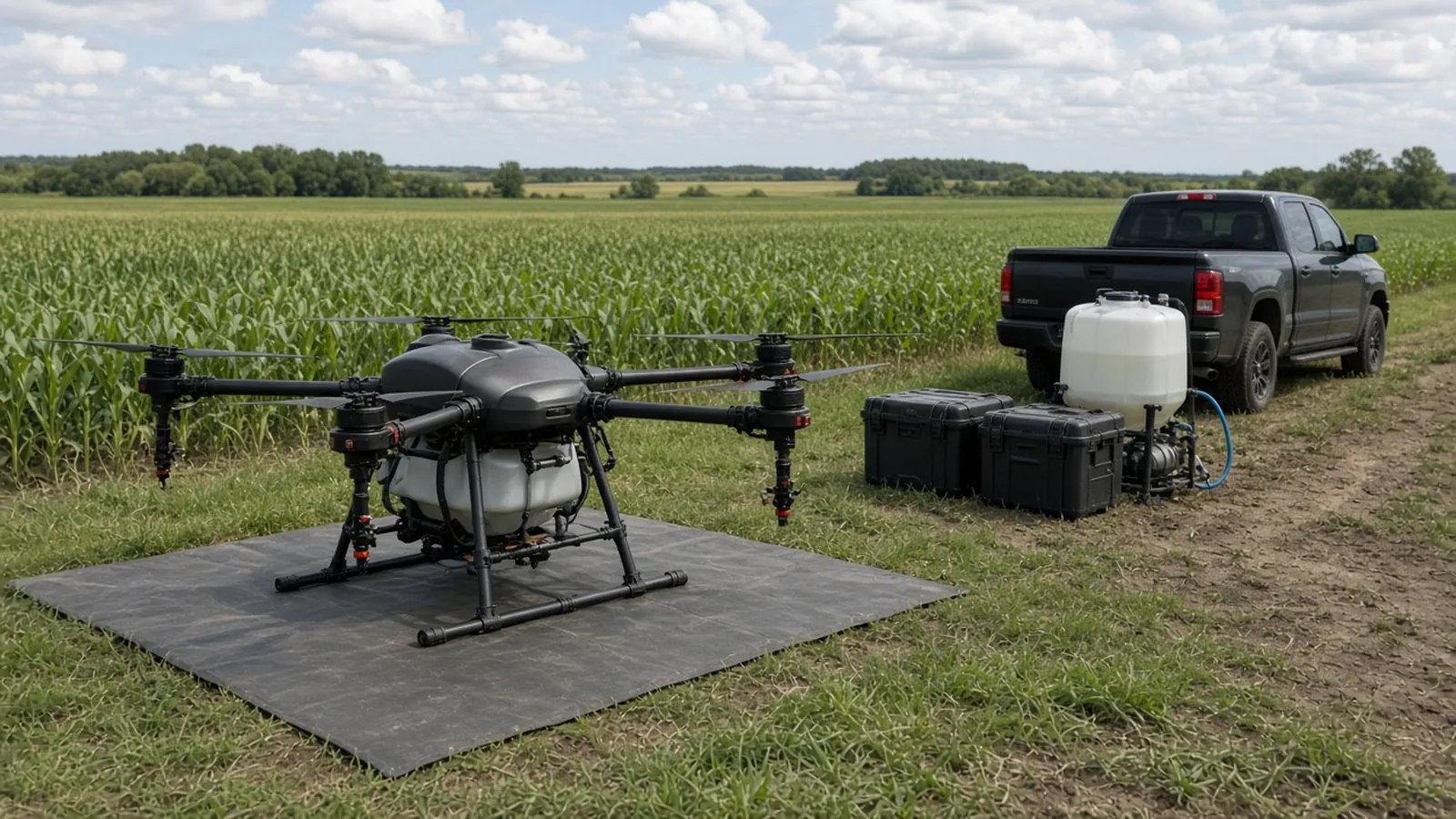
Custom drone application is priced by the acre and by the product, and it varies with travel distance, acreage, and whether the operator is already in the neighbourhood. Ask for a written rate, a minimum job size, and who holds the pesticide licence. Local aerial applicators who already fly helicopters or aeroplanes sometimes add drones for awkward or wet ground; they may be a more dependable phone call than a new operator with one aircraft.
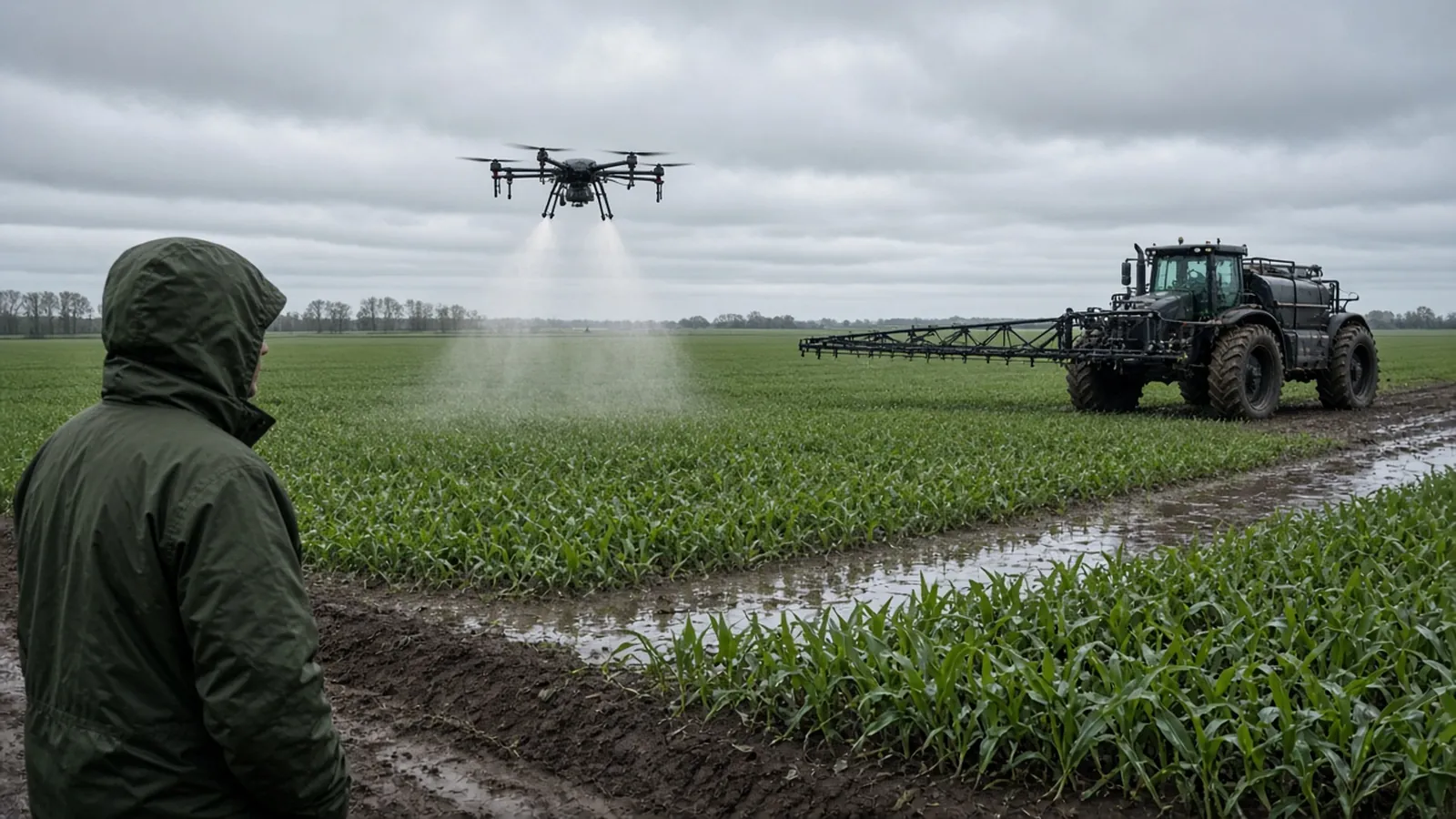
The 2025 r/farming discussion was blunt about speed. One farmer, on fields of 35–50 acres, said they could spray 800–1,200 acres a day at 15 gallons per acre with a 90-foot boom, and that drone operators they had spoken to talked about 200 acres a day if the fields were close — and that even that was optimistic. Another comment, more optimistic about drones, said a local operator covered about 40 acres an hour, and that a $40,000 drone could still pay out faster than a $600,000 sprayer and a nurse truck, especially in rice or in wet no-till ground where a boom would rut the field. Both can be true: a boom wins on a dry, open day; a drone (or a helicopter) wins when the ground will not carry a machine and the crop cannot wait.
If you already own a well-set-up sprayer, the first question is not “drone or boom” as a religion. It is “how many acres a year do I fail to spray on time because of wet ground, awkward trees, or a small field the boom is a poor tool for?” Those acres are the ones to cost against a custom operator first. Buying an aircraft to feel modern, while the boom sits in the shed, is how money disappears.
3. Using G1274 without pretending it is your farm
How to use the Missouri numbers. G1274 put total ownership cost at $12.27 an acre for a farmer and $7.39 an acre for a custom operator, under the paper’s assumptions, with a break-even around 980 acres a year for a farmer compared with hiring. If you spray 200 acres a year, ownership is unlikely to win on cost alone, and a custom operator — at whatever rate you are actually quoted — is the default. If you spray 1,500 acres a year of work that a drone is actually good at, the ownership case is at least worth a spreadsheet. Put your quoted aircraft cost, your insurance, your labour and your real custom rate in a sheet, and see where the lines cross. If you only reach the 980-acre world by inventing work, you do not have a case. You have a hobby aircraft.
Spot-spraying weeds, covering a wet hole, and treating a small or obstructed field are the jobs where drone operators keep getting hired even when the per-acre cost is higher than a boom. Broad-acre fungicide on dry, open ground is the job where the boom, or a traditional aerial applicator, will usually still be the cheaper and faster tool. Insect pressure that will not wait, which our fall armyworm notes illustrate in a different climate, is the sort of time pressure that can justify a more expensive pass — if the licence and the label allow the product to go on from the air.
4. A practical decision order
- List the acres, the crops, and the jobs a drone would actually do this year, including wet-year acres you missed last time.
- Get a written custom rate from a licensed operator, with a minimum charge and an availability note for your peak week.
- If you are still tempted to buy, get a full kit quote, an insurance quote, and a clear list of licences you must hold in your country.
- Run the G1274-style per-acre arithmetic with those quotes, including labour and a downtime allowance.
- Only then compare the result with keeping or upgrading the ground sprayer, or with a traditional aerial applicator for the big week.
A compact tractor and a boom are still, for many small farms, the first spray investment that makes sense; see the compact tractor cost guide if you do not yet have a way to carry a sprayer at all. A drone will not replace a machine you have not yet justified.
5. Labels, drift and being a neighbour
Not every product in the shed is labelled for aerial or unmanned application, and not every labelled rate is a rate you can legally apply from a drone. Read the label, and have the operator show you the label too if you are hiring. A cheap job that is off-label is not a cheap job. Buffer zones, bee clauses, water courses and organic neighbours do not become optional because the aircraft is small.
Drift is the complaint that will follow you down the road. Drones can apply a finer spray and can work closer to a boundary than a high boom, which is either an advantage or a hazard, depending on the wind and the nozzle. Set a personal wind limit that is stricter than “the aircraft can handle it,” keep a log of wind and temperature, and tell a neighbour with a sensitive crop before you treat a shared fence line. If you are the customer, ask the operator what they will do if the wind comes up mid-job, and who pays for a drifted field. Put that in the short written booking, along with the product, the rate, the map and the date.
Safety around the take-off site is the other quiet cost. Livestock, bystanders, overhead lines and a public road are all good reasons to walk the site before a blade turns. A generator, a mix tank and a charged battery on a tailgate is a workplace. Treat it as one: gloves, a spill kit, clean water, and one person whose only job is to watch the aircraft and the site, not to scroll a phone. A crashed machine is an insurance event and a chemical event at the same time. Have a number for the broker and a plan for the tank, not only a plan for the flying.
If you hire, ask to see proof of insurance and of the licences on the day, not only a website badge. If you own, diary the renewals the way you diary a sprayer inspection. Aviation and pesticide credentials lapse. A farm that treats those dates casually will eventually treat a field illegally, which is a worse outcome than a late custom booking.
Common mistakes
- Comparing an aircraft sticker price with a custom per-acre rate, and forgetting licences, insurance and batteries.
- Assuming you can fly and spray on a neighbour’s field on a Part 107 certificate alone, without checking agricultural and pesticide rules.
- Buying to spray 1,500 acres and then discovering the useful drone work on your farm is 120 acres of wet corners.
- Ignoring the boom you already own, which is still the right tool on a dry day.
- No plan for a crashed aircraft, a chemical spill, or a week of wind.
Frequently asked questions
1. Should I buy a spray drone or hire a service?
Hire first, unless you already have the acres, the licences and a spreadsheet that beats your quoted custom rate after insurance and labour. G1274’s planning threshold was about 980 acres a year under its assumptions. Your threshold will follow your quotes.
2. What does a spray drone cost, fully loaded?
Farmer reports in recent years have often put a ready-to-work kit in a wide band of tens of thousands of dollars, plus licences, insurance and spares. Get a current, itemised quote. Do not use a two-year-old forum figure as a bid.
3. How many acres can a drone spray in a day?
It depends on the aircraft, the rate, the field layout and the battery plan. In one 2025 farmer discussion, 200 acres a day was described as an optimistic operator figure, and 40 acres an hour as a local-custom figure. A large boom can still do several times that on a dry day. Ask an operator for a realistic number on your fields, not a marketing maximum.
4. When is a ground sprayer still better?
On dry, open fields, at higher water rates, when you already own a well-set-up boom, and when a tight weather window needs hundreds of acres in a day. Drones compete when the ground is wet, the field is awkward, or you only need a targeted pass.
5. What licences do I need?
In the US, plan on at least a remote-pilot certificate and on the additional aviation and pesticide-applicator requirements for agricultural spraying. Other countries have their own packages. Confirm with the aviation authority and the pesticide regulator, and do not spray a word of product until both are satisfied.
6. Can I pay for a drone with a farm loan?
An equipment or operating loan can sometimes finance machinery of this kind, if the lender understands the asset and the insurance. That is a credit decision, not a reason to buy. See Farm Credit versus FSA versus a bank for the lending doors, and take a full cost sheet, not a brochure, to the meeting.
Final thoughts
A spray drone is a specialist tool with a specialist cost structure. Let a custom operator, or G1274’s kind of arithmetic, prove the job before you buy the aircraft. If the useful work on your farm is wet corners and awkward edges, hiring may be the whole answer. If you truly have the acres and the licences, own the system as a business, with insurance and a depreciation line, not as a toy that happens to hold a tank. Re-run the sheet after the first season with the acres you actually flew, the hours you actually spent, and the repairs you actually paid for. A lot of aircraft look justified in February and expensive in November, once the wind days and the battery replacements are on the page. That second sheet, not the first, is the one that should decide whether you keep the aircraft, sell it, or go back to hiring.
Record the acres, the product and the weather, whoever flies
LazAgro helps you keep application and crop records so a custom invoice or an ownership log can be checked against what actually happened in the field.
Discover LazAgroSources and further reading
- University of Missouri Extension, G1274, Economics of Drone Ownership for Agricultural Spray Applications
- r/farming, “Drones spraying - when is it most cost effective to hire out a drone spraying company vs doing it your self?” and “Let’s talk about the Drones” (January 2025), used as evidence of the questions and of operator-reported prices and work rates, not as a specification.