 LazAgro
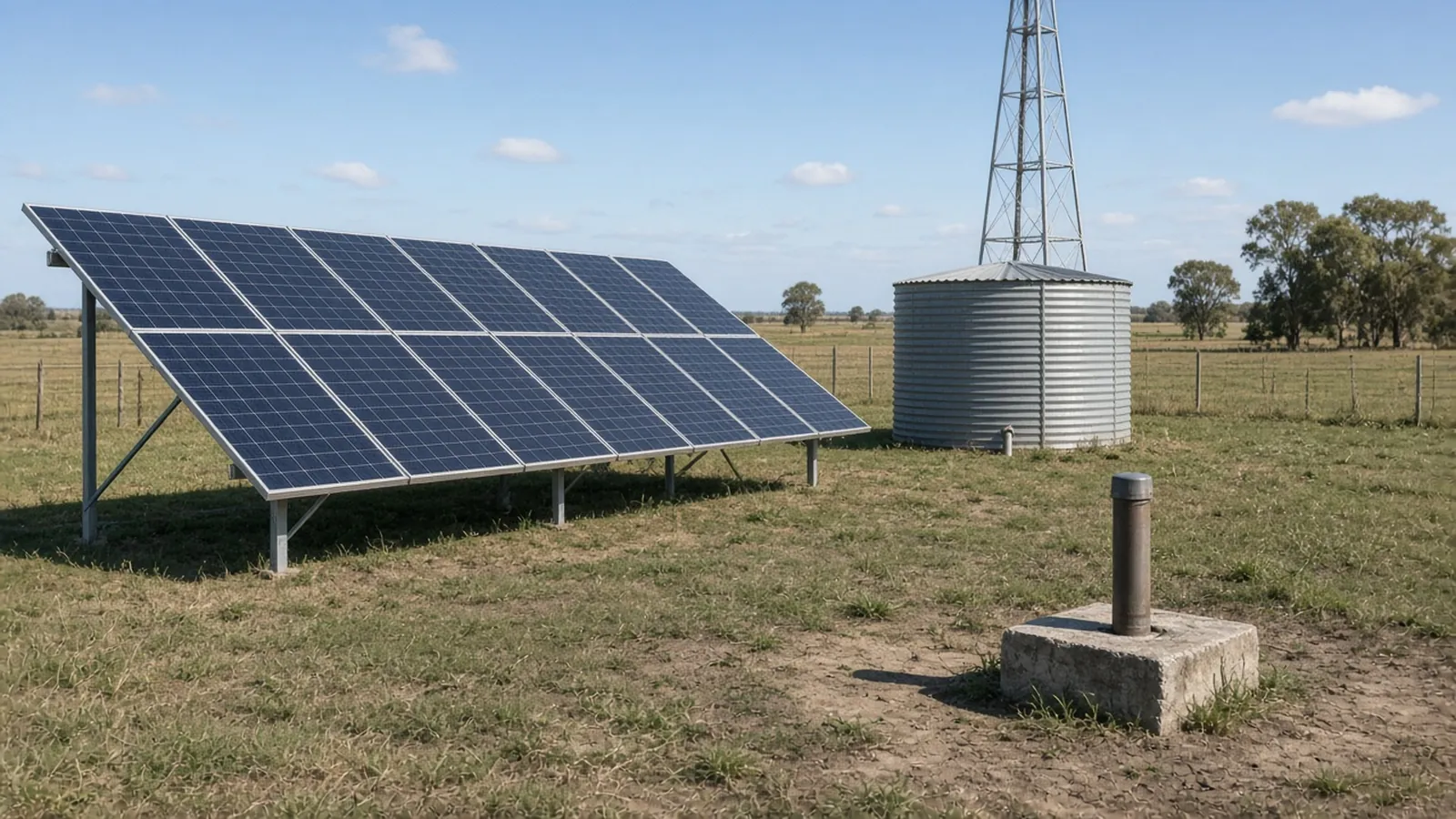
A solar pump is not a panel with a hose on it. It is a system: well or surface source, pump, controller, enough array to run that pump in the hours of sun you actually get, and, in almost every homestead and livestock setup that works, a tank that stores water so you are not trying to sprinkle at noon or go dry at dusk. The questions people ask in off-grid, SolarDIY and farming threads are nearly always about sizing and payback, not about which brand of panel is fashionable.
This guide is for farmers and rural landholders in the United States and Australia first, and it will still help in Canada and in sunnier parts of the United Kingdom, who want to water livestock, fill a tank, or run drip irrigation without depending entirely on a diesel engine or a weak grid line.
Last checked: November 2026. Hardware prices, utility rates and grant rules change. The figures below are either sourced, or clearly labelled as examples or as one operator’s reported experience. Have a pump dealer or a solar installer run the sizing for your well before you buy. This is general information, not engineering or financial advice.
1. What a farm solar pump system actually includes
A working setup is usually:
- a source — a well or bore, a creek, a pond, or a storage already filled by another pump;
- a pump — submersible in a well, or a surface pump if the source is open and the suction conditions allow it;
- a controller, often with maximum power-point tracking (MPPT), so the pump sees a usable voltage as the light changes;
- an array, mounted where it will not be shaded at mid-morning in winter;
- protection — a well-level probe or a dry-run device, fusing, earthing, and a way to stop the pump when the tank is full;
- storage — a tank or a trough large enough to carry you through a cloudy spell and through the hours of darkness;
- the delivery side — pipe, a filter if you are on drip, and valves that can stand the pressure the pump actually produces.
Batteries are optional. Many irrigation and livestock systems do not use them at all: they pump to a tank and stop. Batteries add cost and maintenance. They make sense when you must pump at night or when the load is not water. Do not add a battery bank because it feels more “off grid” if a tank would do.
2. A sizing worksheet you can actually fill in
Write numbers in a notebook before you talk to a supplier. If a number is a guess, label it as a guess.
- Daily water need, in gallons or litres. Livestock: use a published livestock-water figure for the species and climate, then add a margin. Irrigation: crop, area, and a reasonable daily depth (for example, a drip block that needs the equivalent of 4–6 mm on a hot day). Greenhouse and tunnel crops do not share rainfall; they can need a planned volume every clear day. If you also run a house from the same well, include that.
- Days of storage you want. Two to three days is a common starting conversation for livestock tanks. Irrigation from a tank can be planned around one to two days if you can skip a watering in dull weather, or more if you cannot.
- Tank size. Daily need times days of storage, plus a little freeboard. This is often the item people under-buy.
- Total dynamic head. Vertical lift from the pumping water level in the well to the tank inlet, plus friction in the pipe, plus any extra pressure you need at the tank or filter. Head is not “the depth of the well” alone. A 60-metre bore with the water standing at 25 metres and a tank on a hill is a different pump from a 60-metre bore that has water at 8 metres and a tank beside the well.
- Flow rate. Daily volume divided by the hours of useful sun you will actually pump. In many mid-latitude farm settings, people plan around 4–6 peak-sun-hours in the poorer months, not the July brochure figure. If you need 4,000 litres a day and you only have five good pumping hours in April, you need a pump that can do 800 litres an hour at your head, not at zero head.
- Array size. The pump curve and the controller will dictate wattage. Leave a margin for heat, dust, wire losses and a few years of panel ageing. Mounting facing true north in Australia or true south in the US, at a tilt that favours the season you most need water, matters more than a small difference in panel brand.
Illustrative sizing only. A paddock tank needs about 2,000 litres a day for cattle in summer, and the owner wants three days of storage: a tank of at least 6,000 litres. The pumping water level is 28 metres down, the tank inlet is 6 metres above ground, and 100 metres of pipe adds the equivalent of a few more metres of head. The installer might be looking at a total head in the mid-30s of metres and a pump that can move roughly 400–500 litres an hour over a five-hour solar day. The array is then sized to that pump at that head, not to a round number of panels that “looks enough.” Your well log and a measured pumping level replace every number in this paragraph.
3. Payback: diesel, grid, and when solar is not cheaper
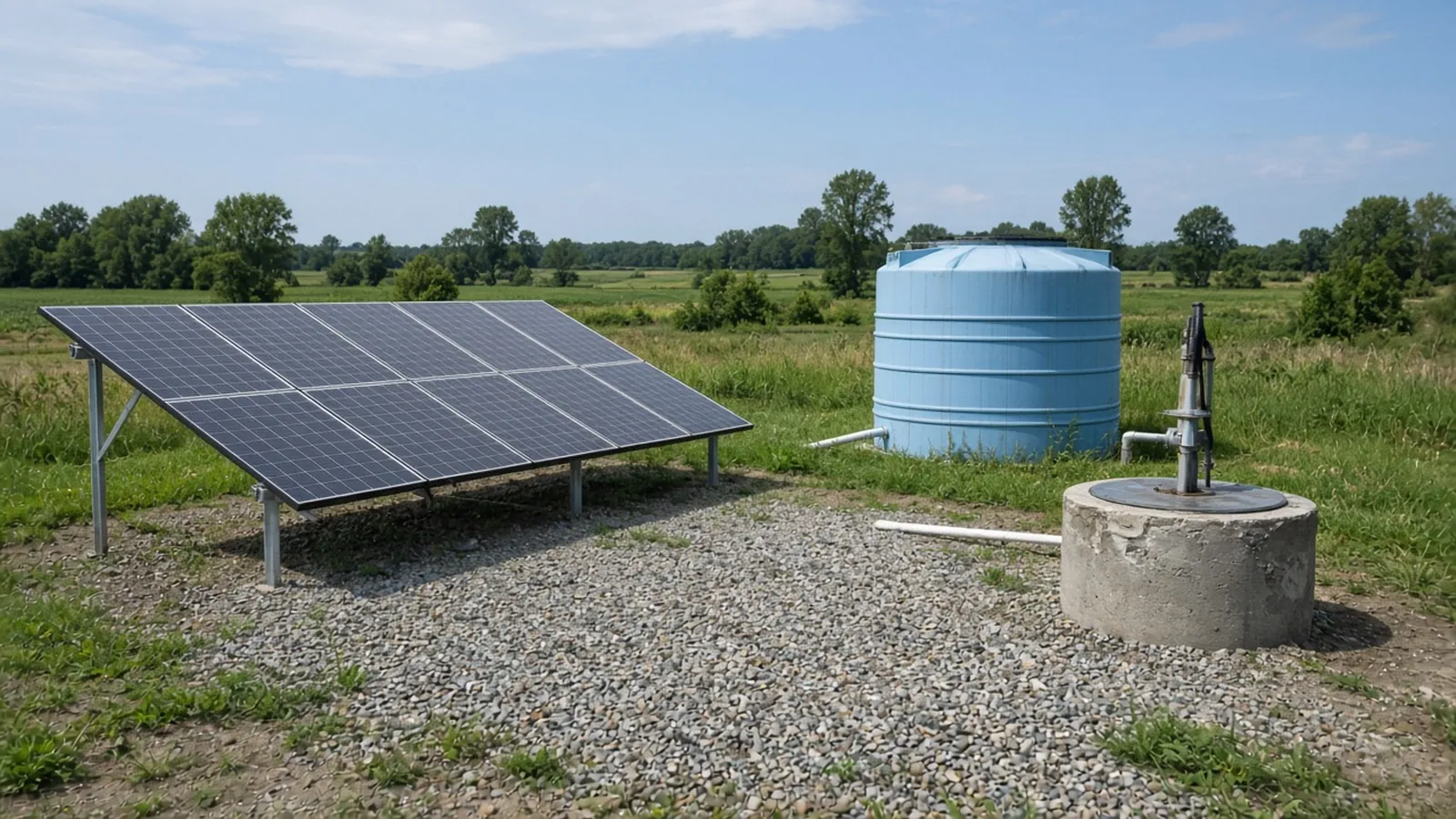
Payback is a local arithmetic problem. A diesel pump costs fuel, travel to refuel, and engine maintenance, and it is usually easy to beat with solar if you already haul fuel to a remote paddock. A grid-connected pump on a cheap, reliable tariff is harder to beat, especially if the well is deep and you would need a large array.
One detailed write-up on r/farming, from an operator who published their own irrigation figures, reported a payback of about six years replacing a diesel irrigation pump, and about eleven years when solar was only supplementing an existing electric pump. That is one farm’s arithmetic, from an older thread, not a rule for 2026. Fuel prices, diesel-service costs, your tariff, and whether you already own a working electric pump will move the result by years.
Solar is usually a weaker idea when:
- the well already has a reliable electric pump on a modest tariff, and the panels would only trim a small bill;
- you must have high pressure at all hours and you do not want a tank;
- the site is heavily shaded, or high-latitude winter sun will not meet a winter livestock demand without a very large array or a backup;
- the well cannot yield the flow you are planning, which is a well problem, not a solar problem.
It is usually a stronger idea when the alternative is a diesel engine a long way from a road, or a new hook-up that would cost you a utility extension measured in tens of thousands. Get a written cost for the extension before you compare.
4. Irrigation, livestock, and tunnels
Livestock watering is the most forgiving solar job on many farms: a tank, a float, and a modest daily volume. Drip irrigation can work well if you pump to a tank or a header and then use gravity or a small pressure pump to feed the laterals, with filtration. Trying to run a sprinkler gun directly off a solar pump, with no storage, is the setup that disappoints people in SolarDIY threads, because the pump output swings with every cloud.
High tunnels and greenhouse beds, as in our hoop house and EQIP high tunnel guide, do not receive rainfall on the crop. Plan the water as part of the structure, not as an afterthought. Vegetable ground that already needs reliable water — tomatoes and potatoes are the obvious examples in our production guides, including tomato production — will punish a system that only works on clear afternoons.
5. Money: ordinary finance, and USDA REAP in the United States
Hardware can be paid for in cash, with an equipment loan, or, for qualifying US agricultural producers, as part of a farm operating loan. There is also the Rural Energy for America Program, which is the main federal energy programme people mention in the same breath as farm solar. The rules for REAP changed in October 2026, and grant applications were not being accepted when we checked the official Rural Development page in November 2026, though guaranteed loans could still be submitted. Read the current status in our REAP farm-solar guide before you count on a grant to shrink the payback.
6. Installation, the well, and staying safe
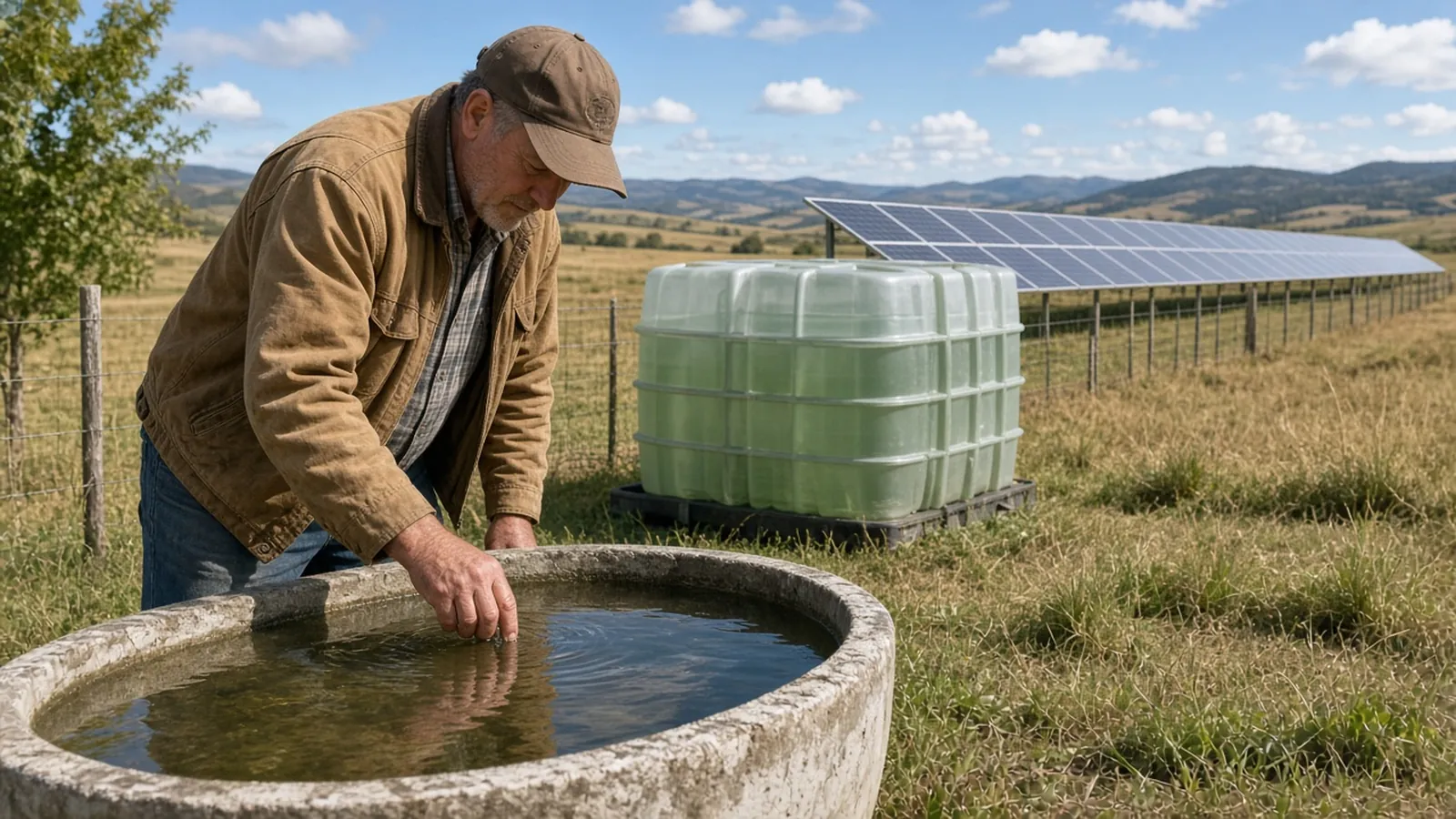
If the source is a well, get the well log and, if you can, a recent pumping-level measurement. A solar pump cannot fix a bore that will not yield. A simple test — running the existing pump and watching the water level and the recovery — is worth more than a catalogue curve. If you do not have an existing pump, a well contractor can test yield. Do not let an enthusiastic panel seller skip that step.
Pipe size is a frequent disappointment. Undersized pipe on a long run steals head and can make a correctly chosen pump look “weak.” Ask the installer to include friction in the head calculation, and to specify a pipe diameter in writing. On drip systems, put a filter that you will actually clean where you can reach it, and a pressure-relief or a bypass so a closed valve does not abuse the pump.
Electrical work on arrays and well heads should meet the code that applies in your country, including earthing and a way to isolate the array. Lightning and damp well pits are a bad mix with casual wiring. If you are not qualified, hire someone who is. Keep the array where a loader tractor will not back into it, and where livestock cannot rub a junction box off a post.
Once the system is running, write down the tank level at dusk for a couple of weeks in the season you care about, and a note on the weather. If the tank is falling through a string of dull days, you have a storage or a winter-sun problem, not necessarily a broken pump. That log is also what you would want if you later apply for a US energy-loan file, or if you simply need to tell the next installer what the system actually does.
Common mistakes
- Buying panels first and asking what pump they will run afterwards.
- Using the depth of the well as if it were the pumping head.
- Omitting a tank, then blaming the pump for not running sprinklers at dusk.
- Ignoring filtration on drip systems, then blocking every emitter in a week.
- Assuming a federal grant is automatically available to cut the cost in half.
Checklist
- I know my daily water need, in writing, for the driest month I care about.
- I know, or will measure, the pumping water level and the height of the tank inlet.
- I have chosen a storage volume in days, not just a pump brand.
- I have a dry-run and a tank-full stop, not only a hopeful on/off switch.
- I have a backup plan for a long dull spell (a generator plug, a grid fallback, or enough storage).
- If I am in the US and hoping for REAP, I have read the current Agency status, not an old blog post.
Frequently asked questions
1. Can I run the pump only in daylight if I have a tank?
Yes. That is the standard design for livestock and for many drip systems. Size the tank for the dull days, not for a brochure afternoon.
2. How do I size the panels?
From the pump’s need at your total head, in the sun hours of the month that matters, with a margin for dirt and heat. A supplier should show you that calculation. “Four panels ought to do it” is not a calculation.
3. Solar versus diesel versus the grid — which pays back faster?
Diesel at a remote paddock is often the easiest comparison for solar to win. A cheap, reliable grid pump is often the hardest. Use your fuel invoices or your kWh rate, include service and travel, and be honest about whether you already own a working electric pump. One published farmer-reported example landed around six years versus diesel and around eleven years as a grid supplement; your numbers will differ.
4. Will it work in cloudy weather?
It will work less, or not at all, in heavy cloud. That is what the tank is for. In a long dark spell you need either more storage or a backup source. High-latitude winters are a design constraint, not a surprise.
5. Do I need batteries?
Not for many water systems. Use a tank unless you have a clear reason to pump at night or to run other loads.
6. Can USDA help pay for this?
Sometimes, through REAP guaranteed loans and, when a grant window is actually open, through REAP grants, or through ordinary FSA operating credit. Check the current REAP status. Do not sign a purchase order on the assumption that a grant will land.
Final thoughts
A farm solar pump earns its keep when the water need, the head, and the storage are honest numbers, and when the alternative — diesel, a long utility extension, or a dry trough — is also costed honestly. Start with litres and metres, not with a panel shop, and the rest of the conversation with an installer will be much shorter. If two installers cannot both explain the head and the tank in units you recognise, keep shopping. A clear sketch of the well, the array and the tank, with the elevations marked, is a better thing to leave on the kitchen table than a pile of panel brochures.
Record water, power and irrigation jobs in one place
LazAgro helps you keep field and livestock records, including the sort of notes that make a later energy or equipment decision easier to justify.
Discover LazAgroSources and further reading
- Owner discussions on r/OffGrid, r/SolarDIY, r/homestead, r/Irrigation and TractorByNet well-pump threads (2024–2026), used for the questions people ask and for one reported diesel/electric payback example, not as engineering specifications.
- USDA Rural Development, REAP guaranteed loans page — confirm current grant and loan status before you budget for a subsidy.