 LazAgro
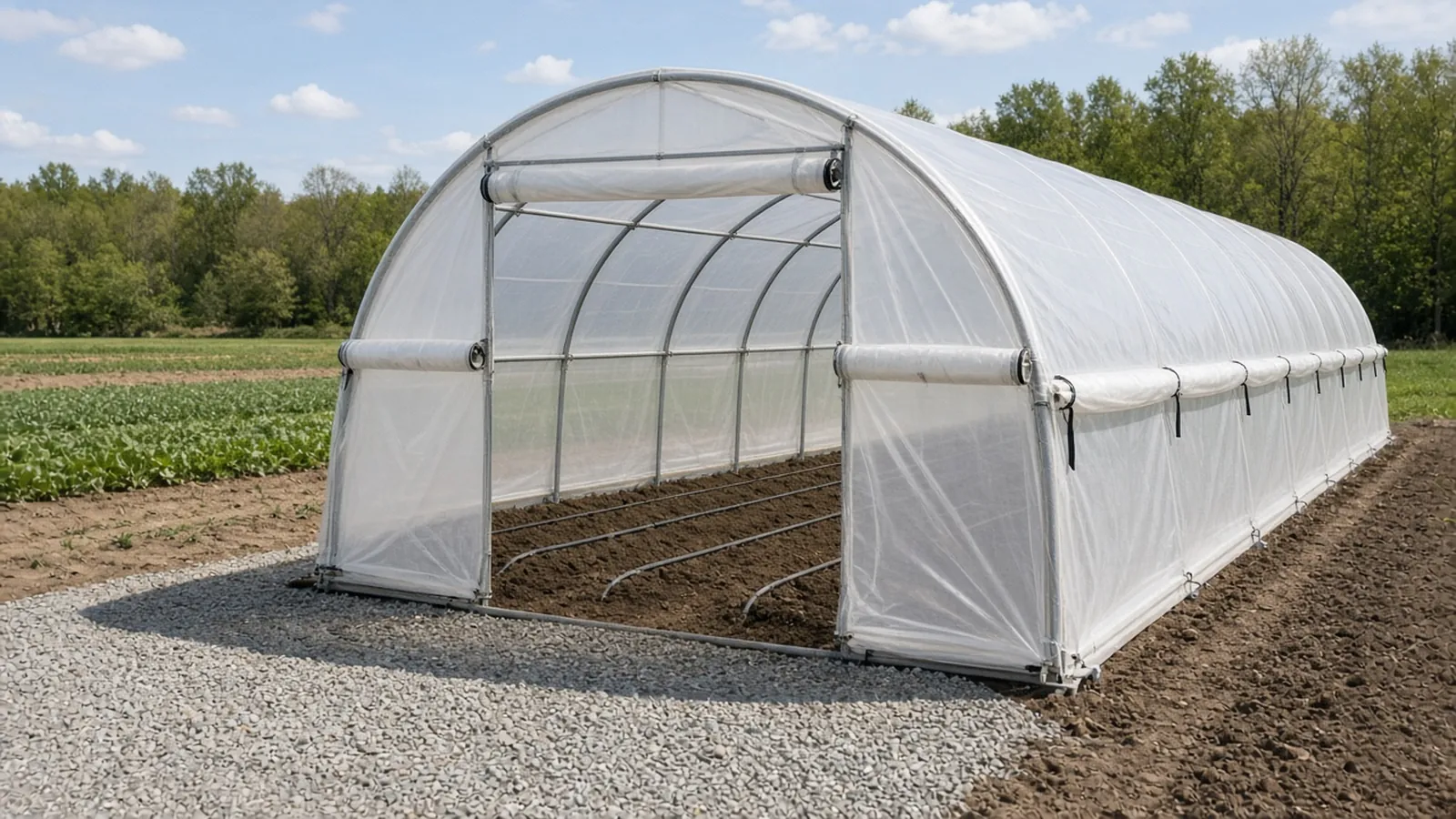
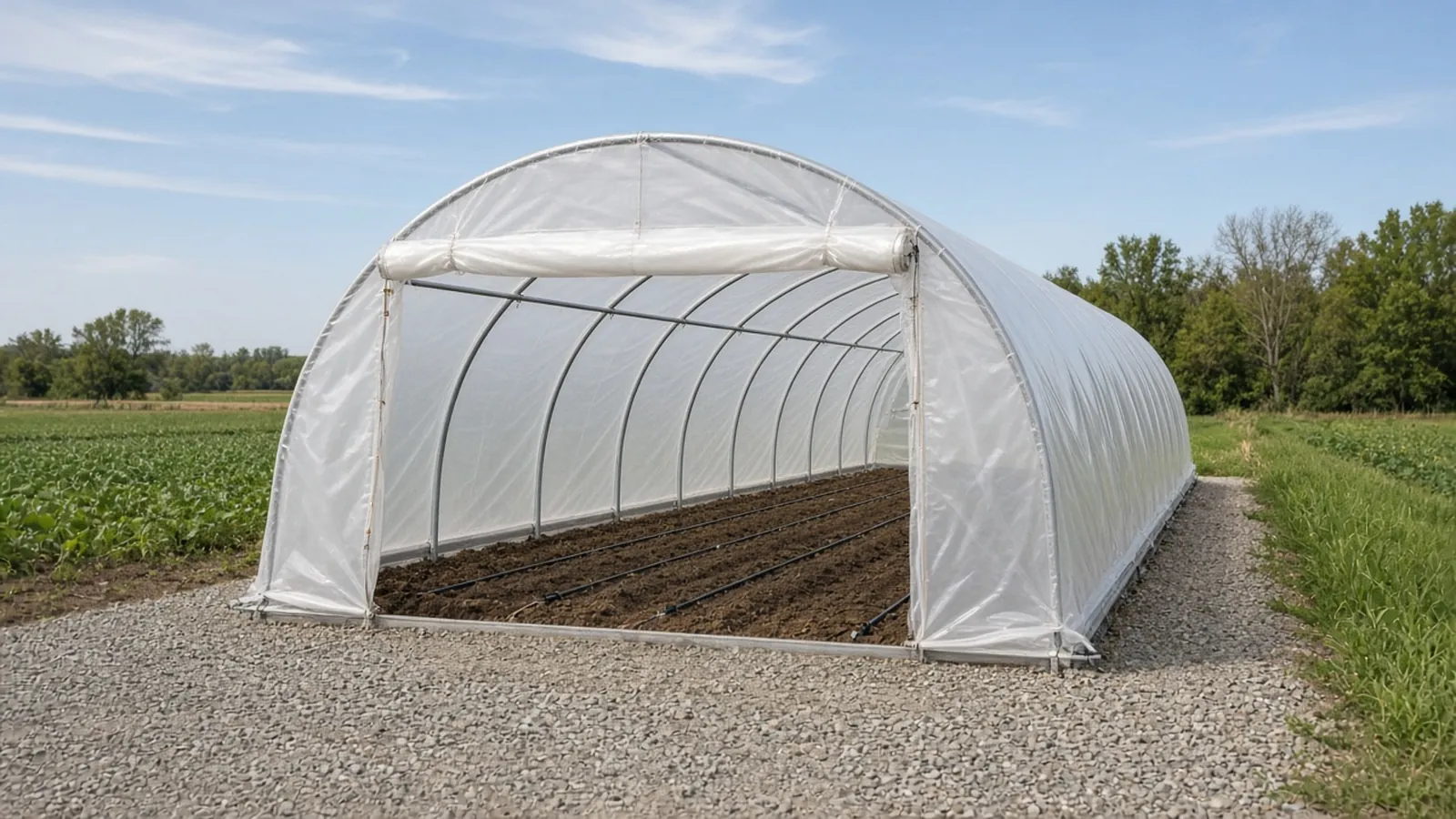
A hoop house — the same structure NRCS calls a high tunnel — is a polyethylene-covered frame that stretches the season, keeps rain off the crop, and can be put up in days. A greenhouse, as most people mean it, is a more permanent, often clad or glazed building with a foundation and, usually, more climate equipment. The two are not interchangeable, and the USDA cost-share that everyone asks about is written for the first, not for a fully fitted glasshouse or a hydroponic hall.
This guide compares build cost and use, then walks through the Environmental Quality Incentives Program (EQIP) High Tunnel Initiative in the United States: what practice 325 will and will not pay for, how to apply, and why you must not start building before there is a contract. Growers in the United Kingdom, Canada and Australia can use the cost comparison; the EQIP sections are US-only.
Last checked: November 2026. EQIP payment rates, caps and ranking dates are set by each state and change every fiscal year. Confirm the current schedule and deadline with your local NRCS office. This is general information, not a grant application or legal advice.
1. Hoop house versus greenhouse: what you are actually buying
In a July 2024 r/farming thread titled “Hoop Houses $$$,” one of the first replies was to check EQIP, and another grower who had built both said a hoop house went up in a couple of days with no foundation, while a framed, panel greenhouse took a month and was “the absolute worst waste of money” for their purpose. That is one farmer’s experience, not a universal law, but it is the comparison a lot of vegetable growers eventually make: if you want season extension and rain protection, a tunnel is often the better use of capital. If you want year-round heat, benches, automated vents, or a retail space, you may be in greenhouse territory, and you should not expect EQIP to fund that building as a high tunnel.
| Hoop house / high tunnel | Greenhouse (typical commercial or hobby glass / rigid cladding) | |
|---|---|---|
| Structure | Hoops or a gothic frame, pipe or square tubing, polyethylene cover, roll-up sides | Often a foundation or a heavier base, rigid panels or glass, more permanent doors and vents |
| Climate | Passive, with roll-up sides, end walls, maybe a fan or a small heater. Still tightly coupled to the season | Can be heated, lit and ventilated as a controlled room, at a higher energy cost |
| Build time | Often measured in days for a kit, with a couple of people | Often measured in weeks or months |
| Site | Needs a reasonably level site; NRCS has slope limits for the practice. No heavy foundation in most kits | Usually wants a prepared pad or footings |
| Typical job | Earlier spring and later autumn vegetables, rain protection, better quality, drip irrigation instead of rainfall | Longer-season or year-round production, retail display, propagation, or crops that need tighter control |
| US cost-share | May qualify as EQIP practice 325 if you meet the standard and are funded | Generally not as a high tunnel. Other EQIP practices (irrigation, energy) sometimes apply to a piece of a more permanent house; that is a different application |
Extension publications have, in recent years, published very wide cost bands — hoop or high-tunnel kits often discussed from well under a few dollars per square foot of cover, and more finished greenhouses clearly higher, especially once heat and benches are included. Those published ranges go stale quickly and vary with steel, poly and freight. Treat any per-square-foot number you see online as a prompt to get a kit quote and a freight quote for your postcode, not as a budget.
If you are choosing a structure in order to grow in nutrient solution, stop here and read whether a hydroponic greenhouse is profitable. An EQIP high tunnel is the wrong tool for that system, and a heated hydroponic house is a different business from a soil tunnel.
2. What EQIP High Tunnel (practice 325) will and will not pay for
NRCS describes a high tunnel as an increasingly popular conservation practice: it extends the season, can improve plant and soil quality, allows drip irrigation because rain no longer hits the crop, and can reduce some pesticide and nutrient movement. Supporting practices — micro-irrigation, drainage, mulching, a grassed waterway — are often planned at the same time.
The practice, as growers and conservation staff apply it, has hard edges. Independent guides that track the 325 standard, and NRCS’s own high-tunnel materials, consistently describe a manufactured kit, a peak height of at least 6 feet, a cover rated for several years (commonly four or more), and crops grown in the soil or in soil-based raised beds. Benches, pots and hydroponic channels are outside the practice. If you want those, plan a second structure you will pay for yourself, or a different conservation practice if one actually fits.
Payment is not “NRCS will give me 75% of my invoice.” Each state publishes a payment schedule for the fiscal year, usually a base amount plus a per-square-foot rate, sometimes with a higher rate for historically underserved producers (a category that can include beginning farmers, veterans, limited-resource and socially disadvantaged producers). Some states also set a practice cap. As an example only, Pennsylvania’s published FY 2026 EQIP/CSP cost list included a $10,000 per operating-unit cap for High Tunnel System, practice 325, and listed per-structure base and per-square-foot rates for open-ended and enclosed tunnels. Those dollars are not your state’s dollars. Ask your office for the current schedule, and do the arithmetic on the schedule, not on your kit invoice. If the kit, freight and labour cost more than the payment, you fund the difference. If they cost less, you are not usually paid a windfall above the schedule.
Historically underserved applicants may also be eligible for an advance payment option on EQIP, rather than only being reimbursed after certification. That is worth asking about. It is not automatic, and it does not change the requirement to build to the standard.
3. How to apply, in the order NRCS actually uses
Applications for EQIP are accepted year-round. Funding is competitive and is ranked in cycles. Each state publishes ranking dates. Miss the date and you wait for the next cycle, even if the application itself was already on file.
- Get a farm number from the Farm Service Agency if you do not already have one, and file AD-1026 (highly erodible land and wetland certification). The FSA and NRCS offices are often in the same USDA service centre.
- Call the local NRCS office and say you want to discuss a high tunnel. Ask for the current practice standard, the payment schedule, the ranking date, and whether supporting practices (especially micro-irrigation) should go in the same plan.
- Bring eligibility documents: a tax identification number, a deed or a written lease that shows you have control of the land, and the farm number. On leased land, NRCS will want written landowner permission for a structural practice.
- Complete CPA-1200, the Conservation Program Application, with NRCS staff. You do not need to invent a conservation plan alone; that is a large part of what the district conservationist is for.
- Be ranked. NRCS ranks applications by resource concerns, conservation benefit and local priorities. Not every eligible tunnel is funded. Treat a 20–30% funding rate, which some educator and consultant write-ups have cited in recent years, as a reminder that this is competitive, not as a precise odds table for your county.
- If you are offered a contract, read it, then sign it or walk away. Only then do you order the kit, build to the specification, and call for inspection. Payment follows a successful certification, at the scheduled rate.
A beginning farmer who is also planning an FSA loan should not mix the two files casually, but should tell both offices what is being planned so the tunnel, the irrigation and the operating loan do not collide on timing or on liens.
4. A worked cost sketch (illustrative, and not a payment quote)
Example. A vegetable grower wants a 30-by-96-foot tunnel (2,880 square feet) for early tomatoes and later greens, with drip irrigation already on the farm. A kit-plus-freight quote comes in at $9,500, and the grower will supply labour. The state’s FY payment schedule (this is a dummy schedule for the example, not Pennsylvania’s and not yours) might pay a base plus a per-square-foot rate that, on that size, adds up to $7,200, perhaps more if the grower qualifies for a historically underserved rate, and perhaps less if a cap applies. The grower should be ready to fund the rest, plus anchors, a better end wall, and drip fittings, and should not plant in the tunnel until the inspection is done if the contract says so.
If the same grower instead wanted a rigid, heated greenhouse for winter retail plants, EQIP 325 is the wrong programme. They would price that building as a commercial investment, look at energy programmes separately — with the caveats in our REAP guide — and only then decide whether the crop can carry the heat bill.
5. Running the tunnel so the investment is not wasted
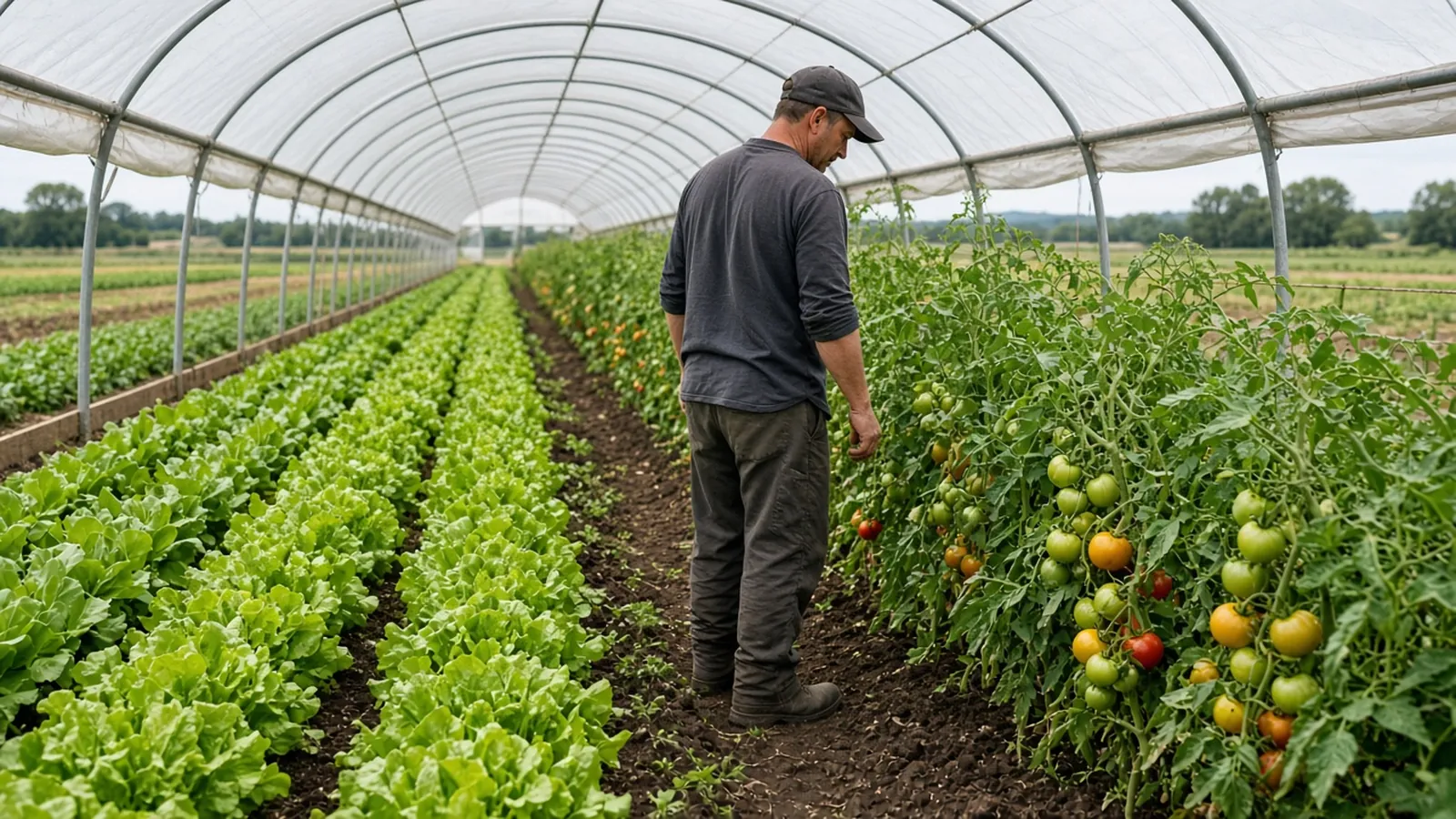
Rain will not wash the beds. Salts can build up; many growers test soil and water, and some uncover the house for a season to let rain flush it. Drip is not optional in a closed cover. Disease and heat will concentrate if you do not roll the sides and use shade when the house needs it. Crop rotation and a simple winter cover crop inside or beside the house will do more for next year’s crop than a more expensive frame. If you will take a compact tractor inside, measure the hoops and the end-wall opening before you buy either the tractor or the kit.
A high tunnel also changes the marketing calendar. Early tomatoes and late salad are the usual reason US growers want one. If you already raise seedlings, our nursery guide and the tomato production notes are about the crop; the tunnel is the climate around it.
Common mistakes
- Ordering a kit the week you apply, then finding you started before the contract.
- Planning hydroponic gutters or bench crops in a structure you hoped EQIP would fund as a high tunnel.
- Using the invoice total as if it were the NRCS payment.
- Forgetting irrigation, drainage and a level site, then failing an inspection or drowning the first crop.
- Missing the state ranking date and waiting a year.
Checklist
- I know whether I want a seasonal soil tunnel or a more permanent, possibly heated greenhouse, and I am not pretending they are the same building.
- I have a farm number, AD-1026, and proof of land control.
- I have asked NRCS for the current 325 schedule, the ranking date, and whether irrigation should be in the same plan.
- I will not start construction until the contract is executed, unless I have a written waiver.
- I can fund the difference between the scheduled payment and the real kit-plus-freight cost.
Frequently asked questions
1. Will EQIP pay for a “real” greenhouse or for hydroponics?
Practice 325 is a high tunnel, with the crop in soil or soil beds. Rigid, heated greenhouses and hydroponic or bench systems are generally outside that practice. Ask NRCS if some other practice applies to a piece of a more permanent house; do not assume the high-tunnel initiative will stretch.
2. How much of the cost will I get back?
Whatever your state’s current payment schedule says for the scenario you install, after inspection, subject to any cap. It may be a large share of a simple kit or a modest share of a heavily optioned one. It is not a pledge to match your invoice.
3. Can I start building while I wait to be ranked?
Not if you want to be paid, unless you have a written waiver. Starting early is a regular reason people lose the payment.
4. Do beginning or organic farmers get a better rate?
Historically underserved producers, a category that can include beginning farmers, may be eligible for a higher payment rate and, in some cases, an advance payment. Organic status can matter for ranking or for related practices in some states, but it does not by itself rewrite 325. Ask your office how you are classified.
5. Is a hoop house worth it without EQIP?
Many growers say yes, if the crop calendar and the market will use the extra weeks, and if you buy a kit rather than inventing a structure from scratch. The cost-share is a help, not the only reason to build. If the market will not take earlier tomatoes or later greens, a tunnel will not fix that.
6. How long do I have to keep the tunnel up?
The contract and the practice lifespan in the standard will say. You will be expected to maintain the practice for that period. Read the contract before you treat the house as something you can move or take down in year two.
Final thoughts
Choose the structure for the crop and the market first. If that structure is a soil-based high tunnel, EQIP may pay a scheduled share — after a competitive ranking, a signed contract, and an inspection — and it will not pay you to invent a greenhouse and call it a hoop house. Call the office, get the state’s current sheet, and only then send a deposit to a kit supplier.
Plan the crop, not only the frame
LazAgro helps you record plantings, irrigation and harvests so a tunnel or a field is managed as a business, not as a one-off project.
Discover LazAgroSources and further reading
- NRCS, High Tunnel Initiative
- NRCS, how to apply for EQIP
- NRCS-CPA-1200 Conservation Program Application
- State payment schedules, which change every fiscal year — ask your local office. Pennsylvania’s FY 2026 published list is cited above only as an example of a cap and of per-square-foot rates, not as a national rate.